





Direct Answer
An IT inventory management solution from Germany captures every device, license and access right automatically and in one place, instead of in spreadsheets. Location is what decides the rest: data and support stay in Germany or the EU, and the platform works GDPR compliant, ISO 27001 certified and under German law. deeploi is one example, an All-in-One IT Management Platform with automatic inventorying through MDM and human expert support included.
Key Takeaways
- Location and compliance decide the shortlist. With a provider based in Germany or the EU, you get data storage inside the EU, support in your time zone, and encryption and access control as part of the product rather than a paid add-on.
- EU hosting alone is not enough. If the provider belongs to a US corporation, the US CLOUD Act can compel disclosure of your data even when the servers sit in Europe. Only a provider under EU law keeps both the data and the contract inside the European framework.
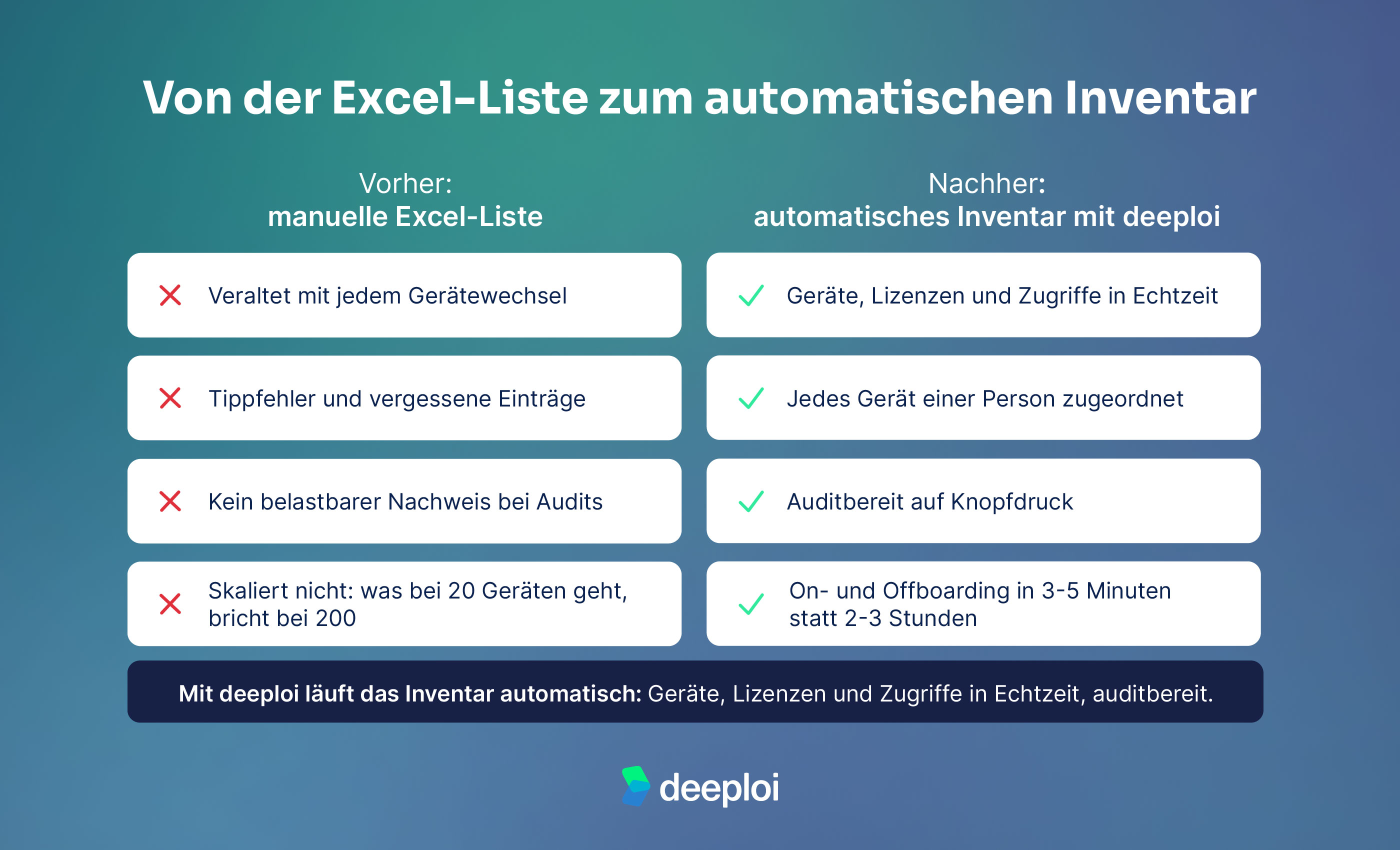
- Automatic beats a spreadsheet. Manual lists fall out of date with every device swap, lose sight of hardware and licenses, and fail when an auditor asks. MDM-based platforms inventory in real time.
- With deeploi the automation pays off. Inventory, MDM and expert support bring onboarding down to 3 to 5 minutes from 2 to 3 hours, whether or not you have an IT team of your own.
What is IT inventory management?
IT inventory management, usually shortened to ITAM for IT asset management, means capturing and maintaining every piece of hardware, every software license, every account and every access right across its full lifecycle, from procurement through assignment to return and deletion.
Modern platforms do this through MDM (mobile device management), which administers all company devices centrally from one place. Each device enrolls automatically the first time it starts up, and hardware, installed software, licenses and access rights are captured continuously in real time. A hand-maintained spreadsheet becomes unnecessary, because the record stays current on its own.
What happens when the IT inventory is wrong
The most exposed moment is offboarding. Someone leaves the company, and nobody can say on the spot which accounts were deactivated, which device has to come back and which licenses are now free. 71% of companies lose hardware when employees leave, because nobody ever wrote down the handover process. Add the ghost devices that no longer appear in anyone's list, and the unused licenses that quietly keep billing month after month. A clean inventory surfaces both before they get expensive.
Manual inventorying breaks down on three points:
- No real-time view. A change is only recorded once someone remembers to update the file.
- High error rate. Typos and forgotten entries produce a list that looks complete and is not, which is worse than no list at all.
- No headroom. What works at 20 employees falls apart at 200.
For a company without an IT team this quickly becomes an overload. For a company with an IT team, the small stuff eats the hours that strategic projects needed.
Why IT inventory management is becoming mandatory in Germany
Picture a typical German SMB with 80 employees. The device list lives in a spreadsheet kept by someone in office management who is already carrying three other jobs. When a GDPR access request or a security incident arrives, it has to be clear immediately who uses which device, which licenses are running and who could reach which data.
As long as the inventory is maintained by hand, most companies cannot answer that from a standing start. The risk is concrete: GDPR fines, security gaps that nobody notices, and audits that fail for want of clean records.
Germany adds a layer of its own. GDPR disclosure duties, evidence requirements for ISO 27001 audits or for controls modeled on the BSI (the Federal Office for Information Security), liability questions that reach the managing director, and employment law around returning a device. If you cannot produce complete documentation, you have a legal problem rather than an administrative one.
That is why the location of your inventory platform matters. A provider based in Germany knows these requirements and makes the evidence easier to produce.
{{cta}}
What an IT inventory management solution from Germany has to deliver
Not every inventory tool fits a German SMB. What good IT asset management has to do in general is covered in our guide to IT asset management. With location in mind, check these six points:

- Automatic capture through MDM and zero-touch provisioning. Devices arrive preconfigured and set themselves up at first login. New devices appear in the dashboard straight away, and retired ones drop out of it.
- GDPR compliant data storage in Germany or the EU. The platform itself has to operate in a GDPR compliant way, while your own compliance still depends on how you use it. No provider can seriously guarantee that you are compliant.
- ISO 27001 certification you can verify. Ask to see the certificate rather than assuming it. It is not a given even among German providers, and it tells you whether the processes were audited or only described.
- HRIS integration. The platform should link device and employee to your HR system automatically (HRIS, short for human resources information system), for example Personio, HiBob, BambooHR or Factorial.
- Support in your language with a clear SLA (service level agreement, meaning a committed response time). You want people who know your setup, without tickets shuttling between time zones.
- Documentation for inspections. Assignments, changes and deletions should be recorded, so the evidence an auditor asks for is something you retrieve rather than reconstruct.
A German solution vs. international tools: what to weigh up
The market offers four typical routes, and none of them is wrong in principle. It comes down to what your team can carry and which evidence you need to produce.
- US enterprise tools such as Intune or Jamf are powerful, but they are built for IT admins. For a non-technical owner at a German SMB they are usually too complex, and support and contract law both run through US structures.
- Regional MSPs are close at hand, but they typically bill per ticket and work through manual processes. Costs stay opaque as long as every incident carries its own fee.
- Open-source tools such as Snipe-IT cost nothing in license fees, but setup, operation, updates, backups and the GDPR evidence all stay your job. They pay off mainly when an IT team of your own takes on the upkeep. The FAQ goes into this.
- European platforms combine automation with a GDPR and EU focus, and an interface that works without IT training.
Data protection: why EU hosting alone is not enough
Here is what gets missed. Not every platform sold in Europe is governed exclusively by European law. If the provider belongs to a US corporation, the US CLOUD Act applies. It obliges US companies to hand over data even when that data sits on servers in Europe, and in some circumstances the provider is not permitted to tell you. EU hosting on its own therefore does not protect you from US access. The European Data Protection Board and the European Data Protection Supervisor have described this as a conflict with Article 48 GDPR, which recognizes disclosure orders from third countries only on the basis of an international agreement.
The question never arises if the data and the contract both stay in Europe and the provider is governed by European law.

deeploi: IT inventory management as part of the whole IT lifecycle
deeploi is an All-in-One IT Management Platform from Germany that treats the inventory as one part of the full IT lifecycle, from automated onboarding through device management and software deployment to patch management, security and support. More than 200 companies with over 17,000 managed users already run on the platform.
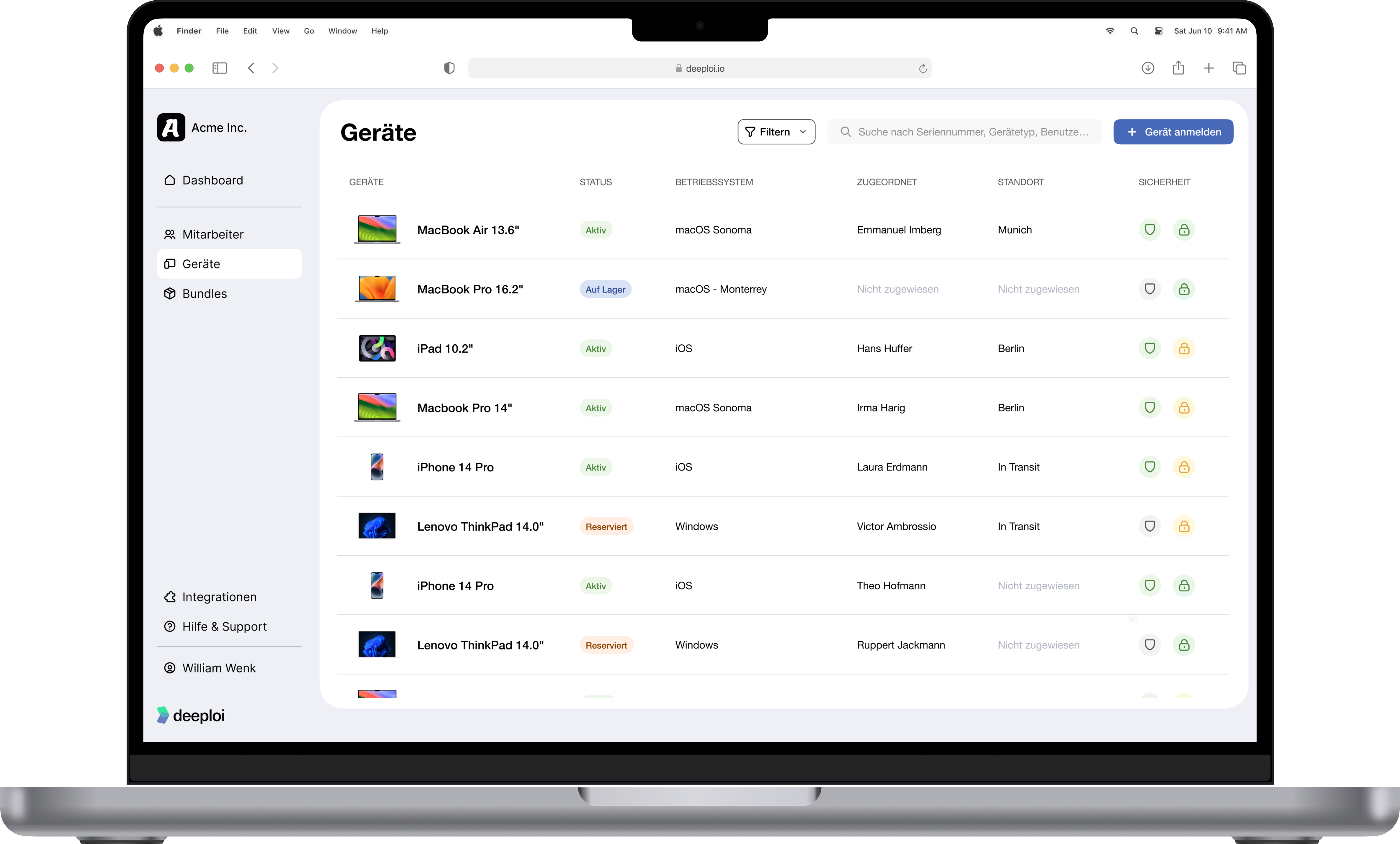
In practice that means:
- Automatic inventory. Devices, assignments, encryption status and live data are captured through MDM across Windows, macOS, iOS and Android. You can see who uses what at any time.
- Fast onboarding and offboarding. Onboarding takes 3 to 5 minutes instead of the 2 to 3 hours manual processes consume, and offboarding takes 2 to 5 minutes to configure. Device ordering runs inside the onboarding flow: pick the device, and it ships preconfigured to the employee.
- Integrations into your existing setup. They run from Personio through Google Workspace and Microsoft 365 to a curated catalog of more than 250 applications.
- Human IT support in English and German. Technical problems reach deeploi's expert team directly, with a 12-minute average response time against a 30-minute SLA. Sam, our AI agent, is the first point of contact 24/7. He answers immediately, reads live device data through MDM where it helps, suspends users, manages group memberships and adjusts mailbox access, with every action requiring sign-off from your IT owner. Anything more complex he hands to the human expert team.
- Transparency for audits. The dashboard shows which device is assigned to whom, including encryption and security status. That is the starting point for any evidence an inspector asks for.
- Less manual work. Up to 95% less manual IT effort overall.
deeploi fits two starting positions. A company without an IT team hands over IT administration completely. A company with an IT team hands off password resets and routine requests, and gets time back for strategic projects.
Device management is where the difference shows most clearly: a classic MDM tool manages the devices and nothing else, while deeploi covers the process around them as well.
Conclusion: how to get your IT inventory under control
An IT inventory sounds like a chore until the first audit. In Germany it is the basis for every GDPR record and every ISO 27001 review. A spreadsheet will not carry you there, because it is never quite current, and when the auditor asks, the one record they want is the one that is missing.
What makes the difference is the combination of automation that keeps the inventory current, a provider inside the EU that knows the local evidence requirements, and support that holds up even without an IT team of your own. deeploi brings those together and cuts manual IT effort by up to 95%, so you can go back to your core business instead of the device list.
FAQ
Why does the provider's location matter in IT inventory management?
Location determines data storage, contract and liability law, support hours and support language. A European provider holds and processes data in Germany or the EU, works under German law and speaks your language in your time zone. Data protection comes on top: a provider with a US parent can fall under the US CLOUD Act, which permits access from the United States even when the servers stand in Europe. Location on its own guarantees nothing, since a German provider still has to be ISO 27001 certified and GDPR compliant. What it does is simplify the evidence you need at an inspection.
Which IT inventory management solution suits an SMB without an IT team?
One that combines ITAM and MDM with support included. Pure enterprise tools assume an IT admin who configures and runs them, and are usually oversized for a non-technical owner. Platforms like deeploi are built for exactly that role: automation handles the capture, an expert team handles the rest, and operating it takes no technical background.
What does IT inventory management software cost?
It depends on the pricing model. Platforms like deeploi charge a fixed monthly price per active team member, with no setup fee and no per-ticket billing, so the invoice follows headcount and nothing else. Traditional MSPs bill per incident or per hour, which makes the cost hard to plan.
Is an open-source tool like Snipe-IT enough for an SMB?
Snipe-IT is free and capable, but "free" covers the license only. Setup, operation, updates, backups and above all the GDPR evidence stay with you, and all of it takes IT knowledge and time. For an SMB without an IT team, the effort the automation was supposed to remove lands back on your desk. Open source makes sense mainly when you have an IT team that actively owns the maintenance.