





Direct Answer
For most SMBs without an in-house IT team, deeploi is the best choice. The All-in-One IT Management Platform combines MDM, patch management and onboarding/offboarding automation with an expert helpdesk that responds in 12 minutes on average. If you have your own IT team and want to run the tool yourselves, Miradore is a good fit. Relution suits schools and public administrations that need on-premises hosting, Cortado works for teams that mostly use Apple devices, and Matrix42 fits larger organizations with service management requirements.
Key Takeaways
- MDM brings device management into one place: Mobile device management (MDM) centralizes the management, security and provisioning of every device in one platform, from Windows and macOS to iOS and Android.
- European MDM providers make GDPR compliance easier: They offer GDPR-compliant data processing, hosting in Europe and support in your time zone, often at no extra cost. Contracts and data protection are governed by European law, not the US CLOUD Act.
- Four criteria decide which solution fits: What matters is platform coverage, level of automation, support quality and pricing transparency, not long feature lists.
- MDM and IT support from one provider with deeploi: The All-in-One IT Management Platform combines MDM, patch management and IT support. That makes it the ideal choice if you don’t have an in-house IT team or want to take work off your existing one.
Why SMBs need MDM software
In many growing SMBs, every device is still set up individually and documented by hand. That costs time with every new hire and leaves security gaps open, for example when updates are missing or a lost laptop can’t be locked remotely.
With MDM software, you set up devices centrally, policies and updates roll out automatically, and you can see at any time which device belongs to whom and whether it’s secured.
Expert tip: Someone on your team still has to operate an MDM platform. Day to day, that means maintaining policies, monitoring updates, analyzing device errors and handling edge cases one by one, which quickly gets more complex than expected. If you don’t have an in-house IT team, an All-in-One IT Management Platform that automates the process for you is usually a better choice than a standalone MDM tool.
European vs. US MDM tools: the data protection difference
Not every MDM tool sold in Europe is governed exclusively by European law.
If the provider belongs to a US company, the US CLOUD Act applies. It allows US authorities to compel US companies to hand over data, even when that data is stored on servers in Europe. EU hosting alone therefore doesn’t protect against access from the US. In some cases, the provider isn’t even allowed to tell you about such a request. The European Data Protection Board and the European Data Protection Supervisor see this as a conflict with Article 48 GDPR. Under Article 48, orders from countries outside the EU to transfer personal data are only recognized if they’re based on an international agreement, such as a mutual legal assistance treaty.
European MDM solutions have structural advantages here. Contracts and data protection are governed by European law, hosting in Europe simplifies many compliance questions, and support is available in your time zone and language.
{{cta}}
5 questions to find the right MDM solution
We evaluated the solutions from the perspective of SMBs with 30 to 200+ employees. If you’re choosing an MDM solution for the first time, clarify these five points before your first demo:
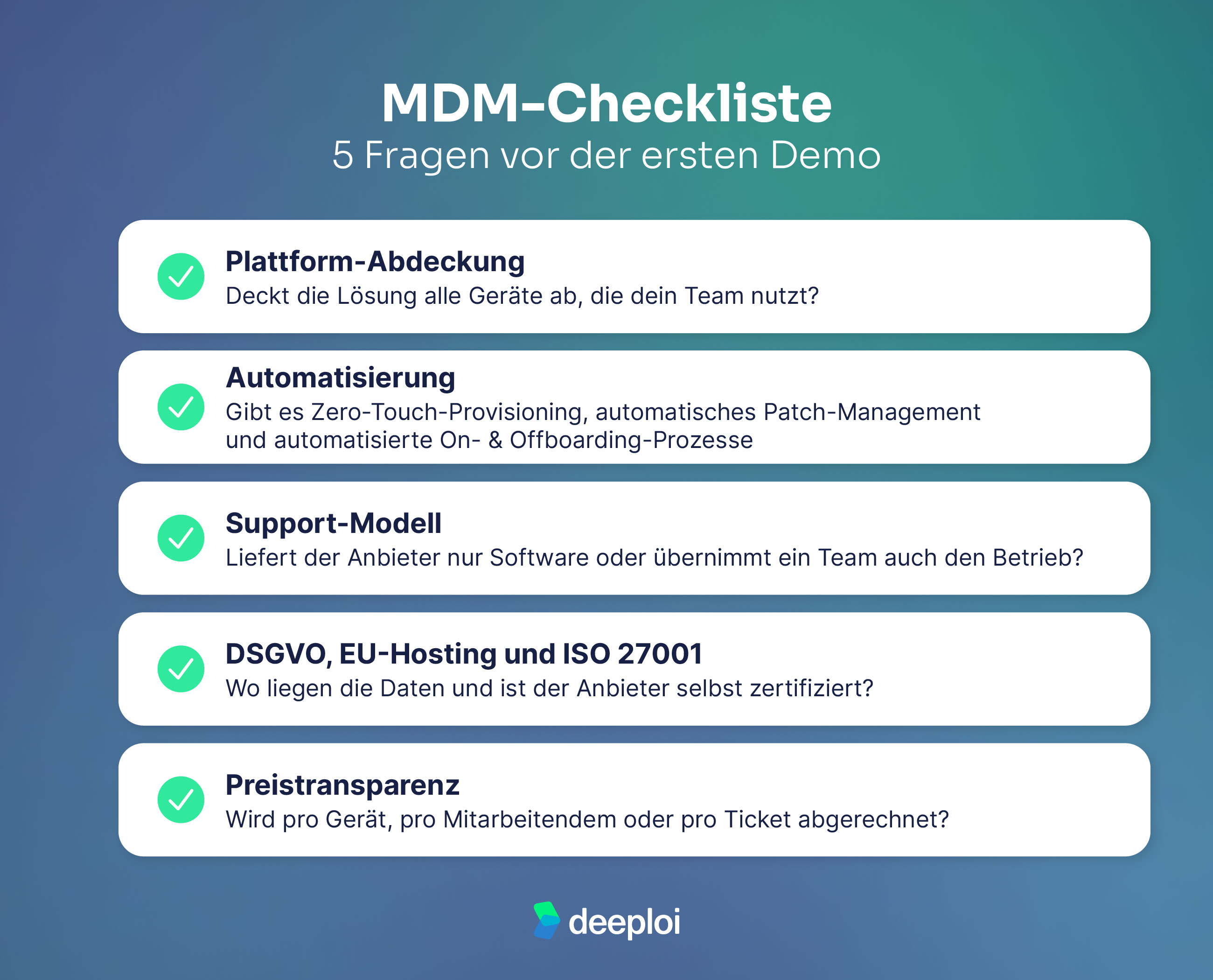
- Platform coverage: Does the solution cover every device your team uses? If you run both Windows and Apple devices, an Apple-only tool won’t be enough.
- Automation: With zero-touch provisioning, a new device sets itself up the first time it’s switched on, including policies, apps and access. On top of that, look for automated patch management and automated onboarding and offboarding.
- Support model: Does the provider only deliver software, or does a team also handle day-to-day operations? Without an in-house IT team, this is the most important question.
- GDPR, EU hosting and ISO 27001: Where is the data stored, where is the parent company based, and is the provider certified itself?
- Pricing transparency: Is billing per company device, per employee or per ticket? Per-request support costs make your budget hard to plan.
The 5 best European MDM solutions compared
Here’s an overview of the five solutions, from an All-in-One IT Management Platform with expert support to an enterprise suite:
deeploi: the All-in-One IT Management Platform with expert support
deeploi is an All-in-One IT Management Platform for SMBs. It brings together device management with zero-touch provisioning, software deployment, patch management, onboarding and offboarding through HR integrations (Personio, Factorial HR, BambooHR and other HRIS tools) and IT support, all from one provider. That includes IT asset management with a central inventory.
Best for: SMBs without an in-house IT team, and small IT teams that want to hand off password resets and simple support requests so they have time for strategic projects.
The platform’s strengths at a glance:
- Onboarding and offboarding in 3–5 minutes instead of 2–3 hours, with up to 95% less manual IT work.
- GDPR-compliant, with hosting on servers in Germany and the EU, and ISO 27001 certified itself. Device encryption (BitLocker, FileVault), password policies and admin rights management are included. Device status, policies and access are documented centrally in one place, which helps you prepare for ISO 27001 or NIS2 audits.
- HRIS integrations connect HR onboarding directly to IT provisioning.
- More than 200 customers, over 17,000 managed users and more than 3,000 onboardings.
- Expert helpdesk in German and English, with an average response time of 12 minutes (SLA: 30 minutes). The first point of contact, around the clock, is Sam, deeploi’s AI agent. He answers requests instantly and carries out actions such as user management or access changes directly in the workspace and on devices. Every action requires sign-off from the person responsible for IT, and Sam hands complex cases to the human expert team.
- Windows, Apple and Android devices in one platform: Mac, Windows and Android devices are managed through the same interface. For Apple, deeploi is a certified partner in the Apple Consultants Network, and the team holds certifications including Apple Certified Support Professional.
- Easy to use, even without IT knowledge.
Limitations: deeploi doesn’t support Linux, and the platform runs exclusively in the cloud, so on-premises deployment isn’t possible. It’s built primarily for SMBs.
Pricing model: A fixed monthly price per active team member, with no setup fee and unlimited support requests. Core compliance and IT security are included as standard: device encryption (BitLocker, FileVault), password policies and admin rights management. For advanced requirements, you can add cybersecurity (SentinelOne) and cloud backup (Acronis).
deeploi manages your devices, installs updates automatically and answers support requests in 12 minutes on average. You pay a fixed price per active team member, with no cost per ticket.
Miradore: cloud-based MDM from Finland
Miradore is a cloud-based MDM solution for Android, iOS, macOS and Windows devices. The company was founded in Finland and is now part of the US-based GoTo group (formerly LogMeIn).
Best for: Teams with their own IT admin who want a simple, affordable MDM they can run themselves.
Miradore’s key strengths:
- Easy to get started with a free trial.
- Covers Android, iOS, macOS and Windows.
- An established provider with a large customer base.
Limitations: Your team needs IT knowledge, because operations, configuration and tickets stay with you. Data protection also deserves a closer look. According to Miradore, it hosts on servers within the EU and stores personal data in compliance with the GDPR. However, contracts and privacy policies run through its US parent GoTo, which as a US company falls under the CLOUD Act. If data sovereignty matters to your company, clarify before signing what role GoTo plays in data processing and which service providers are involved as subprocessors.
Pricing model: Free trial, Premium plan on request.
Relution: privacy-focused UEM from Germany
Relution is a UEM and MDM platform from Germany. It runs on-premises or in the cloud, is GDPR-compliant and manages iOS, iPadOS, macOS, Android, Windows, ChromeOS and Linux. Relution targets schools, public administrations, businesses, healthcare and NGOs, with a focus on education and the public sector.
Best for: Schools, public administrations and organizations that require on-premises hosting.
Relution’s key strengths:
- On-premises deployment is possible.
- A focus on GDPR and hosting in Germany.
- Broad OS coverage, including Linux and ChromeOS.
Limitations: It’s tailored to education and public administration rather than commercial SMBs without an IT team. Support is provided through partners, with no IT support directly from the provider.
Pricing model: On request.
Cortado MDM: device management hosted in Germany
Cortado MDM manages Apple devices (iOS, iPadOS, macOS, tvOS) and Android devices across their entire lifecycle. That covers zero-touch provisioning, security policies, a device overview, and remote lock and wipe if a device is lost. The solution is GDPR-compliant and hosted in Germany.
Best for: Teams that mostly use Apple devices, value hosting in Germany and can run an MDM themselves.
Cortado MDM’s key strengths:
- Hosting in Germany, GDPR-compliant.
- Easy to use, with good support for Apple devices.
- Automated deployment all the way through to offboarding.
Limitations: Windows isn’t part of the core offering, so Cortado is less suitable for companies with many Windows devices. The platform also doesn’t offer IT support.
Pricing model: On request.
Matrix42: enterprise service management from Germany
Matrix42 covers ITSM, UEM and asset management, available in the cloud, in a private cloud or on-premises.
Best for: Larger organizations with their own IT team and real service management requirements.
Matrix42’s key strengths:
- A broad portfolio spanning service, endpoint and asset management.
- Developed, hosted and supported in Europe.
- Flexible hosting, up to and including on-premises.
Limitations: For SMBs with 30 to 200 employees and no IT team, it’s usually too complex and oversized.
Pricing model: Custom enterprise pricing through the sales team.
Which European MDM solution fits which company?
This table shows at a glance which of the five solutions works best for each situation:
Standalone MDM tool or All-in-One IT Management Platform?
Most of the situations in the table come down to the same question: who looks after the platform day to day? With a standalone MDM tool like Miradore or Cortado MDM, you set up devices yourself, install updates and answer support requests. With an All-in-One IT Management Platform that includes support, the provider takes care of that.

A standalone MDM tool works if you have an in-house IT team with time for configuration and tickets.
Without an IT team, or if your small team needs relief, a platform like deeploi is usually the better choice.
Conclusion: which MDM software is right for you?
Which European MDM solution fits depends mainly on whether you have an in-house IT team. If your IT team runs the platform itself, Miradore, Relution, Cortado MDM or Matrix42 are good choices depending on your requirements. If you don’t have an IT team, or your small IT team wants to hand off simple support requests, an All-in-One IT Management Platform with built-in expert support like deeploi is the better choice, because MDM for SMBs only works when someone actually operates the platform.
FAQ
What is MDM software?
MDM (mobile device management) software lets you manage all company devices centrally, with configuration, security policies, app distribution and updates running through one console. With zero-touch provisioning, a new device is ready to use the first time it’s switched on. Because modern solutions also manage laptops and desktops, MDM is often used interchangeably with UEM.
Why choose a European MDM solution over Intune or Jamf?
With tools owned by a US parent company, such as Microsoft Intune or Jamf, the US CLOUD Act can allow access to your data no matter where the servers are located. European providers, by contrast, have contracts and data protection governed by European law, usually host in Europe, and offer support in your time zone and language. This helps most when compliance and availability matter to your team.
Can I use MDM without an in-house IT team?
Yes, in two ways. You can run an MDM tool yourself, in which case you need someone internally with time for configuration and tickets. Or you can choose a platform with built-in expert support like deeploi, where the provider handles operations. Without an IT team, the second option is usually more realistic. Learn more in our guide to setting up IT support without an IT department.
How much does MDM software cost?
Depending on the provider, billing is per device, per employee or per support ticket. deeploi charges a fixed monthly price per active team member, with no setup fee and unlimited support requests. Most providers only share specific prices on request, so focus on comparing billing models.