





Direct Answer
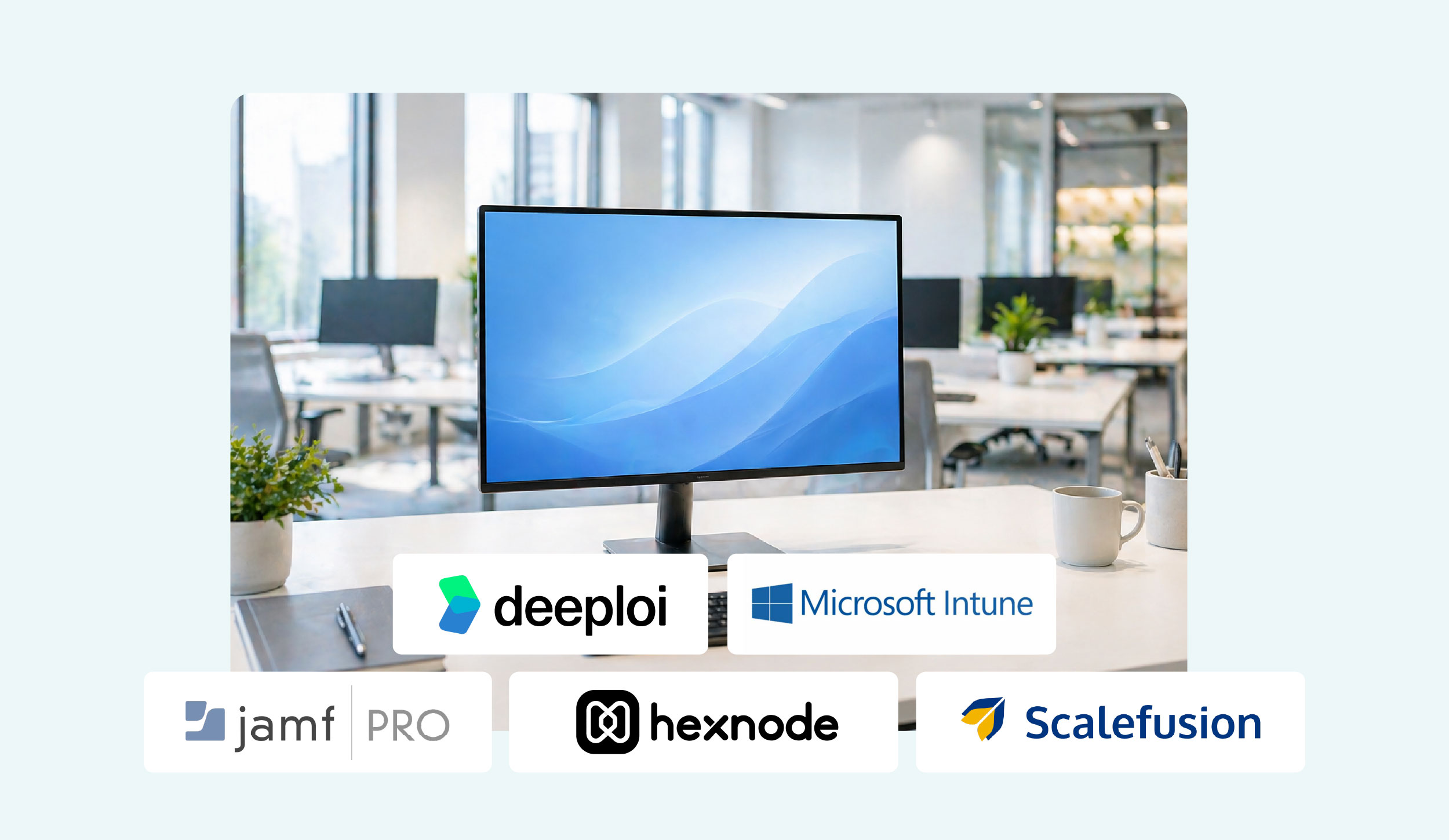
The best Miradore alternative depends on your needs: Microsoft Intune, Jamf Pro, Hexnode UEM, and Scalefusion each suit different device environments and IT setups. For SMBs without a dedicated IT team, deeploi goes beyond MDM by combining device management, onboarding automation, and IT support in one platform.
Key Takeaways
- Miradore works for simple device fleets with Android, iOS, macOS, and Windows: once onboarding automation, HR integration, or scalable compliance are required, the platform stops being enough.
- The right Miradore alternative depends on your reason for switching: whether you need broader OS coverage, deeper Apple integration, or a complete IT platform, the right choice depends on where Miradore specifically hits its limits for your team.
- MDM alone often falls short: pure MDM tools do not solve automated onboarding, IT support, or software deployment for your team.
- All-in-one over point solutions: platforms like deeploi combine MDM, device management, onboarding automation, and expert support in one system, making them the right choice especially for teams without a dedicated IT department.
Miradore is an affordable entry-level solution for device management, but it quickly hits its limits. Many companies miss deeper HR integrations, or simply need more automation depth. This comparison covers the five best alternatives and helps you find the right solution for your team.
Why teams look for Miradore alternatives
Miradore is a solid starting point in the world of Mobile Device Management (MDM) for many small and mid-sized businesses. As a cloud-based MDM platform, it supports Android, iOS, macOS, and Windows. But at a certain company size or complexity level, the platform runs into documented limitations.
The most common reasons for switching:
- Apple DEP issues: Employees can remove MDM profiles from iPhones, and device sync runs slowly, which undermines centralized control over Apple fleets.
- Limited BYOD management: Capterra reviews show that Android BYOD implementation often falls short of expectations in practice.
- Shallow integration depth: Connections to identity providers via SAML/SCIM or to HR systems are either missing or only rudimentary, which makes automated onboarding processes difficult.
- Gaps in the free tier: Key security features like device encryption, location tracking, and deeper analytics are not available in the free version.
- Missing automation depth: Miradore manages devices, but automated onboarding, software deployment, and IT support remain separate. For growing companies without a dedicated IT team, that can quickly become a bottleneck.
For growing companies looking for a scalable MDM platform with comprehensive multi-OS support, the alternatives below are worth a closer look.
The 5 best Miradore alternatives compared
The table below gives you a quick overview before we look at each tool in detail.
deeploi: the all-in-one IT platform
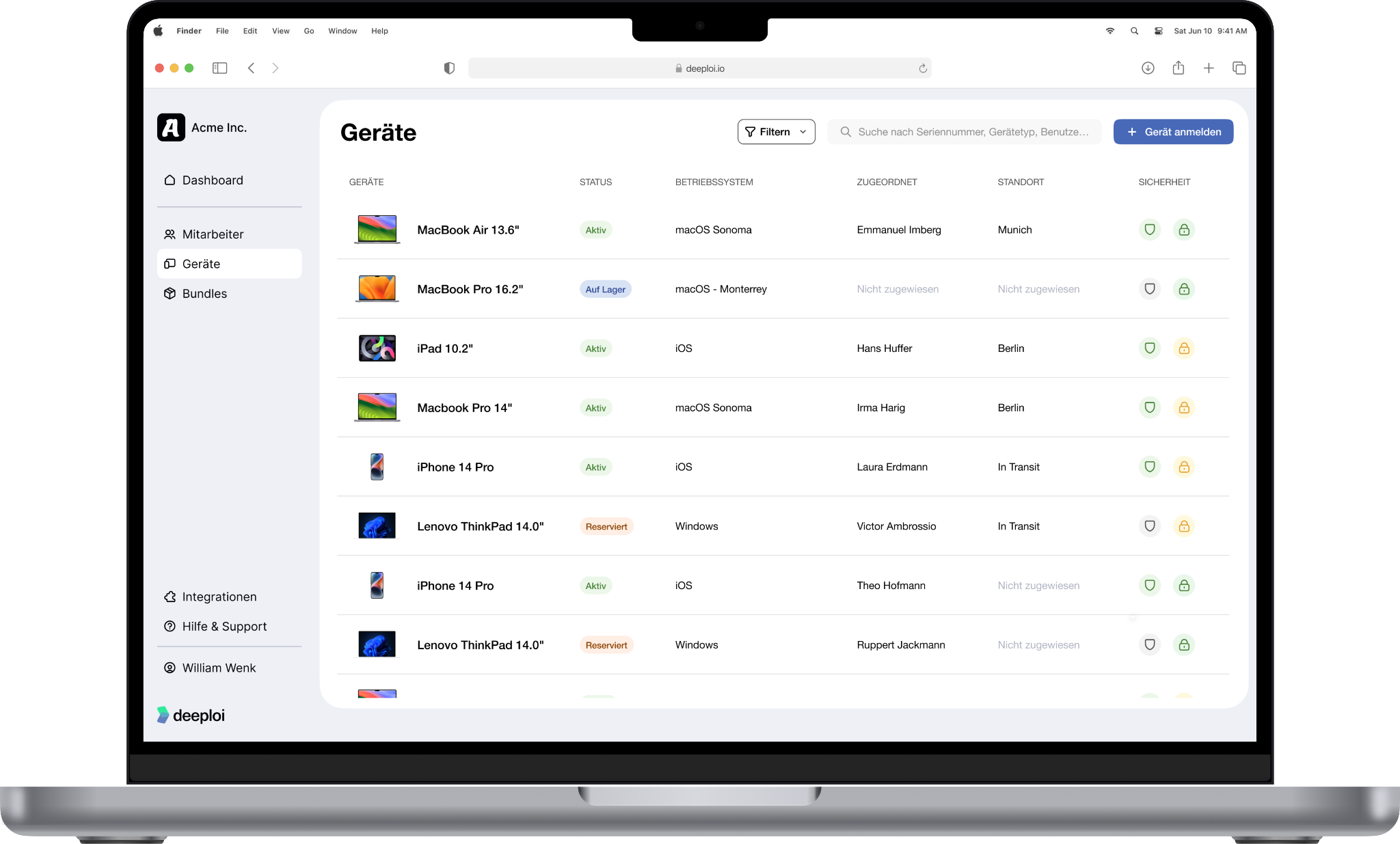
deeploi is not a pure MDM tool – it is an all-in-one IT platform that combines device management, automated onboarding and offboarding, software deployment, IT support, and GDPR-compliant compliance in a single system. Instead of just managing devices, deeploi handles the entire IT operation, including Zero-Touch Provisioning and HR system integrations with tools like Personio, HiBob, and BambooHR.
Strengths:
- Automated onboarding and offboarding in 3–5 minutes instead of hours
- Centralized account management across Microsoft 365 and Google Workspace
- Built-in human IT support in German and English, with an average response time of 12 minutes
- ISO 27001 certified and GDPR compliant, with hosting in Germany
- Up to 75% lower IT costs compared to traditional Managed Service Providers
- Transparent per-user pricing with no hidden costs
Limitation: No Linux or ChromeOS coverage
Ideal for: HR managers and founders at growing SMBs who want IT onboarding automation, endpoint management, and support from a single platform.
The key difference from pure MDM tools: deeploi combines platform automation with an expert helpdesk. You do not need your own IT team.
{{cta}}
Microsoft Intune
Microsoft Intune is Microsoft's cloud-based endpoint management platform, part of the Intune Suite. It covers Windows, macOS, iOS, Android, Linux, and ChromeOS, and integrates natively with Microsoft Entra ID, Conditional Access, and the full Microsoft 365 ecosystem. Pricing is per user, and Intune is often already included in M365 E3, E5, and Business Premium plans.
Strengths:
- Deep Microsoft 365 integration with Conditional Access
- Broad OS support including Linux and ChromeOS
- Often included at no extra cost in existing M365 plans
Weaknesses:
- Complex per-user licensing
- Apple management lags behind dedicated Apple specialists
- No built-in IT support
- High configuration overhead for non-technical teams
Ideal for: Windows-dominated fleets at companies with an existing Microsoft 365 contract and an IT team to manage the platform.
Jamf Pro
Jamf Pro is a management platform focused exclusively on Apple devices, covering macOS, iOS, iPadOS, and tvOS. It offers Apple Business Manager integration, Smart Device Groups, an app catalog for Apple applications, and Configuration Profile Deployments. Pricing is per device in tiered thresholds, and a minimum commitment applies for advanced features.
Strengths:
- Deep Apple Business Manager integration
- Instant profile deployments and granular Smart Groups
- Extensive app catalog for Apple applications
Weaknesses:
- Apple devices only; a second MDM is needed for Windows or Android
- Minimum commitment for advanced features
- Implementation and renewal costs can add up
- High technical requirements for administrators
Ideal for: Companies with a pure Apple fleet and an IT team that can administer the platform. Less suited for mixed or Windows-heavy environments.
Hexnode UEM
Hexnode UEM is a Unified Endpoint Management platform from Mitsogo, focused on cross-platform management. It manages Windows, macOS, iOS, Android, Linux, ChromeOS, tvOS, visionOS, and Fire OS from a single dashboard. The platform offers five tiered plans ranging from basic MDM to full UEM, targeting companies with heterogeneous device fleets.
Strengths:
- Broad OS support across numerous platforms
- Five tiered plans for different requirements
- Endpoint management from a single central dashboard
Weaknesses:
- Higher tiers are expensive
- Setup complexity for non-technical users
- No built-in IT support
Ideal for: IT teams with mixed OS environments looking for a scalable, cross-platform MDM platform who have the technical knowledge to manage it themselves.
Scalefusion
Scalefusion is a UEM platform focused on frontline scenarios, Kiosk Mode, and rugged device management. It supports Windows, macOS, iOS, Android, Linux, and ChromeOS, and is particularly strong in Android Enterprise as well as dedicated devices in retail, field service, and logistics. Scalefusion is aimed at technical admins who manage the platform themselves.
Strengths:
- Broad OS coverage including ChromeOS
- Kiosk Mode for frontline devices
- COPE and BYOD deployment models
Weaknesses:
- Minimum device commitment required
- No built-in helpdesk
Ideal for: Retail, field service, and logistics companies with kiosk requirements and an IT team in place. The platform is built for technical admins and is less suited for accidental IT owners.
Choosing the right Miradore alternative for your team
The best MDM alternative is not the tool with the most features, it is the one that fits your specific reason for switching. Instead of working through endless feature lists, use this decision guide:
If you manage a pure Apple fleet and have internal IT resources → Jamf Pro offers deep Apple Business Manager integration and instant profile deployments. For Apple fleets at SMBs without a dedicated IT team, deeploi is the simpler option since setup, support, and onboarding are all included.
If your company already uses Microsoft 365 and has an IT team → Microsoft Intune is often already included in your license and provides native Conditional Access policies. Teams that find configuration and ongoing maintenance consuming internal resources will find deeploi an alternative that takes the full operation off their plate.
If you need to manage multiple operating systems from one dashboard → Hexnode UEM covers Windows, macOS, iOS, Android, and Linux. For pure Windows, macOS, and iOS environments, deeploi offers the same centralized management with automated onboarding and built-in support included.
If you run kiosk or frontline devices → Scalefusion provides Kiosk Mode and the broadest OS coverage including ChromeOS.
If you have no internal IT team and want onboarding, support, and device management in one platform → deeploi combines MDM with IT onboarding automation, software deployment, and an expert helpdesk.
For growing SMBs in the DACH region, it is worth taking an honest look at your actual needs: do you really just need an MDM tool, or are you missing a complete IT platform? deeploi closes exactly that gap by combining device management, onboarding, and support in one place. What pure MDM tools cannot solve is covered in the next section.
MDM vs. all-in-one IT: what pure MDM tools cannot solve
An MDM tool manages devices. But who handles onboarding new employees, software provisioning, HR integration, or IT support when something breaks? For accidental IT owners at growing SMBs, the MDM setup leaves a whole stack of unsolved tasks. That is the key conceptual difference: MDM is one building block. An all-in-one IT platform like deeploi handles the entire IT operation.
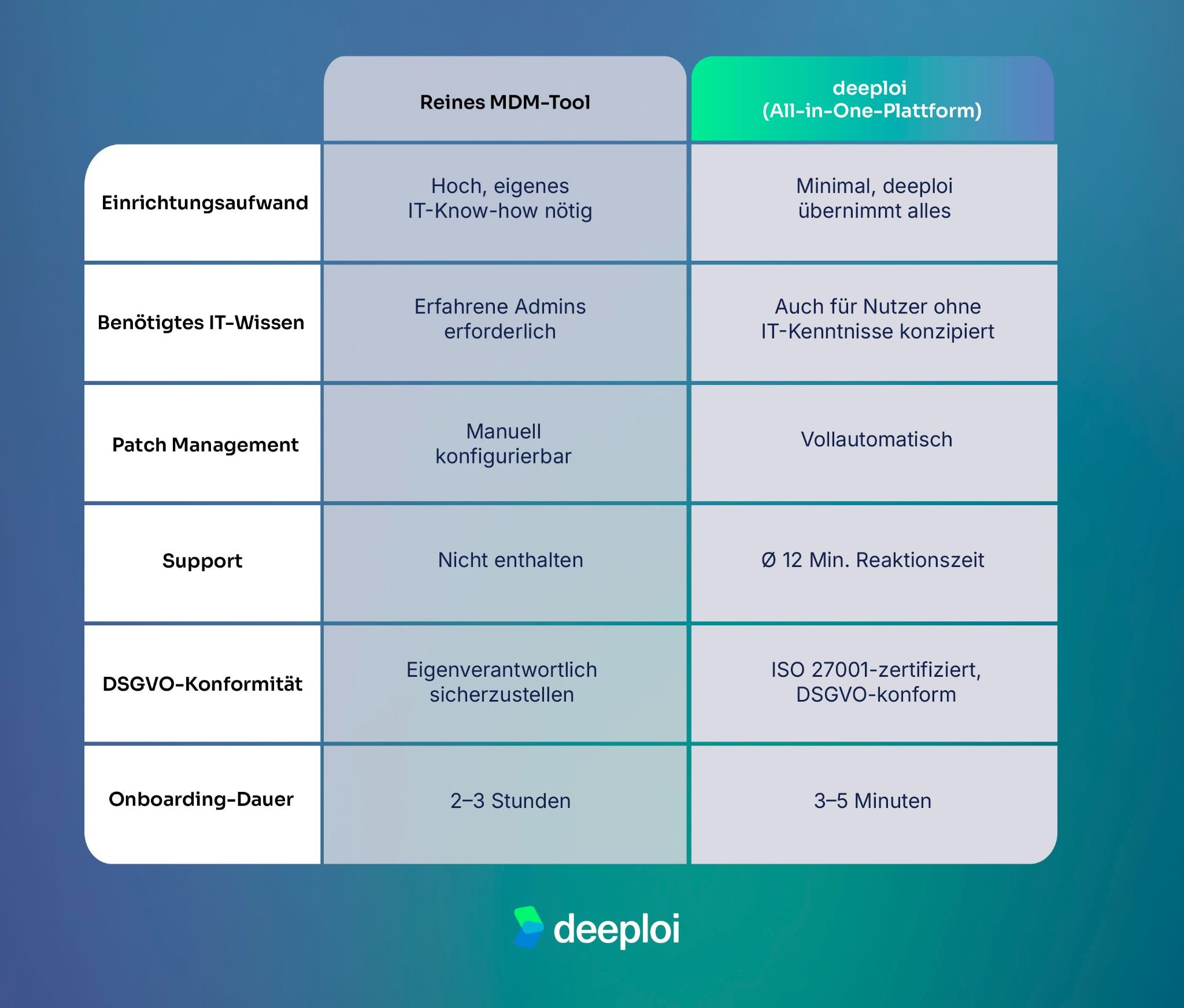
The difference shows up in everyday work: with a pure MDM tool, you still have to set up devices yourself, distribute software, manage access rights, and answer support tickets. deeploi takes those tasks off your plate so you can focus on your core business.
Switching from Miradore: how to make the migration work
One important thing to know upfront: there is no universal portability standard between MDM platforms. A structured pilot project is the best way to minimize risk and downtime:
- Inventory your devices: Create a complete overview of all managed devices, operating systems, and installed apps.
- Document your policies: Write down all existing MDM policies, security configurations, and access rules.
- Define a pilot group: Choose a small group covering different roles and device types to test the new platform under real conditions.
- Set rollback criteria: Define in advance which problems would trigger a rollback – for example, failed enrollments or non-functioning policies.
- Run the full rollout: After a successful pilot, migrate the remaining devices in controlled batches.
What a smooth MDM migration can look like: after switching to deeploi, The Female Company reduced IT workload by 97%. Instead of spending weeks on manual configuration, their entire IT operation now runs through a single platform.
Conclusion: the Miradore alternative that actually relieves your team
Miradore is a solid entry point, but for growing SMBs in the DACH region, a pure MDM tool eventually stops being enough. Teams that want not just better Mobile Device Management but IT onboarding, device management, software deployment, and IT support unified in one platform will find deeploi to be the logical next step.
Over 200 companies already rely on deeploi. Whether a startup, agency, or growing mid-sized business: HOLY Energy now onboards new employees in just five minutes, and The Female Company reduced IT workload by 97%. These results show what is possible when MDM, support, and automation work together.
{{cta}}
FAQ
Which Miradore alternative is right for SMBs without an IT team?
Pure MDM tools like Hexnode UEM or Microsoft Intune require technical expertise. All-in-one platforms like deeploi are designed specifically for non-technical users and combine an intuitive interface with built-in expert support and automated workflows that require no IT background.
What are the main limitations of Miradore?
Users report Apple DEP issues, slow device sync, and weak Android BYOD management. The free tier also lacks key features like device encryption and location tracking, and since September 2024 the free plan is capped at 50 devices.
How much work is involved in switching from Miradore to another MDM?
Every MDM migration requires a full re-enrollment, since only one MDM can manage a device at a time. Plan a structured pilot test with a small device group before migrating your entire fleet. Depending on fleet size, the switch takes anywhere from a few days to several weeks.
What is the difference between MDM and an all-in-one IT platform?
MDM manages devices and enforces policies. An all-in-one IT platform like deeploi additionally handles onboarding automation, software deployment, HR integration, and IT support. For SMBs without a dedicated IT team, the all-in-one approach is often the better choice.

.jpg)