








Direct Answer
For SMBs without a dedicated IT team, a classic ITSM tool is often overkill because it manages processes but still requires someone to run the IT behind them. deeploi is the better fit: it combines support, device management, onboarding and offboarding, security, and compliance in one managed IT platform.
Key Takeaways
The 10 best ITSM tools in 2026 compared
Which ITSM tool is the right fit for your company? In this post, we compare 10 tools across complexity, automation, support model and other key factors – from ServiceNow and Jira to Freshservice and deeploi as an all-in-one alternative.
Why do companies need ITSM software?
ITSM (IT Service Management) describes how companies operate their IT in a structured and reliable way. The goal is for processes such as support, device management and onboarding to run predictably, transparently and scalably – and not depend on chance or individual people.
An ITSM tool forms the operational backbone. It functions as a central platform (single source of truth) for all service operations:
- Incident Management: Fast resolution of reported IT problems.
- Request Fulfilment: Standardised provisioning of hardware or software licences.
- Asset & Change Management: Comprehensive documentation of infrastructure changes.
By structuring, prioritising and automating these workflows, the tool creates the foundation for measurable service quality, audit compliance and more efficient support.
Advantages and limitations of ITSM software at a glance
Companies use ITSM tools to reduce response times, meet service level agreements (SLAs) and fulfil compliance requirements.
Many companies orient themselves around ITIL (Information Technology Infrastructure Library), a globally established framework with best practices for IT processes such as Incident Management, Change Management and Problem Management.
Not every company needs the full ITIL scope with all processes and roles. For SMBs without a dedicated IT department, a complete ITSM framework can quickly become overwhelming. The following table shows where classic ITSM software excels – and where it reaches its limits.
For SMBs without their own IT department, a fundamental question therefore arises: is a classic ITSM tool really the right category, or does an operational all-in-one IT platform solve the actual problems better?
Managing IT without your own IT team?For companies that don't have a dedicated IT department, deeploi offers an alternative to classic ITSM: an all-in-one IT platform that takes over IT operations completely. No implementation project, no IT knowledge required.Start with deeploi now
The 10 best ITSM tools compared
Before getting to the individual tool descriptions, the following table provides a compact overview of all 10 ITSM tools.
Note on the US Cloud Act: Several tools in this comparison come from US-based providers. The Cloud Act obliges US companies to hand over data upon government request – even when that data is physically stored in EU data centres. This applies to ServiceNow, Freshservice, NinjaOne, Atera and – with limitations – Jira Service Management. For data-sensitive companies in the DACH region, this is a relevant point to check.
deeploi: all-in-one IT platform for efficient IT operations
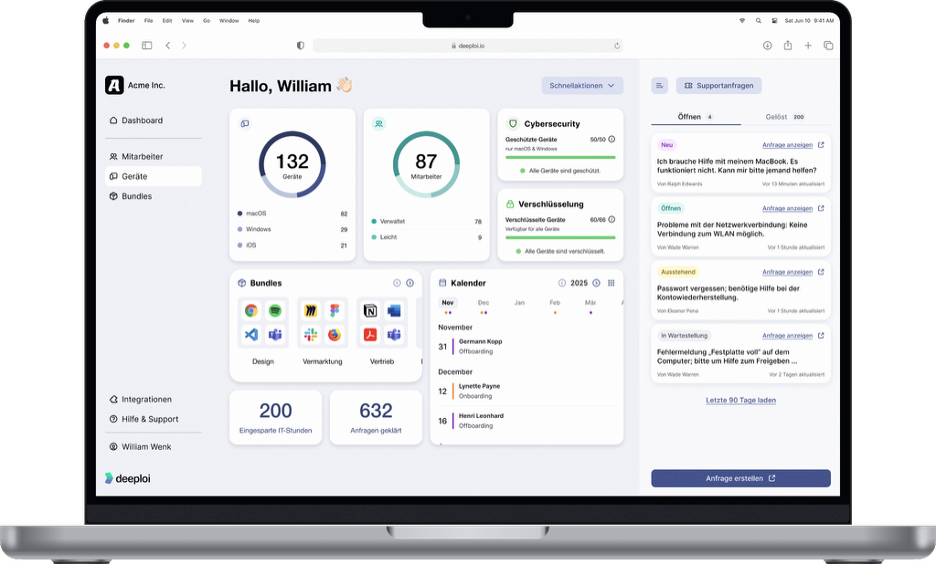
deeploi is not a classic ITSM tool in the narrow sense, but a platform that takes over the entire IT operation. Instead of just managing tickets, deeploi combines automation with expert support in German and English. Core features include a helpdesk with an average response time of 12 minutes (SLA: 30 minutes), automated on- and offboarding in 3–5 minutes, zero-touch provisioning, MDM, patch management and cybersecurity – all from a single source, without you having to manage individual tools.
Advantages at a glance:
- Up to 95% less manual IT effort through end-to-end automation
- No IT expertise required: the platform is intuitively operable – with or without an internal IT team
- Transparent pricing with no hidden fees or complex agent-based models
- German provider with EU hosting, ISO 27001 and full GDPR compliance
- Seamless HR integration with Personio, BambooHR and other systems for automated onboarding and offboarding
- IT support in German and English, avg. 12 min. response time, SLA 30 min.
- AI agent with product knowledge available 24/7 for instant answers without waiting time, with seamless handover to a human agent for more complex questions
Ideal for SMBs with 30–200+ employees who don't have a dedicated IT team or want to relieve the burden on their IT department.
ServiceNow ITSM
ServiceNow offers deep ITIL coverage, Enterprise Service Management beyond IT, and AI features via Now Assist. The ecosystem of partners, integrations and community is extensive.
Advantages at a glance:
- Comprehensive ITIL coverage: Incident, Problem, Change, Release and Service Management
- ESM capability for non-IT areas such as HR, Finance and Legal
- AI features via Now Assist for incident summaries and automated workflows
- Strong partner and integration ecosystem
Limitations:
- High complexity, significant consulting costs, long rollouts
- US provider: note Cloud Act
BMC Helix
BMC Helix is aimed at companies with complex IT infrastructures and high requirements for ITIL 4 compliance. The platform offers AI-powered automation via BMC HelixGPT, multi-cloud management and a powerful CMDB. The on-premises option is particularly relevant for companies with strict data sovereignty requirements.
Advantages at a glance:
- Broad functionality extending beyond ITSM to IT Operations Management
- On-prem option for maximum control over data and infrastructure
- Strong CMDB for complex configuration landscapes
Limitations:
- High implementation effort
- Functionally comprehensive but complex to configure, according to user reviews
- US provider: note Cloud Act, consider on-prem option as an alternative
Freshservice
Freshservice is a cloud-based ITSM platform from Freshworks that covers the key ITIL processes: Incident Management, Problem Management, Change Management and Asset Management. Freshservice particularly stands out for its intuitive interface and fast onboarding.
Advantages:
- Intuitive interface, manageable implementation time
- AI features via Freddy AI for ticket routing and self-service
- ESM capability for non-IT areas such as HR and Facilities
Limitations:
- US provider: note Cloud Act
NinjaOne
NinjaOne is primarily an RMM and endpoint management tool with an integrated ticketing system and patch management. The platform offers device monitoring, automated patching and remote access. Less of a full ITSM in the ITIL sense, but suitable for IT teams that want to manage endpoints centrally.
Advantages:
- Automated patch management for Windows, macOS and Linux
- Remote access and real-time device monitoring
- Integrations with EDR solutions such as SentinelOne and CrowdStrike
- Intuitive interface, manageable onboarding
Limitations:
- Not a full ITSM (no Change or Problem Management, no service catalogue)
- Requires IT knowledge
- US provider: note Cloud Act (German GmbH is a subsidiary)
Jira Service Management
Jira Service Management is a strong choice for companies already working within the Atlassian ecosystem. Native DevOps integration, transparent pricing and a setup time of 60–90 days make it a solid ITSM solution.
Advantages:
- Native integration with Atlassian tools
- Free entry package for up to 3 agents
- ESM capability for non-IT areas, EU data centres available
Limitations:
- Complex to configure without prior Atlassian experience
- On-prem available via Data Centre, but with higher administrative overhead
- US provider: note Cloud Act
Atera
Atera is a US-based IT management platform that combines RMM, PSA (Professional Services Automation) and helpdesk in a single solution. The pricing model is based on technicians rather than endpoints, making it attractive for teams managing a large number of devices.
Advantages:
- RMM, PSA, helpdesk and automation in one platform
- Per-technician pricing model independent of the number of managed endpoints
- AI automation via Agentic AI
- Integrated asset management
Limitations:
- Requires IT expertise
- Advanced features partly only available in higher tiers
- US provider: note Cloud Act
HaloITSM
HaloITSM is an ITSM platform from the British company Halo Service Solutions. The software is ITIL-compliant and covers Incident, Problem, Change and Release Management. HaloITSM is available as both SaaS and on-premises.
Advantages:
- ITIL coverage: Incident, Problem, Change and Release Management, CMDB, self-service portal
- SaaS and on-prem available, UK/EU data centres
- Lower entry price than comparable enterprise platforms
Limitations:
- Smaller ecosystem than ServiceNow or Jira
- Less established in the DACH market
InvGate Service Management
InvGate Service Management focuses on fast implementation and intuitive UX. The platform offers Incident, Problem and Change Management as well as a knowledge base and a self-service portal. Additionally, InvGate Asset Management is available as a separate ITAM module. Particularly interesting for companies that want to get up and running quickly, without months of configuration projects.
Advantages:
- Incident, Problem and Change Management, knowledge base, self-service portal
- SaaS and on-prem available
- Supplementary ITAM module available
Limitations:
- Cloud hosting location varies by region – worth checking
- Smaller partner ecosystem, less established in the DACH market
ManageEngine ServiceDesk Plus
ManageEngine ServiceDesk Plus is part of the Zoho ecosystem and offers broad functionality: Incident, Problem, Change, Release and Project Management plus integrated IT Asset Management and CMDB. Three editions (Standard, Professional, Enterprise) differ significantly in scope. The low entry price and on-prem option make the tool particularly interesting for cost-conscious companies.
Advantages:
- Incident, Problem, Change, Release and Project Management plus integrated ITAM and CMDB
- Low entry price
- On-prem option available
- No separate ITAM module required
Limitations:
- Complex configuration, steep learning curve
- Support quality in DACH varies according to user reviews
Find the right ITSM tool for your company
The best ITSM software is not the one with the most features, but the one that matches your IT maturity level and company size. The following decision matrix helps you make the right choice.
What sets deeploi apart from classic ITSM tools
Classic ITSM tools structure IT processes – but they assume that someone within the company actively operates, configures and maintains the IT. deeploi takes a different approach: instead of just managing tickets, the platform takes over the entire IT operation, from support and device management through automated onboarding to cybersecurity and compliance. This doesn't make deeploi a replacement for classic ITSM – it makes it a category of its own: a solution that fully solves operational IT problems without requiring IT expertise on the customer side.
Conclusion: complete IT solution instead of just ticketing – with deeploi
The ITSM market is fragmented, and most tools are built for companies with dedicated IT teams. ServiceNow and BMC Helix deliver maximum ITIL depth, but require specialist consultants and lengthy rollouts. Freshservice and Jira Service Management are more accessible, but still need an IT team to configure and operate them. NinjaOne and Atera specialise in endpoint management, but require internal IT expertise.
Not every company needs that level of effort. Those who want to operate IT more efficiently – with or without an internal IT team – need a solution that delivers support, device management, onboarding, security and compliance from a single source, without months of implementation and without hidden costs.
That's exactly what deeploi delivers. As a German provider with ISO 27001 certification and full GDPR compliance, the platform reduces manual IT effort by up to 95%. On- and offboarding takes 3–5 minutes instead of hours, support responds in an average of 12 minutes, and cost savings compared to traditional IT service providers amount to up to 75%.
IT that just works.deeploi handles support, device management, onboarding and cybersecurity. Fully automated, GDPR-compliant and with an average response time of 12 minutes. Over 200 customers in the DACH region already rely on deeploi.Book a demo now
FAQ
What is the difference between ITSM tools and a helpdesk?
A helpdesk resolves tickets – ITSM structures the entire IT operation. When an employee reports that their laptop won't start, that's a helpdesk task. When a company wants to ensure that such incidents are documented, escalated and prevented in the long term – that's what ITSM is for. Change Management, Problem Management, CMDB and service catalogue are all part of it. A helpdesk is therefore a subset of ITSM, while ITSM covers the entire lifecycle of IT services.
Does an SMB without an IT department need an ITSM tool?
Probably not – at least not a full ITSM in the enterprise sense. That would be over-engineered and barely operable without IT expertise. But structured IT management is still needed: support must work, devices must be managed, new employees must onboard smoothly. All-in-one platforms like deeploi solve exactly these problems without requiring IT expertise.
What is the difference between deeploi and classic ITSM tools?
Classic ITSM tools structure IT processes and help manage tickets, document changes and meet SLAs. They assume that someone within the company actively operates the IT. deeploi takes over IT operations itself: support, device management, onboarding, patch management and cybersecurity all run automatically – without an internal IT team being necessary.
Which ITSM tool is right if I'm unhappy with my MSP?
Slow response times, unclear costs, the feeling of never really making progress – these are the most common complaints about traditional MSPs. If that sounds familiar, deeploi is a natural alternative. Average response time of 12 minutes, transparent pricing with no hidden fees, and cost savings of up to 75% compared to traditional IT service providers, according to customer data.