






Direct Answer
The baramundi Management Suite is one of the established unified endpoint management solutions in German-speaking countries: deployable on-premises, hybrid, or hosted, with support for Windows, macOS, Linux, iOS, and Android from a single console. But that same flexibility also assumes you have your own server resources and an experienced IT admin to configure jobs, policies, and rollouts. If that's exactly what you're missing, or your team is increasingly thinking cloud-first, one question comes up: which alternative actually fits your situation?
Key Takeaways
- baramundi is powerful, but admin-dependent: the suite covers five operating systems, but only delivers real value once there's dedicated IT expertise in-house.
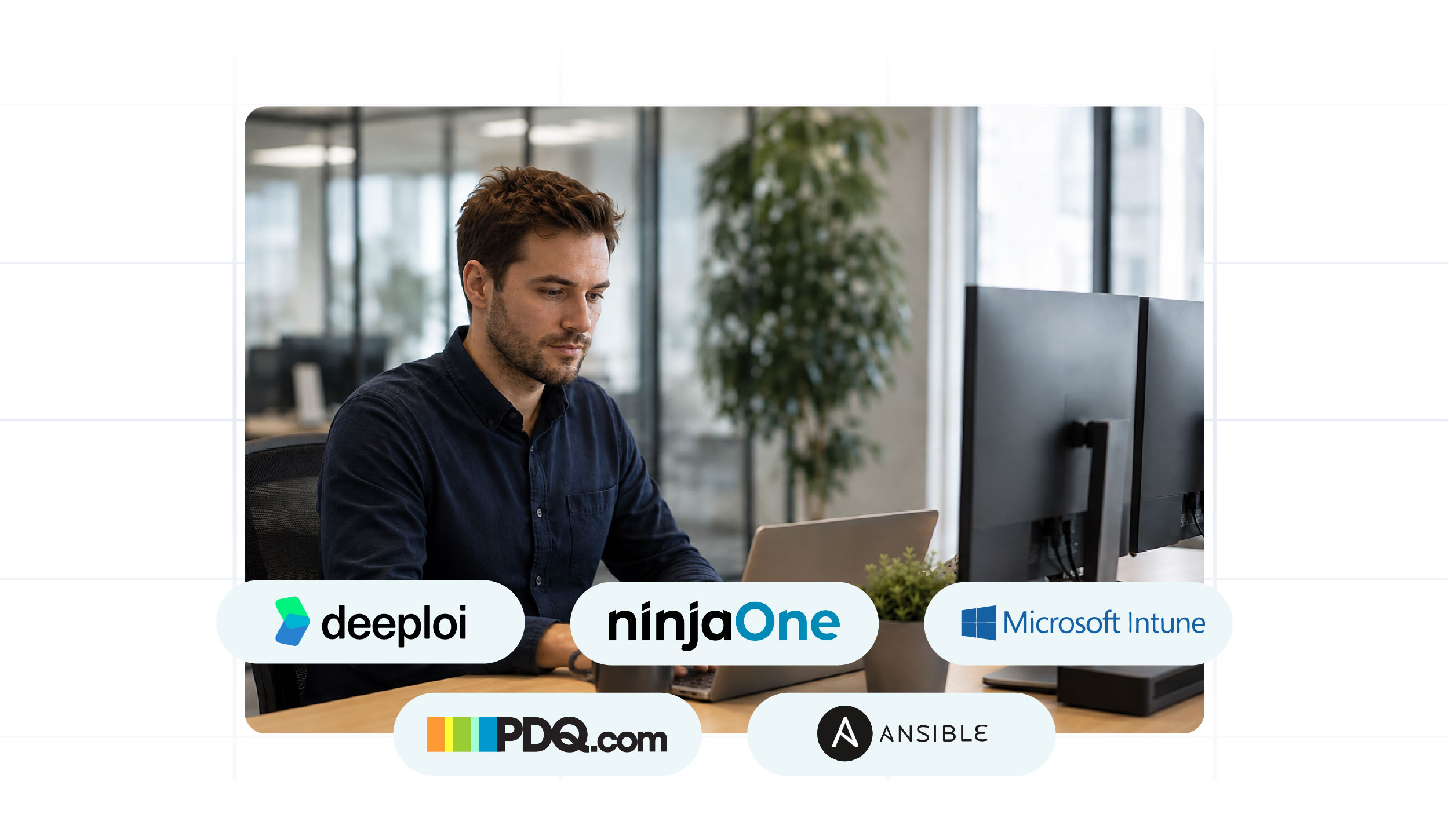
- Cloud-native alternatives solve the on-prem problem, but Microsoft Intune, ManageEngine Endpoint Central, and NinjaOne still require a team to operate them.
- The real question isn't feature depth, it's the operating model: if you're switching because you lack IT resources, you need more than new software.
- deeploi takes on automation and human support at the same time, making a dedicated IT admin for device management (MDM) unnecessary.
{{cta}}
Why companies look for baramundi alternatives
The reasons for switching are rarely dissatisfaction with individual features. Most of the time, it comes down to the operating model behind the suite, and how much IT expertise a company actually has in-house.
- The suite requires its own server resources and a more extensive initial setup compared with cloud-native alternatives.
- Its depth only pays off with an experienced IT admin who configures policies, prioritizes patches, and steers rollouts.
- Companies with a clear cloud-first strategy run into friction with a suite that's primarily rooted in on-premises.
- Hybrid work and mixed Windows/macOS fleets increasingly call for zero-touch deployment instead of script-based rollouts.
Quick overview: baramundi and its 4 best alternatives
What baramundi does well, and where it hits its limits
A fair comparison starts with an honest assessment of the provider you're currently leaving, or considering.
baramundi scores points with broad platform coverage across five operating systems and can deliberately be run on-premises, which enables full data sovereignty. As a German provider with German-language support, the suite is also co-management capable: it can be used alongside Microsoft Intune when a company manages Windows devices on-premises while controlling mobile devices via the cloud in addition.
The limits show up where automation meets staffing. The suite requires its own server resources and a more extensive initial setup than cloud-native alternatives. Getting its full potential requires an IT admin who actively maintains policies, and integrated expert support for end users isn't part of the product's core design.
The 4 best baramundi Management Suite alternatives compared
deeploi: the cloud-native, all-in-one IT management platform
deeploi is the right choice for companies leaving baramundi because they lack the IT resources for self-administration, as well as for companies with an existing IT team that needs relief from routine tasks so it can focus on more complex projects.
Unlike baramundi, deeploi is consistently cloud-native and combines automation with a human expert team, rather than delivering pure software that still assumes an admin.
- Automated on- and offboarding in 3 to 5 minutes instead of 2 to 3 hours.
- ISO 27001-certified and GDPR-compliant, with hosting in Germany.
- IT support for all employees in German and English. For technical issues, everyone reaches the expert team directly, with an average response time of 12 minutes (SLA: 30 minutes).
- Alongside expert support, the AI agent Sam is also available 24/7 when needed and answers all questions instantly.
- Up to 95% less manual IT effort through automated processes.
- Over 200 companies in the DACH region already trust deeploi.
- Up to 75% lower costs compared with traditional managed service providers.
- A fixed monthly price per active team member, with no setup fee and unlimited support requests, instead of hidden per-ticket costs.
Limitations:
- No support (yet) for Linux or ChromeOS.
If you choose deeploi, migration is part of your customer onboarding, with no setup fee. The team handles setting up MDM and accounts as well as the complete device migration, including the switch from your previous MDM solution. How long that takes depends on the complexity of your existing setup, but most teams are up and running within a few days to weeks.
Microsoft Intune: the solution for the Microsoft ecosystem
Intune is a good fit for Windows-heavy fleets at companies with an existing Microsoft 365 contract and their own IT team to manage the platform.
Unlike baramundi, Intune is fully cloud-native and often included at no extra cost in common M365 plans.
- Deep integration with Microsoft Entra ID and the entire M365 ecosystem.
- Often no separate license cost if a suitable M365 plan is already in place.
Limitations:
- Licensing quickly gets complex.
- There's no standalone IT support.
- Configuration effort remains high for non-technical teams.
ManageEngine Endpoint Central: the enterprise solution
This solution fits larger companies with a dedicated IT team and complex compliance requirements.
Like baramundi, Endpoint Central can be run both on-premises and in the cloud, and is similarly feature-rich. According to ManageEngine, over 34,000 IT professionals trust the platform, which manages more than 28 million endpoints across over 190 countries.
- Very broad feature set for heterogeneous, complex environments.
- True multi-platform management across Windows, macOS, Linux, iOS, and Android.
Limitations:
- Setup is very complex, with a steep learning curve.
- Ongoing operations require dedicated IT resources that smaller teams rarely have to spare.
NinjaOne: the RMM solution
NinjaOne targets IT teams and MSPs looking for a modern, cloud-native RMM platform (remote monitoring and management) with built-in MDM functionality (mobile device management).
Unlike baramundi, NinjaOne is built RMM-first rather than UEM-first, and is fully cloud-native. According to NinjaOne, the platform includes over 300 automation scripts for cross-platform patching across Windows, macOS, and Linux.
- Modern cloud architecture with a broad range of automation scripts.
- Fast troubleshooting through direct remote access to endpoints.
Limitations:
- MDM is only one part of the NinjaOne platform, which can feel like overkill for purely device-management needs.
- Operating it still requires technical IT know-how.
How to switch from baramundi successfully
Before switching, document your existing baramundi jobs and policies and export your current device inventory. That way, you start the new solution with a clear overview instead of having to reconstruct configurations from memory. If you choose deeploi, the expert team supports you throughout the entire onboarding process, so the switch goes as smoothly as possible.
What to look for in a baramundi alternative
The right choice depends less on the feature list than on your actual in-house IT capacity. These four criteria will help you assess it.
- Deployment model: if you're switching away from baramundi because of its on-prem dependency, check whether the alternative is genuinely cloud-native, or just offers a cloud option on the side.
- Degree of automation vs. required IT know-how: honestly assess whether your team can configure the automation itself, or whether you need a partner to handle it.
- Support model: pure software assumes someone on your team solves problems. A model with built-in human support takes that burden off you.
- GDPR and ISO 27001 compliance: especially in the DACH region, the alternative should not only cover compliance requirements technically, but also back them up with local support.
IT management without an in-house IT department
Over 200 companies in the DACH region already manage their devices with deeploi, with no dedicated IT team.
{{cta}}
deeploi: the smart baramundi alternative for companies without an IT department
For companies without an in-house IT department, and for Accidental IT Owners handling IT on the side, deeploi is the logical replacement for baramundi. The reason isn't a single feature, but the operating model: automation and human support work together, instead of delivering software that still assumes an experienced admin.
That makes moving away from baramundi a decision for less administrative overhead, not for yet another tool that still needs to be configured. Anyone looking for one of the best baramundi Management Suite alternatives for a team without an IT department will find the obvious answer in deeploi.
Start your switch from baramundi to deeploi
In a short, no-pressure first conversation, we'll look together at your team size, your OS mix, and your current baramundi setup.
{{cta}}
Frequently asked questions
Which baramundi alternative is right for companies without an in-house IT department?
deeploi is the best fit here, because the platform combines automation with built-in expert support. Pure software like Intune, ManageEngine, or NinjaOne still assumes an internal IT team to handle configuration and operations.
How much does a baramundi alternative cost compared with the Management Suite?
Pricing models differ significantly: Intune is often bundled into M365 plans, ManageEngine and NinjaOne typically bill per device or technician, and deeploi uses a fixed monthly price per active team member, with no hidden costs.
Do I still need an IT team if I switch to one of the alternatives?
That's true for Intune, ManageEngine Endpoint Central, and NinjaOne. All three assume internal IT know-how for configuration and operations. With deeploi, that's not necessary, because the platform is built specifically for companies that have no IT team, or want to use their limited IT capacity for more complex projects instead.
Which baramundi alternative supports GDPR and ISO 27001 requirements in the DACH region?
Both baramundi and deeploi are ISO 27001-certified. deeploi adds hosting in Germany and German-language support on top, which matters for companies with strict DACH compliance requirements.


.png)