





Direct Answer
ManageEngine is powerful, but it assumes technical expertise and dedicated IT administrators. For SMBs without an IT department, alternatives like deeploi offer a simpler approach: device management, onboarding, IT support, and compliance are combined on one platform, so the IT infrastructure doesn't have to be managed in-house.
Key Takeaways
- ManageEngine is built for enterprise IT teams. If you do not have a dedicated IT team in-house, you are working against a platform that was never designed for your situation.
- The most common reasons for switching are structural: a cluttered interface, slow support, and too few integrations push users to look for a ManageEngine alternative.
- Not every ManageEngine alternative suits every team: deeploi, SuperOps, Action1, N-able N-sight, and LogMeIn Resolve each fix a different ManageEngine weakness, depending on your team size, IT setup, and budget.
- deeploi is the only alternative that does not require an IT team of your own: we handle IT onboarding, offboarding, device management, and IT support, so HR and leadership get their working hours back for the work they were hired to do.
ManageEngine looks like the obvious choice for a lot of growing companies: established, feature-rich, widely used. The problem starts the moment there is no IT administrator in the building. The platform is built for enterprise IT teams, not for companies with 30, 100, or 200 employees and no IT department. Below are five ManageEngine alternatives that fit your company better, depending on your team size and IT setup.
Why do companies look for a ManageEngine alternative?
For large IT departments with dedicated administrators, ManageEngine delivers a lot. The problems begin when companies with limited IT staff or no dedicated IT team try to run the software productively.
- A complex interface: ManageEngine splits its functionality across several separate products, including Endpoint Central, OpManager, and ServiceDesk Plus. Users report that the console is cluttered and hard to adapt to their own requirements. Without IT expertise in-house, you lose the overview fast.
- Weak customer support: In user reviews and technical forums, support comes up again and again as hard to reach and not particularly helpful. For companies that need fast help when IT breaks, that is a real risk.
- Not built for teams without IT specialists: ManageEngine assumes someone in-house has IT expertise. For SMBs without their own IT department, the learning curve is out of proportion and the risk of misconfiguration is real.
- Few third-party integrations: ManageEngine Endpoint Central supports only 9 external integrations. If you want to connect the tools you already run, such as your CRM, SSO, or HR software, that is a hard limit.
If you are looking for a ManageEngine alternative that is simpler and more reliable, the five tools below are solid options.
The 5 best ManageEngine alternatives at a glance
1. deeploi: your entire IT on one platform
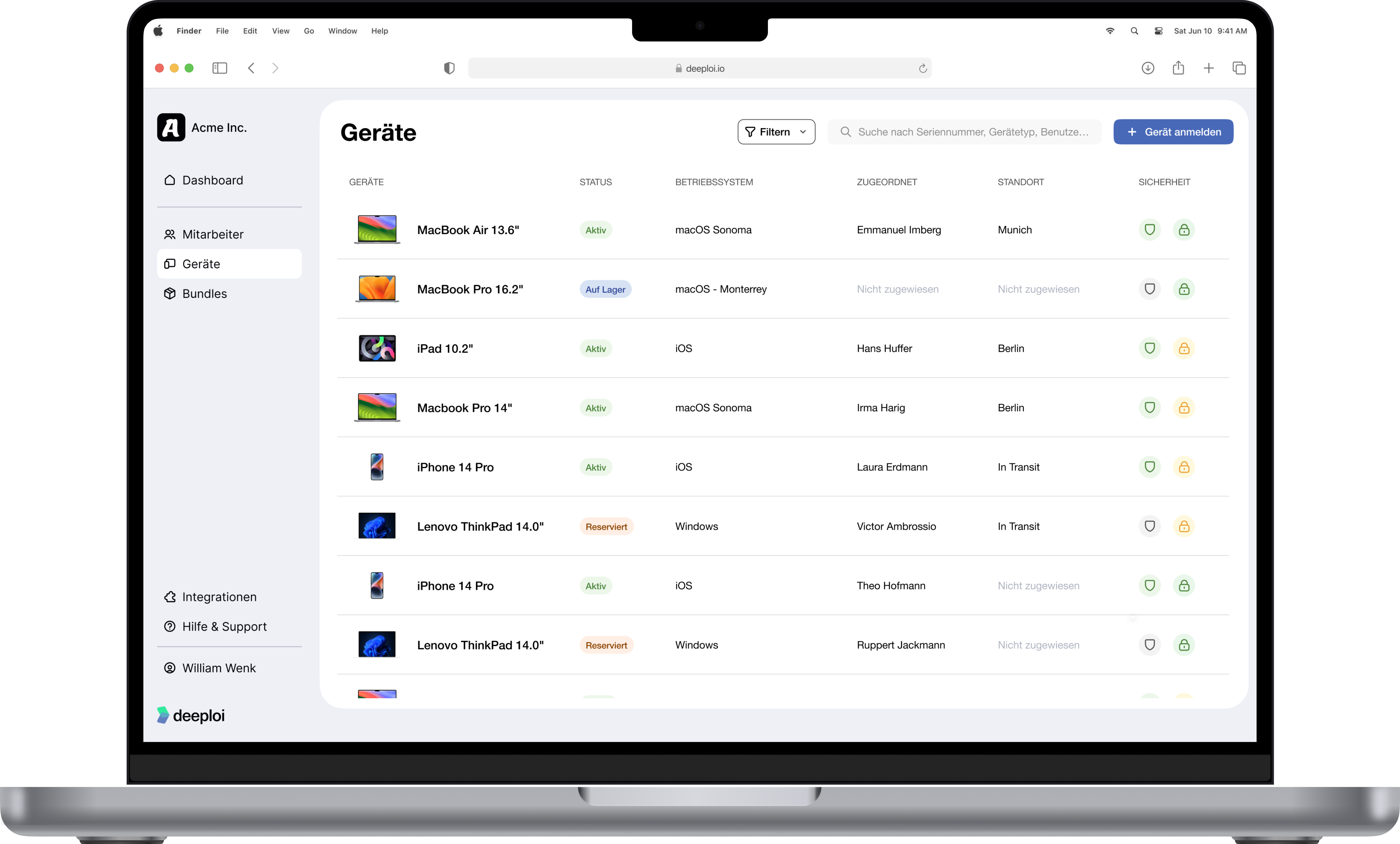
deeploi is all-in-one IT service management software for growing companies in Europe. Instead of handing you another piece of software that somebody has to operate, we take over IT the way an outsourced IT department would. Device management, onboarding, support, cybersecurity, and compliance all run centrally on one platform, with nothing split across separate products.
Strengths
- No IT specialist or administrator required: HR managers, office managers, and founders can run deeploi on their own, without IT expertise. The platform is built so that people with no IT background work with it intuitively, while we handle the technical work in the background.
- Zero-touch provisioning: new devices configure themselves automatically and are ready to use within minutes.
- Automated onboarding and offboarding through integrations with HR systems such as Personio, BambooHR, and Factorial.
- IT support in English and German: Sam, deeploi's AI Agent, is available 24/7 and answers instantly. He does not just answer questions, he acts directly in the system: suspending access, adjusting group permissions, or pulling live device data, always with sign-off from your IT owner. Complex issues go to our human IT experts, who respond in 12 minutes on average (SLA: 30 minutes).
- ISO 27001 certified and GDPR compliant, built and operated in Germany.
Limitations
- On-premise environments are not supported.
Pricing: Transparent, per user per month, with no hidden costs and no module licenses of the kind ManageEngine charges for.
2. SuperOps: one tool instead of five separate products
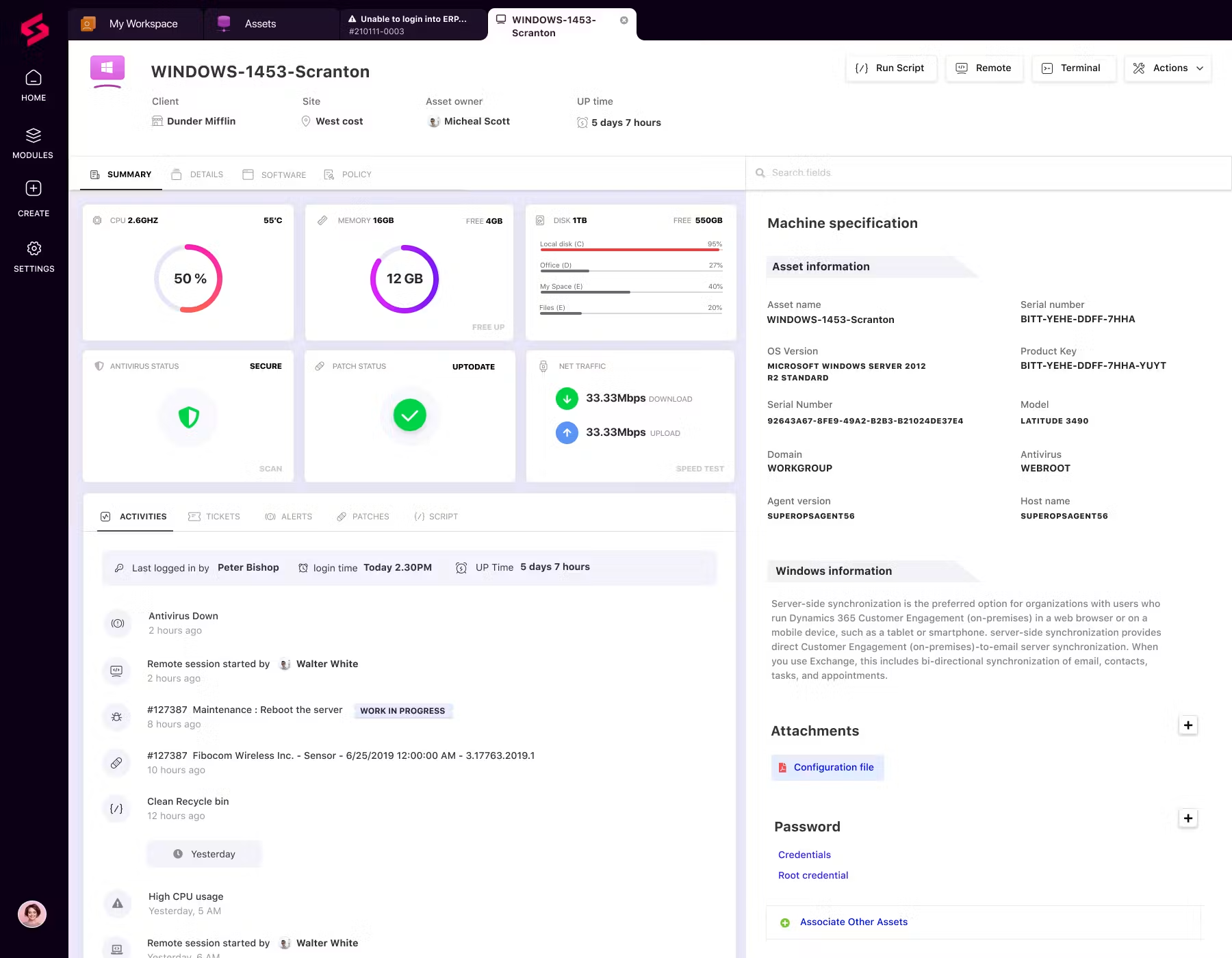
SuperOps is a cloud-native platform that combines PSA (Professional Services Automation) and RMM (Remote Monitoring and Management) in a single tool. Unlike many legacy vendors, it does not need two separate systems to do it. The approach targets MSPs and IT teams that want to run every core process in one interface rather than switching between several products.
Strengths
- Every central function runs in one interface, from the initial alert through the ticket to invoicing.
- Priced below combined ManageEngine license packages, with tiered paid plans by feature scope.
- Integrations with tools including TeamViewer, QuickBooks, Webroot, and Stripe.
Limitations
- The platform's complexity means real onboarding time for your team.
- The tool assumes you have your own IT team with dedicated technicians.
Pricing: Per technician per month, tiered by feature scope (PSA, RMM, or Unified). Current pricing is on the SuperOps website.
3. Action1: free patch management for up to 200 endpoints
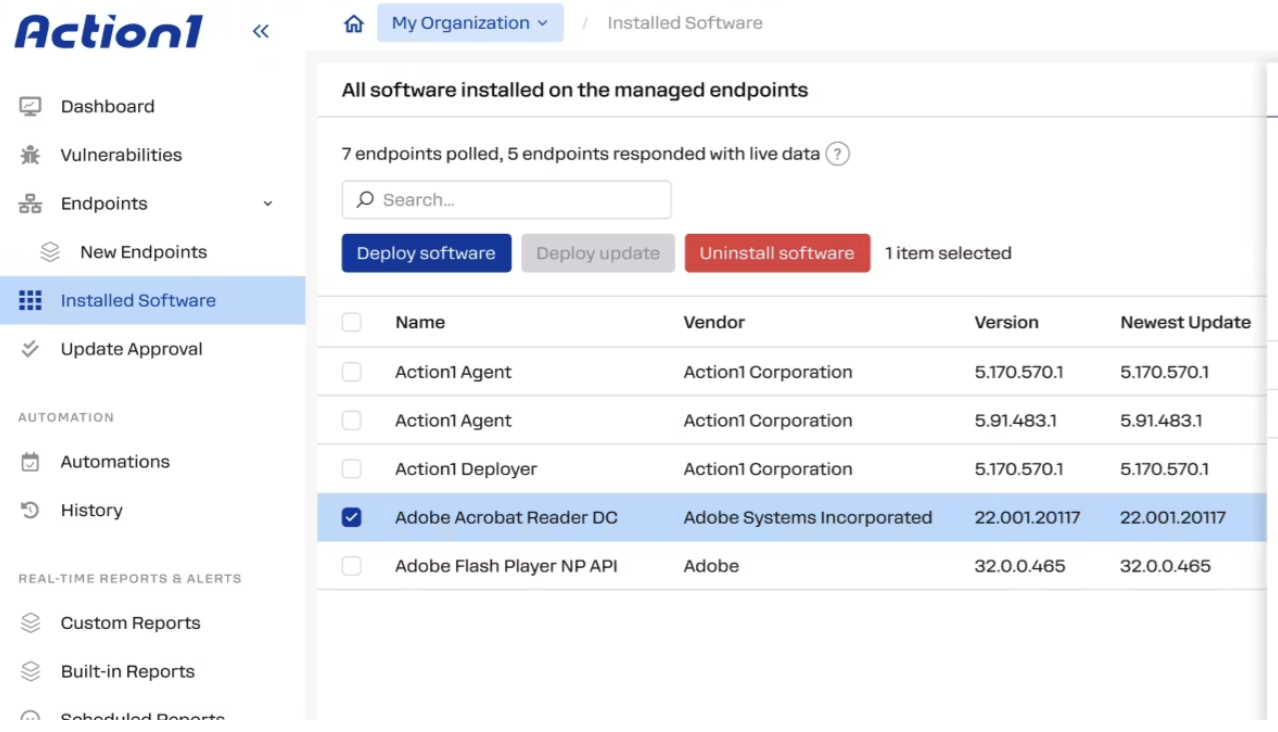
Action1 is a cloud-based endpoint management platform with a strong focus on patch management, vulnerability scanning, and secure software deployment. The full feature set is permanently free for up to 200 endpoints, with no time limit and no feature lock. Compared with ManageEngine, the platform is considerably leaner and faster to set up.
Strengths
- Full feature set free up to 200 endpoints, with no time limit.
- Patching for Windows, Linux, and macOS, including third-party applications, from one interface.
- Remote desktop access is included.
Limitations
- Action1 is not a full ManageEngine replacement: ITSM features and complex helpdesk processes are missing.
- The GDPR certifications that matter in Europe are not publicly documented, and neither is European-native support.
Pricing: Free up to 200 endpoints. From 201 endpoints, pricing is quoted individually on request.
4. N-able N-sight: the ManageEngine competitor built for MSPs
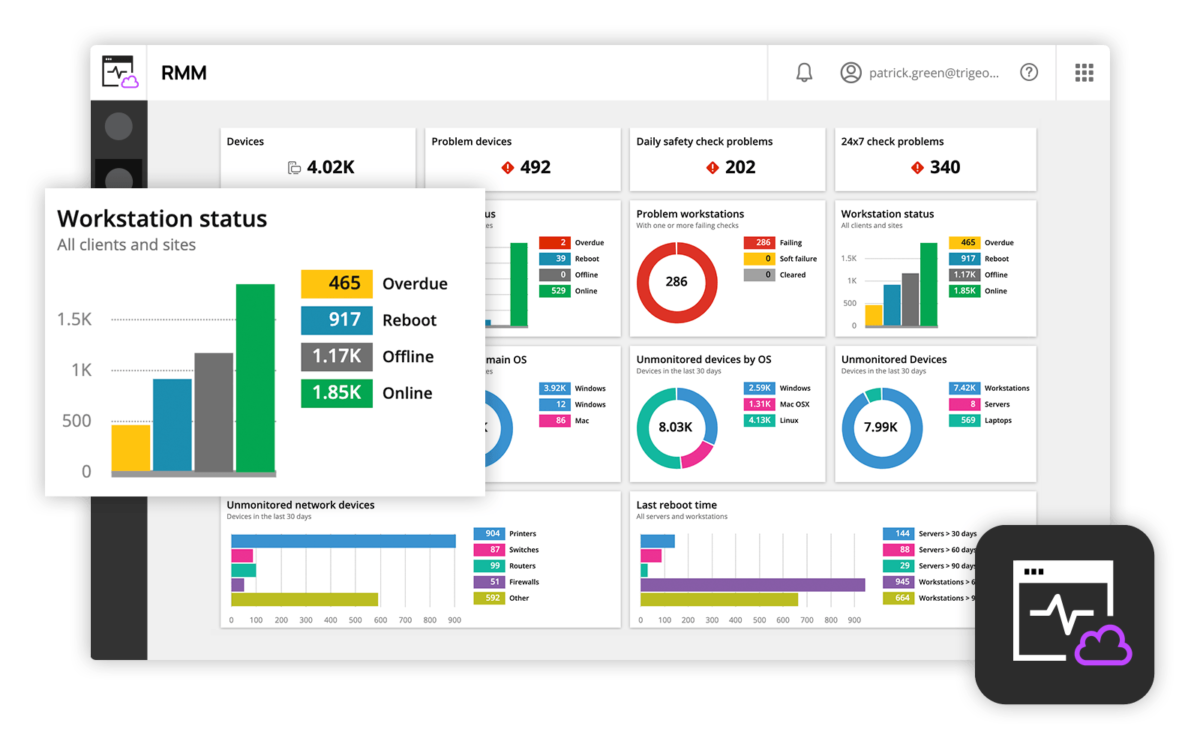
N-able N-sight combines remote monitoring and management, ticketing, and billing on one platform. That puts it in similar territory to SuperOps, but with a stronger focus on managed service providers. If an MSP already looks after your IT, N-sight is worth knowing, because a large share of external IT providers in the DACH region work with it.
Strengths
- Core features for IT monitoring and support run on one platform instead of several separate products.
- Endpoint-based pricing, more transparent than ManageEngine's modular license model.
- Already widely adopted among MSPs in the DACH region.
Limitations
- Core features are split across N-sight and the separate MSP Manager, which only partly solves ManageEngine's fragmentation problem.
- European-native support and GDPR certification are not publicly documented.
- Without your own IT team or an external IT partner, N-sight is not a fit.
Pricing: Endpoint-based, not published. You need to contact sales.
5. LogMeIn Resolve: remote support without the learning curve

Strengths
- Remote access included in every plan, at no extra cost.
- Transparent, endpoint-based pricing.
- Simple to operate, even for teams without deep IT knowledge.
Limitations
- For companies with strict compliance requirements in Europe, LogMeIn Resolve comes with caveats.
- GDPR certification and European-native support are not publicly documented. If that is a requirement for you, a European solution such as deeploi is the safer position.
Pricing: Endpoint-based, tiered by plan (Remote Access, Standard, Premium). Current pricing is on the LogMeIn website.
{{cta}}
Which ManageEngine alternative fits your situation?
No two of these platforms solve the same problem. This overview shows which alternative fits your starting point best.
Conclusion: the right ManageEngine alternative for your setup
There is no single best ManageEngine alternative, only the right one for your situation. Three questions decide it: how big your team is, how much IT know-how you have internally, and how much budget you have.
The other tools on this list stay software that somebody has to operate. deeploi takes over IT the way an outsourced IT department would. Device management, automated onboarding, personal IT support, and compliance run together on one platform. For companies in Europe that want IT to be simpler and more secure without building the expertise internally, deeploi is the right call.
FAQ
What is the best ManageEngine alternative for small businesses?
For small and mid-sized companies in Europe, deeploi is one of the strongest alternatives. deeploi requires no IT staff in-house and is GDPR compliant and ISO 27001 certified at the same time. Companies that do have their own IT team benefit too, because deeploi automates recurring work such as onboarding, device management, and support, which frees the team up for higher-value projects.
Is ManageEngine free?
ManageEngine offers a Free Edition with a heavily limited feature set. For professional use, modular licensing adds up quickly depending on the product, endpoint count, and features you need. What looks cheap at first often becomes hard to track once add-ons and extra modules are in play.
What is the difference between ManageEngine and deeploi?
ManageEngine is an IT management platform for enterprise IT teams with their own IT staff. deeploi takes over IT processes as a full managed service, so you do not need an IT administrator in-house. Device management, onboarding, support, and compliance are all included in one package.
Which ManageEngine alternative is GDPR compliant?
deeploi holds documented GDPR compliance and an ISO 27001 certification. The platform is built and operated in Germany and is designed specifically around European compliance requirements.

.jpg)
.jpg)