.jpg)








Direct Answer
BYOD appears free but isn't: support overhead from heterogeneous devices, external compliance audit costs, cyber insurance surcharges, and GDPR consulting fees quickly add up to the level of a structured company device setup - with the critical difference that BYOD without MDM and documented security policies exposes managing directors to personal liability under NIS2 and German company law; deeploi solves this through device procurement via partners, automatic Zero-Touch onboarding in 3-5 minutes, and central MDM management without a dedicated IT team.
Key Takeaways
- Not cheaper, just distributed differently: Personal devices and company devices often land closer together on total cost than expected, because BYOD creates additional line items that are invisible at first glance.
- The tipping point comes earlier than you think: Once extra support effort, compliance audit costs, and insurance premium loading enter the calculation, BYOD costs overtake the savings from skipping hardware purchases even in smaller teams.
- Personal liability is not theoretical: NIS2 and Section 43 of the German Limited Liability Companies Act (GmbHG) turn BYOD without mobile device management into a real liability risk for managing directors.
- deeploi makes the switch predictable: With the deeploi platform, the classic main advantage of BYOD disappears, because onboarding and device management run automatically in minutes rather than hours, and company hardware can be bought or rented directly through deeploi partners inside the platform.
Employees use personal laptops, smartphones, and tablets for company work. It looks straightforward and free at first glance, but in practice every new hire adds to a growing patchwork of operating systems, missing security policies, and unclear data ownership, and tightening compliance requirements are making that patchwork increasingly risky.
What BYOD costs on paper and what happens in practice
The strongest argument for BYOD is the hardware purchase you never make. Employees bring their own equipment, so the company buys no laptops and maintains no device inventory. That picture is accurate, but it is incomplete.
Look more closely and you find a series of line items that still apply under BYOD, or that only appear because of it. Many SMBs pay employees a monthly stipend for using personal devices for work. On top of that come MDM licenses (mobile device management), which remain essential under BYOD in order to meet data protection requirements. And GDPR-compliant processes for personal devices regularly require external consulting work that largely disappears with standardized company devices.
Add all of those items together and the total cost of BYOD and of a structured company-device setup often sit surprisingly close to each other. The difference is not the amount, it is the visibility: BYOD costs hide in stipends, consulting invoices, and time spent, while company-device costs appear on an invoice.
Hidden cost drivers that SMBs overlook
Four items frequently go missing from the BYOD calculation even though they generate real spend.
Support effort. Heterogeneous devices mean heterogeneous problems. A helpdesk supporting macOS 13, Windows 11, older Apple iOS versions, and a wide range of app configurations at the same time needs considerably more time per incident than a standardized company-device fleet does. That extra effort rarely shows up as a single number, but it adds up substantially over months.
Compliance and audits. Without centrally managed devices, external compliance audits take longer and cost more. In a standardized company-device setup with MDM, evidence can be pulled straight out of the management software, whereas BYOD requires every device to be checked individually.
Cyber insurance. Many insurers now distinguish between managed and unmanaged device fleets. Companies without MDM across every device in use often pay a risk premium, or no longer meet the minimum requirements for certain policies at all.
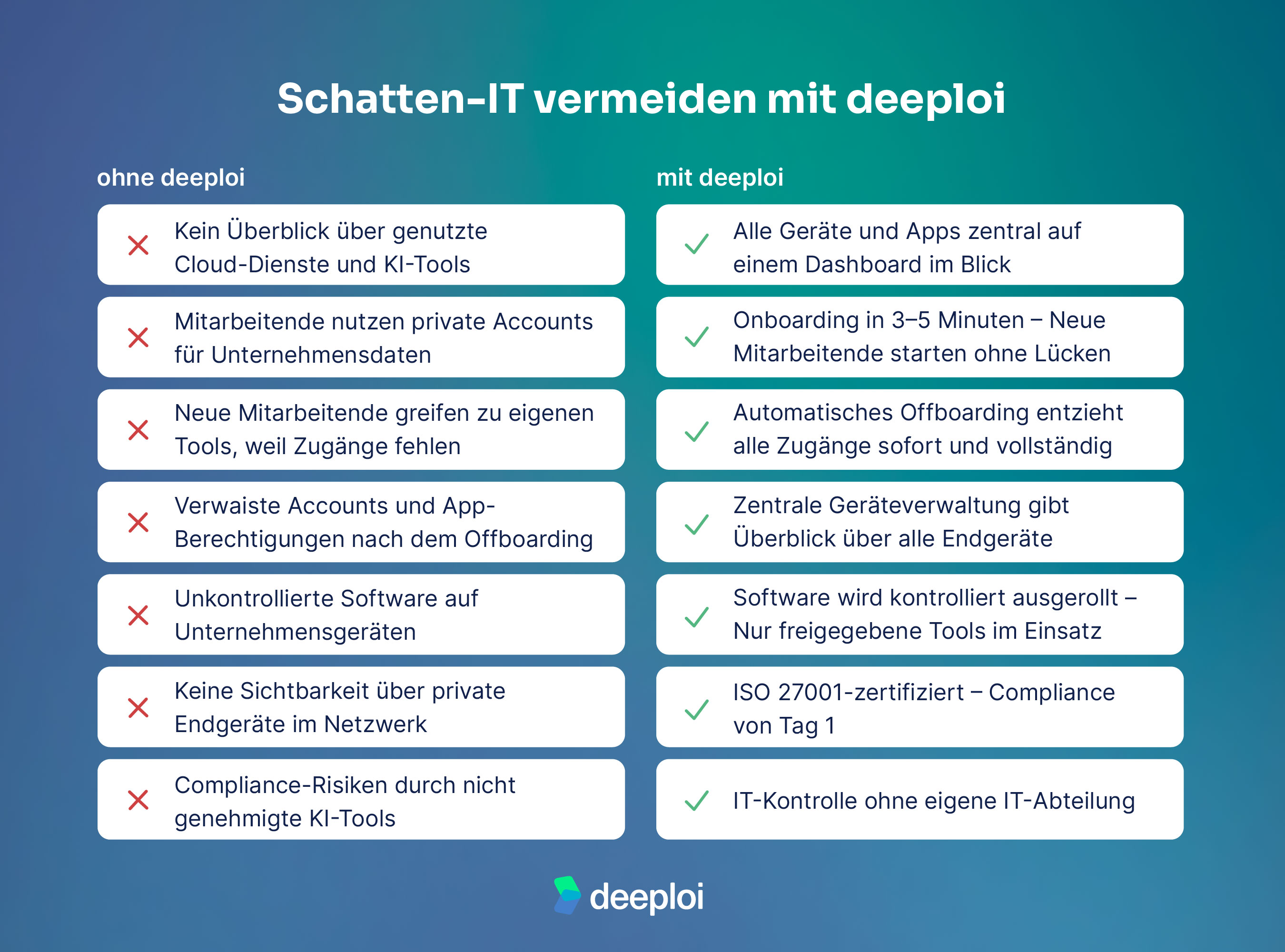
Shadow IT. Personal devices are the main entry point for unapproved software. Since AI tools like ChatGPT became part of everyday work, employees on personal devices frequently use applications that have no IT approval, cannot produce a data processing agreement under Article 28 GDPR, and may be transferring sensitive data into unknown systems.
The break-even point: when do company devices become the cheaper option?
There is no universal employee count at which BYOD automatically becomes more expensive than company devices. The answer depends on how high your actual support effort is, how heavily compliance requirements weigh on the model, and whether your cyber insurer applies a loading.
What can be shown clearly is this: on pure hardware terms, the two models often sit closer together than expected. As soon as extra support costs, external audit costs, and insurance loading enter the total, though, the picture shifts noticeably in favor of company devices. That tipping point often arrives earlier than managing directors assume, because BYOD costs never appear on a single invoice.
The practical approach is to add up three things: the monthly hours your team currently spends on IT problems, the consulting costs generated by GDPR requirements, and any premium your insurer charges for unmanaged devices. If that sum exceeds the monthly rate of a structured company-device setup, you have passed the break-even point.
BYOD, COPE, CYOD, or COBO: which model fits your team size?
Not every company needs the same model. Before you decide, it is worth a quick look at the four common approaches.
BYOD (Bring Your Own Device): Employees use personal devices for company purposes. The company carries no hardware costs but has limited control over security and data protection.
COPE (Corporate-Owned, Personally Enabled): The company buys the devices and permits limited personal use. Full IT control with high employee acceptance. Widely regarded as the gold standard in the mid-market.
CYOD (Choose Your Own Device): Employees pick from a device catalog defined by the company. This combines the acceptance of BYOD with the control of COPE.
COBO (Corporate-Owned, Business Only): Strictly business use on company devices. Typical for regulated industries or security-critical environments.
As a rough guide by team size:
- Under 15 employees, low control requirements: BYOD with mobile application management (MAM) can work as an interim solution, but only with MDM configured correctly and a written BYOD agreement in place.
- 15 to 50 employees, growing team: COPE or CYOD with MDM is the cleanest approach. Total costs at this team size often barely differ from BYOD, while control, compliance, and insurance coverage are considerably better.
- Over 50 employees or a regulated industry: COBO or COPE with full MDM. NIS2 obligations make documented device control practically mandatory from this size onward.
GDPR, NIS2, and the GmbHG: why BYOD becomes a leadership issue
Personal liability of the managing director
BYOD is not purely an IT question. It is a management question, because in the event of a data protection breach the company's leadership can be held personally liable.
Under Section 43(2) of the German Limited Liability Companies Act (GmbHG), managing directors are required to run the company with the care of a prudent businessperson. Anyone who deploys BYOD without enforcing security policies, MDM, and a demonstrable BYOD policy can be held personally liable for organizational fault in the event of a data protection incident (anwalt.de, in German).
A concrete example: the managing director of a tax consultancy wanted to sell a used iPhone. The device had been used for work for years but had never been attached to a central MDM system. Client emails were still sitting in the synced iCloud backup. There was no wipe process, no evidence, and no protection. The result was a reportable GDPR breach with personal responsibility falling on the managing director (hagel IT, in German).
On top of that, Article 35 GDPR makes a data protection impact assessment mandatory for BYOD in most cases, which generates external work and has to be kept up to date (MiMann.net, in German).
Since December 1, 2025, the German implementation of the NIS2 directive has also been in force, affecting roughly 30,000 companies. Under Section 38 of the German BSI Act (BSIG), company leadership carries personal, non-delegable responsibility for implementing cybersecurity obligations. Breaches can trigger fines of up to 2% of global annual revenue or up to 10 million euros (Section 38 BSIG, in German). Personal devices without a demonstrable security configuration do not meet these requirements.
Buy or rent hardware directly through deeploi and manage it immediately
The most common objection to company devices is that they involve too much work, too high an upfront investment, and an IT department you do not have. deeploi resolves all three at once.
Through the deeploi all-in-one IT management platform, SMBs can procure company devices directly from partner suppliers, with no separate hardware contract and no procurement process of their own:
- Buy via COMSPOT: Devices are ordered through deeploi partner COMSPOT, arrive preconfigured, and appear immediately in the central inventory. New employees unbox the device, sign in, and are ready to work.
- Rent via topi: For SMBs that would rather not make a one-time investment, the partnership with fintech company topi offers a rental model with low monthly rates. Old devices do not sit gathering dust in a cupboard, because return and replacement are part of the lifecycle process. Optionally, topiCare covers necessary repairs so no unplanned costs arise.
In both cases, procurement, configuration, and management come together centrally on one platform. That is the decisive difference from a traditional DaaS contract with a third-party provider, where hardware and IT management remain separate processes.
How deeploi moves the break-even point forward for SMBs
The classic argument for BYOD is the administrative work you avoid, since there is no IT team to build, no hardware to buy, and no manual setup to run. With deeploi that argument disappears entirely, because the platform takes on exactly that work.
Instead of hours of manual laptop setup, onboarding for new employees runs through deeploi's HR integration, for example with Personio or other connected HR tools. As soon as a new record is created in the HR system, the provisioning process starts automatically, covering device configuration, app installation, account setup, and security policies. The whole onboarding takes 3 to 5 minutes instead of 2 to 3 hours.
MDM, security policies, and patch management run automatically in the background with no manual IT intervention. Unapproved applications are blocked centrally, which reduces the shadow IT risk on managed devices to zero.
The first point of contact in IT support is Sam, deeploi's AI agent, reachable around the clock and answering instantly. Sam does more than answer questions, acting directly in the workspace and on devices by suspending users, managing group memberships, adjusting mailbox access, or reading live device data via MDM, which only works on centrally managed company devices. Every action goes through the same strict approval process as it would with the human support team, so Sam executes nothing without your IT lead's consent and you keep full control.
For more complex matters, Sam hands over seamlessly to the human expert team, which responds in an average of 12 minutes against a guaranteed 30-minute SLA. More than 200 customers with over 17,000 managed users work on this basis today. Automation cuts operational IT effort by up to 95%, and according to customer feedback the costs run up to 75% below the level of traditional IT service providers.
{{cta}}
Conclusion: company devices instead of BYOD, ready to work in 3–5 minutes
BYOD looks free, and it is not. Factor support effort, compliance audit costs, insurance loading, and GDPR consulting into the total and you find that personal devices and company devices often sit at a similar cost level, while the difference in control and liability is substantial. With NIS2 and the personal liability rules of the GmbHG, BYOD without documented device control becomes a business risk on top of that.
What matters is when you tackle the switch. If you want to take that step without your own IT department and without a one-time investment, deeploi gives you a direct route: buy hardware through COMSPOT or rent it via topi, have devices configured automatically, and bring your entire IT operation together on one platform.
FAQ
At how many employees does BYOD become more expensive than company devices for an SMB?
There is no universal threshold. The decisive factor is not headcount alone, but how high your actual support effort, compliance audit costs, and insurance loading are. Add those three items up and compare them with the monthly cost of a structured company-device setup, and you will quickly see whether and when the tipping point has been passed. In most growing SMBs that point arrives earlier than expected, because BYOD costs never appear on a single invoice.
Which hidden BYOD costs do SMB managing directors usually spot only in hindsight?
Four items get overlooked most often: the extra support effort caused by heterogeneous device landscapes, external compliance audit costs that are considerably higher without MDM, cyber insurance risk premiums for unmanaged devices, and GDPR consulting costs for the data protection impact assessment regularly required under Article 35 GDPR. On top of those come the monthly device stipends many companies pay employees for using personal devices for work. None of these items appears on a single invoice, and together they can quickly eat up the savings from skipping hardware purchases.
What is the difference between COPE and BYOD for a growing SMB?
Under BYOD, employees use their personal devices for work purposes. The company carries no hardware costs but has limited control over security configuration and data protection. Under COPE, the company buys the devices and permits limited personal use, so IT has full control over configuration, MDM, and compliance evidence. On a total-cost basis the two models often sit closer together than expected in growing teams, and the decisive difference lies in the depth of control, the liability position, and how well the model scales as you keep growing.
Can I rent or buy company devices directly through the deeploi platform?
Yes. SMBs can procure devices through the deeploi platform in two ways. The first option is buying company devices through partner COMSPOT, in which case they arrive preconfigured and appear immediately in the central inventory. The alternative is renting company devices through fintech company topi at low monthly rates, with optional topiCare for repairs. In both cases procurement, configuration, and management come together on one platform, with no separate hardware contract with a third-party provider.