







Direct Answer
The modern alternative to a traditional IT provider is a Managed Service or an all-in-one IT platform. Instead of billing IT work by the ticket or hour, these models offer predictable costs, proactive support, and automated processes such as onboarding, offboarding, software distribution, and updates. For growing SMBs without an internal IT team, an all-in-one platform like deeploi can be particularly effective by combining automation with personal helpdesk support.
Key Takeaways
- The problem with the traditional IT provider: it bills by the hour and only reacts once something breaks. That makes costs unpredictable and rewards manual work instead of automation.
- Managed Service Provider: a fixed monthly price per workstation, with proactive monitoring and an SLA, but often without the platform depth for automated onboarding.
- All-in-one IT platform: automation and helpdesk from a single source, at a transparent per-user price. The right choice depends on your company's size, your internal IT expertise, and how fast you're growing.
- Manage every IT process centrally and simply: deeploi brings hardware, software, employees, and other IT processes together in one user-friendly IT service management platform, for IT that is efficient, secure, and scalable.
The modern alternative to the traditional IT provider
A traditional IT provider is the right choice for many tasks, especially one-off projects or classic on-premise infrastructure. But the model has a built-in limit that becomes visible as a company grows. Billing is by the hour, and the focus is on projects and individual jobs. That works well for occasional needs, but it reaches its limit as soon as IT tasks come up daily and are meant to run predictably. So if you're looking for a new provider, the first thing to question isn't which provider to pick next, but the model itself. In this article we look at where the classic limits lie, what alternatives exist, and how to find the model that really fits your company.
When an alternative to your IT provider really becomes necessary
Not every support delay justifies a switch. The real question is whether your provider's model still fits your company size at all. Many SMBs put the step off for months because they fear the effort and the risk. But it's worth being honest about the difference between occasional friction, which can happen with any provider now and then, and a structural mismatch that only gets more expensive over time.
These warning signs can help:
- Your response times stretch from hours to days, and there's no binding SLA, or it's regularly missed.
- Your invoices swing sharply, every ticket drives the total up, and there's no predictable per-user billing.
- Communication stays purely reactive. No one reaches out on their own about updates, security gaps, or expiring licenses. You often only hear about problems once they're already disrupting your work.
- Your points of contact change often, and knowledge about your setup is lost at every handover.
- Clean documentation of devices, access rights, and configurations either doesn't exist or is long out of date.
- Onboardings still take hours, because automation and HR integration are missing.
- Cybersecurity, patch management, and compliance topics like ISO 27001 only come up when you raise them yourself.
If you recognize several of these points, it's rarely a coincidence: your company has simply outgrown the model. A single late ticket can be sorted out. Several of these signals at once suggest that the way your provider works no longer matches what you need.
3 alternatives to the traditional IT provider
Today the market offers three viable models:
- The traditional IT provider, built on project and hourly work
- The Managed Service Provider, with fixed pricing and proactive monitoring
- The all-in-one IT platform like deeploi, which combines automation and helpdesk
Which model fits you depends above all on how much IT expertise you have in-house and how large your company is.
Small teams often still get by with a local provider, while growing SMBs without their own IT department usually benefit from a fixed-price or platform model.
The table below compares the three models by billing, response, scope, and ideal company size.
The traditional IT provider: hourly billing and project work
The traditional IT provider makes its money from hardware sales, one-off projects, and reactive support per ticket. Billing is by the hour, and considerably higher for senior security consulting. That creates a structural conflict of interest: every ticket and every on-site visit raises revenue, while automation would cut into the provider's own margin.
The model still makes sense for one-off projects, classic on-premise infrastructure, or complex server migrations. For modern SMBs without their own IT, though, it ties up too much time and produces costs that are hard to plan ahead.
Managed Service Provider: fixed pricing and proactive monitoring
A Managed Service Provider works with a clearly defined SLA and a fixed price per workstation. Instead of waiting for tickets, the provider takes over proactive monitoring, patch management, and regular reports. Compared to the traditional IT provider, you gain predictable costs and a preventive approach that catches many disruptions before they're even noticed.
The catch lies in how the work gets done. Many MSPs support their clients largely by hand, meaning a person configures devices, maintains policies, and rolls out software. That works, but it scales poorly and ties up time on both sides. For very small teams, the model is usually oversized. And for growing SMBs with a high need for HR integration, automated onboarding, or zero-touch provisioning, many MSPs lack the platform depth to automate exactly that routine.
Fully managed all-in-one IT platform: automation plus helpdesk
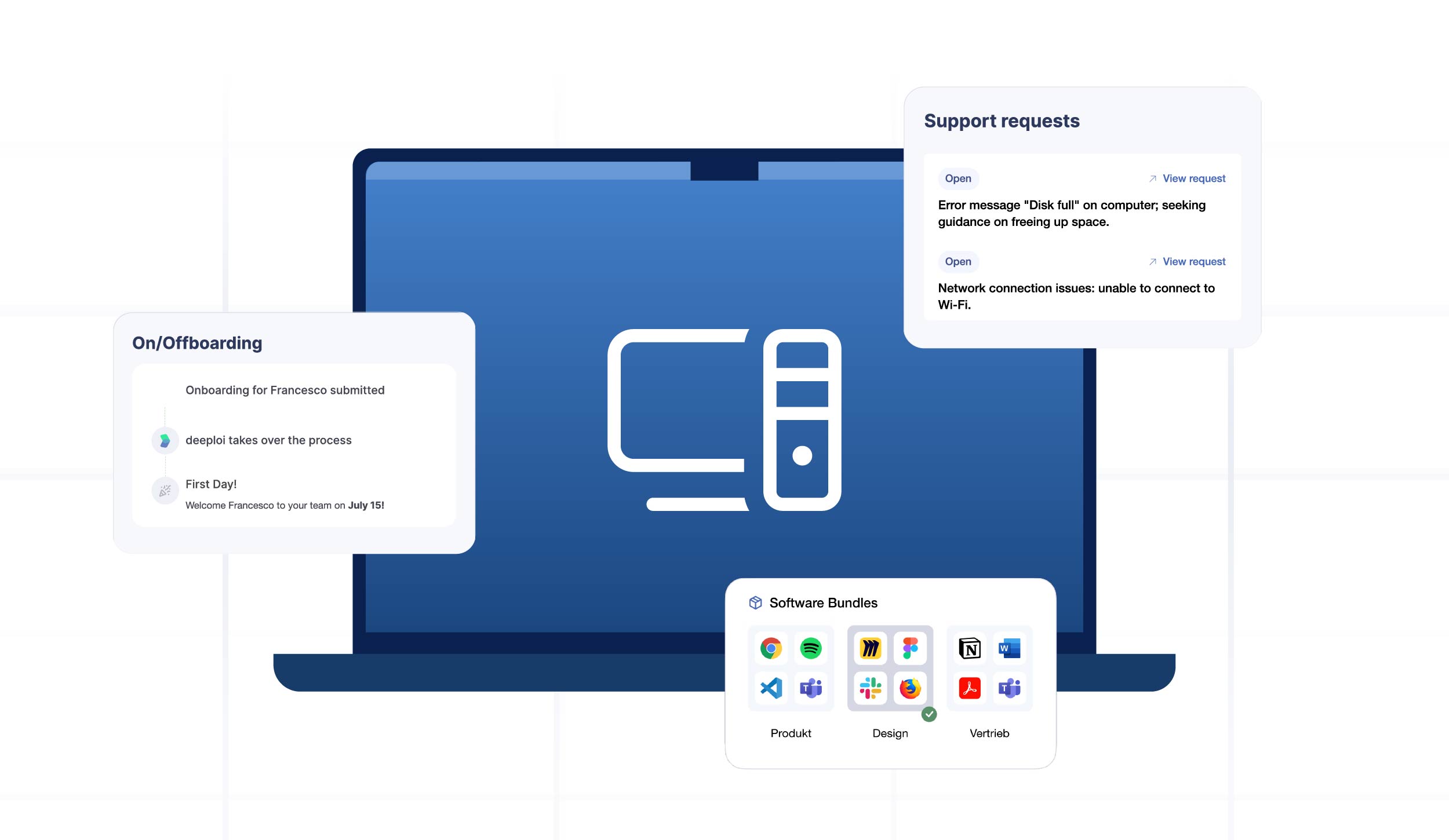
A fully managed all-in-one IT platform connects what stays separate with an MSP: automation and human support. Routine tasks like on- and offboarding, software distribution, updates, and security configurations run automatically in the background. For anything a person needs to handle, a German- and English-speaking helpdesk staffed by IT experts is on hand. So the difference from a pure MSP isn't whether there's support, but how much routine runs automatically before anyone has to step in. And the difference from a pure RMM tool, which an internal admin at your company would have to operate themselves, is that here the provider does the work, not you.
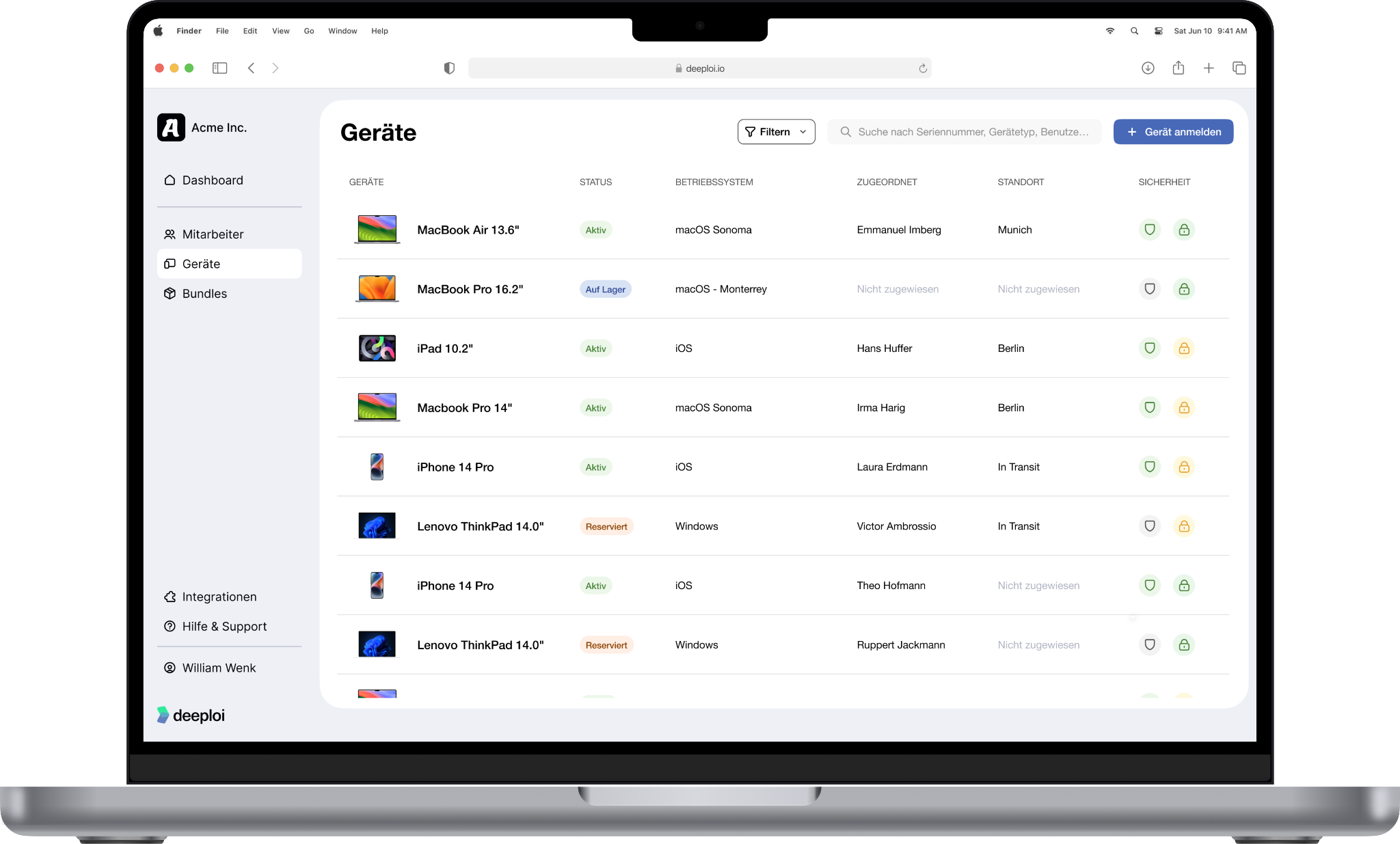
deeploi is one example of this model: the platform automates on- and offboarding and connects HR systems like Personio, FactorialHR, and HiBob directly. At the same time, a support team helps your employees with specific issues. So you get the relief of a managed model and the speed of automation in one, instead of having to choose between them.
How to choose the right IT provider alternative
Three criteria structure your decision: company size, internal IT expertise, and growth dynamics.
If you have fewer than ten employees and only occasional IT needs, a local provider you bring in for specific projects is often enough. Once you grow and IT tasks come up daily, the move to a fixed model pays off. Here, internal expertise becomes the deciding question.
If you have someone on the team who can handle MDM (mobile device management), patches, and software rollouts themselves, a Managed Service Provider with a good SLA is a fit. If that person is missing, or should really be focusing on something else, you need a model that does the work rather than just handing you the tools.
When HR managers or founders take on IT on the side, they're the classic accidental IT owners: people who suddenly find themselves responsible for IT without any IT background. They need real relief, not another tool they have to operate themselves. Anyone who has deliberately decided against building their own IT team is most likely to reach the goal with a fully managed all-in-one IT platform like deeploi. And if you're growing fast, you should also watch for scalability: a model that works at 30 employees but hits its limits at 100 just pushes the problem down the road.
{{cta}}
deeploi as an IT provider alternative with no hidden costs
If you've decided on an all-in-one IT platform, deeploi gives you a finished setup rather than another implementation project. The difference from the traditional IT provider shows not just in the price, but in the whole model behind it.
.jpg)
Instead of having your IT managed externally for a surcharge, you reduce the effort for good. On- and offboarding, software distribution, updates, and security configurations run automatically in the background, instead of landing as a new ticket every time.
Beyond the platform, deeploi doesn't hand you yet another isolated tool, but a central place where your IT comes together. Devices, software, security, and support are connected there, instead of being scattered across different providers and tools.
Over 200 companies of various sizes and industries already rely on deeploi, including Instaffo, Planet A Foods and trawa.
{{quote}}
ease was able to cut its IT costs by 40% and reduce the onboarding time for new employees from up to two hours to just five minutes.
Conclusion: finding the right IT provider alternative
Anyone who simply swaps one traditional IT provider for another often doesn't solve the real causes of high costs, slow processes, or missing transparency. What matters isn't the provider, but the operating model behind it. While small companies can get by with a traditional provider, growing SMBs frequently benefit from managed services or a centralized IT platform like deeploi, with automated processes and predictable costs.
{{cta}}
FAQ
What's the difference between an all-in-one IT platform and a Managed Service Provider?
Both take over managing your IT; the difference is in the degree of automation. Many Managed Service Providers work largely by hand, meaning devices, policies, and software are maintained manually. An all-in-one IT platform like deeploi automates that routine, namely onboarding, offboarding, software distribution, and updates, and adds a helpdesk for the cases a person needs to handle. deeploi is one example of this model, combining automated processes with personal support.
What happens to Microsoft licenses when you switch providers?
Microsoft 365 is usually sold through the CSP model in a business context, so your licenses are tied to your current partner. When you switch, they're generally transferred to the new partner or signed anew. Before you cancel, check which licenses you're running and what terms or renewal dates are attached to them, so nothing expires unintentionally or gets billed twice during the transition.
Do I even still need an IT provider at 30 employees?
From 30 employees onward without in-house IT expertise, a traditional IT provider built on project and hourly work often no longer fits everyday life, because IT tasks then come up daily and should run predictably. A managed model, such as a Managed Service Provider or an all-in-one IT platform, usually makes more sense. Anyone handling IT on the side above all needs automation and a helpdesk that catches the daily issues, rather than more project work with unpredictable invoices.
Is an all-in-one IT platform cheaper than a traditional IT provider?
Traditional IT providers usually bill by the hour, often in the range of about 100 to 200 euros per hour, and every ticket stays hard to plan. An all-in-one IT platform works instead with a fixed per-user flat rate that makes your costs predictable. More decisive than the hourly rate alone are planning certainty and the degree of automation, because automated processes cut the effort for good rather than rebilling it with every visit.