





Direct Answer
Most small and mid-sized companies overpay for software because they enter a renewal without usage data, a benchmark, or a fallback plan. Better terms start with preparation: one overview of every license and what it costs, honest usage numbers, and a conversation that begins around 90 days before the contract rolls over. With that in hand, you can ask for flexible seat counts, a price cap, and a clean exit instead of accepting whatever the renewal email proposes. Not every vendor will move, so this guide also shows where your effort pays off first.
Key Takeaways
Pull last-login reports for your five largest tools this week and cancel every seat with no activity in 60 days.
Put a 90-day pre-renewal reminder in a shared calendar for every contract you hold, starting today.
Ask for a renewal price cap in writing on your next contract, and treat 3 to 5% as your target.
Name one owner per vendor relationship, even if IT is not their job title.
Request one competing quote before every major renewal, whether or not you plan to switch.
Why do software renewals quietly drain your budget?
Because nothing visibly breaks. The invoice arrives, finance pays it, and the tool keeps working. The money leaks out in four places: auto-renewals that pass unnoticed, seats nobody uses, annual price increases that compound, and contract terms that make leaving harder than staying.
Auto-renewal is the default, not the exception. Common Paper's 2026 contract analysis found that 87% of cloud service agreements contained auto-renewal clauses, up from 85% in 2024, and that around 70% of them required notice of non-renewal 30 days before the term ends (Common Paper). Miss that window by a week and you have bought another full year, at whatever price the vendor set.
Waste is also getting worse rather than better. In Flexera's 2026 survey of 512 IT asset management professionals, 43% said their organization's wasted SaaS spending had grown over the previous year (Flexera). The pattern behind that number is familiar to anyone who has grown a team quickly: you add seats during hiring sprints and nobody removes them afterwards.
Procurement teams feel both sides of this. In Spendflo's 2025 survey, 45% of respondents named vendor price increases as a renewal challenge, and 35% pointed to poor visibility into how tools are actually used (Spendflo). Those two problems feed each other. Without usage data you cannot push back on a price increase with anything stronger than an opinion. The same blind spot shows up on service contracts, which is why it helps to know what each invoice line item covers before you approve it.
Signs you are overpaying right now
Run through this list. Three or more checks mean there is money on the table.
- You pay for seats that nobody has logged into for 60 days or more.
- Nobody can say what each tool costs per person per month without digging through invoices.
- Contract end dates live in someone's inbox rather than a shared calendar.
- Accounts are still active for people who left months ago.
- Two tools in your stack do roughly the same job for different teams.
The first point about unused seats is rarely a small rounding error. Zylo's 2026 SaaS Management Index found that 46% of licenses in the average organization's portfolio went unused (Zylo). If your own numbers are anywhere near that, right-sizing before you negotiate will save you more than any discount a vendor offers.
What do you need before you sit down with a vendor?
Preparation is where the negotiation is actually won. Before you write a single email, gather three things: a complete license inventory, real usage numbers, and your contract timeline with notice periods marked.
Build a single overview of all your software and costs
Scattered spreadsheets and a dozen vendor dashboards leave you guessing, and guessing is a weak position. You want one list with the tool name, the plan, the number of seats, the cost per seat, the renewal date, and the internal owner.
The volume is the problem. BetterCloud's 2025 survey of roughly 600 IT professionals found companies running an average of 106 SaaS applications, down from 112 in 2023, and 70% of respondents said they would prefer a single platform for discovering, managing, securing, and optimizing spend across that stack (BetterCloud). Nobody keeps a hundred subscriptions straight in a spreadsheet that gets updated twice a year.
This is the practical case for a centralized view of devices, users, software, and accounts. Platforms built for small and mid-sized teams, deeploi among them, pull licenses, accounts, and hardware into one place so the overview exists before you need it rather than being rebuilt in a panic each December. If you would rather start manually, our walkthrough on auditing your SaaS stack at year end covers the inventory step in detail, and the IT cost per employee calculator helps you sanity-check the total against typical benchmarks.
Know your usage numbers cold
Shelfware means licenses you pay for that nobody opens. It is the single strongest talking point you can bring to a renewal call, because it is factual and the vendor can verify it.
Vertice reported that 62% of the SaaS licenses in its analyzed data were unused or underutilized as of the third quarter of 2026, slightly up from 61% at the end of the previous quarter (Vertice). Your own figure matters more than any benchmark. Pull last-login and activity reports from the admin consoles of Google Workspace or Microsoft 365, then do the same in the five tools you spend the most on. Most admin panels export this as a CSV in under five minutes.
Write the result as a single sentence you can say out loud: "We pay for 85 seats, 52 people logged in during the last 30 days." That sentence changes the conversation from a discount request into a correction of the facts.
Which vendors are worth negotiating with?
Not all of them. Sort your list by annual spend and work on the top five, then handle everything else by right-sizing seats, moving to a cheaper plan, or switching from monthly to annual billing where the discount is published.
Tools with self-service list pricing on a public page rarely negotiate below a certain volume. Anything sold through a salesperson almost always has room. Friction is common at this stage: in a Futurum Intelligence survey of 895 IT decision-makers, 18% named pricing and terms negotiations as a hurdle in acquiring enterprise software (The Futurum Group). Expect the back-and-forth and budget time for it.
What should you actually ask for in a negotiation?
Price is the obvious ask and often the least valuable one. The terms around the price decide what the contract costs you over three years.
Volume discounts and flexible seat counts
Tie your pricing to how your team actually changes, not to a headcount someone guessed at twelve months ago. Useful asks include a true-up and true-down clause so you can reduce seats at renewal without penalty, a mid-term adjustment window if you cut headcount, and a locked per-seat rate that applies to new hires so growth does not reset your discount.
If you are adding people, trade that growth for a better rate now. A vendor would rather commit to a lower per-seat price across 80 future seats than lose 50 today.
Shorter terms, price caps, and exit clauses
Multi-year deals are fine when they buy you something concrete. They become expensive when they lock a growing team into a plan that no longer fits. Ask for one of these three protections, ideally all three.
- A price cap. Limit any renewal increase to a fixed percentage. Software vendors surveyed by Teneo in early 2026 expected like-for-like renewal prices to rise by an average of 7.6% during the year (Teneo), so a cap of 3 to 5% is a reasonable counter.
- A shorter term, or a break clause. Twelve months with an option to extend beats 36 months with no way out.
- A documented exit. Data export in a usable format, a defined deletion process, and no migration fee. Thinking about the exit early is also the cheapest way to reduce vendor lock-in across your stack.
Terms beyond price
Before you sign, check these points. They cost nothing to request during negotiation and a lot to fix afterwards.
- A data processing agreement (DPA, or AVV in Germany) that matches how you actually use the tool.
- Where data is stored and processed, and which sub-processors are involved.
- Support hours, response times, and what happens when the vendor misses them.
- Export and deletion rights when the contract ends.
- The cancellation notice period, written in your calendar the day you sign.
One caution: this is practical guidance, not legal advice. Have a lawyer review anything that carries meaningful financial or data protection risk.
Use alternatives and timing as leverage
A credible alternative is the only pressure that reliably works. Get a comparable quote from one competitor, even if you fully intend to stay. Checking whether two overlapping tools can become one has the same effect, and a structured comparison such as Slack versus Microsoft Teams for smaller teams shows the level of detail that makes a quote request convincing.
Be realistic about switching, though. In a 2026 survey of 300 US SMB decision-makers, 80% said software and technology costs had hurt profitability in the previous month, yet 29% said high upfront costs stopped them moving to more efficient software (Expert Market). Vendors know migration is painful, which is exactly why your alternative needs to be researched rather than bluffed.
Timing helps too. Sales teams commonly have more room near the end of their quarter or financial year. Treat that as a pattern worth testing, not a rule.
What should you say? A short negotiation script
Keep the renewal email to five short blocks. Friendly, factual, no theatrics.
- Current usage. "We hold 85 seats. 52 were active in the last 30 days."
- Planned headcount. "We expect to reach about 70 users by Q3."
- The specific ask. "We would like to renew at 60 seats, with the same per-seat rate for additional users and a renewal increase capped at 4%."
- The alternative. "We are also evaluating [competitor], who quoted us X per seat."
- The deadline. "Our notice period ends on March 1, so we need a response by February 14."
Send it from a named person, not a shared inbox, and copy whoever signs the invoice. That single detail tends to speed things up considerably.
How do you keep control after the deal is signed?
A good renewal lasts twelve months. Keeping control is a habit. Three things make the difference: someone owns each vendor relationship by name, usage gets reviewed quarterly, and accounts disappear when people leave.
That last point is where the quiet leak starts again. If a license stays assigned after someone's last working day, you pay for it until the next renewal, and you also carry an open account into your security surface. Automated offboarding handles this: when a leaving date flows in from a connected HR system, app accounts are deactivated and their licenses are freed as part of the exit flow. Keeping that cost line clean also makes the next round of IT budget planning for 2027 considerably less guesswork.
Create a renewal calendar and review cycle
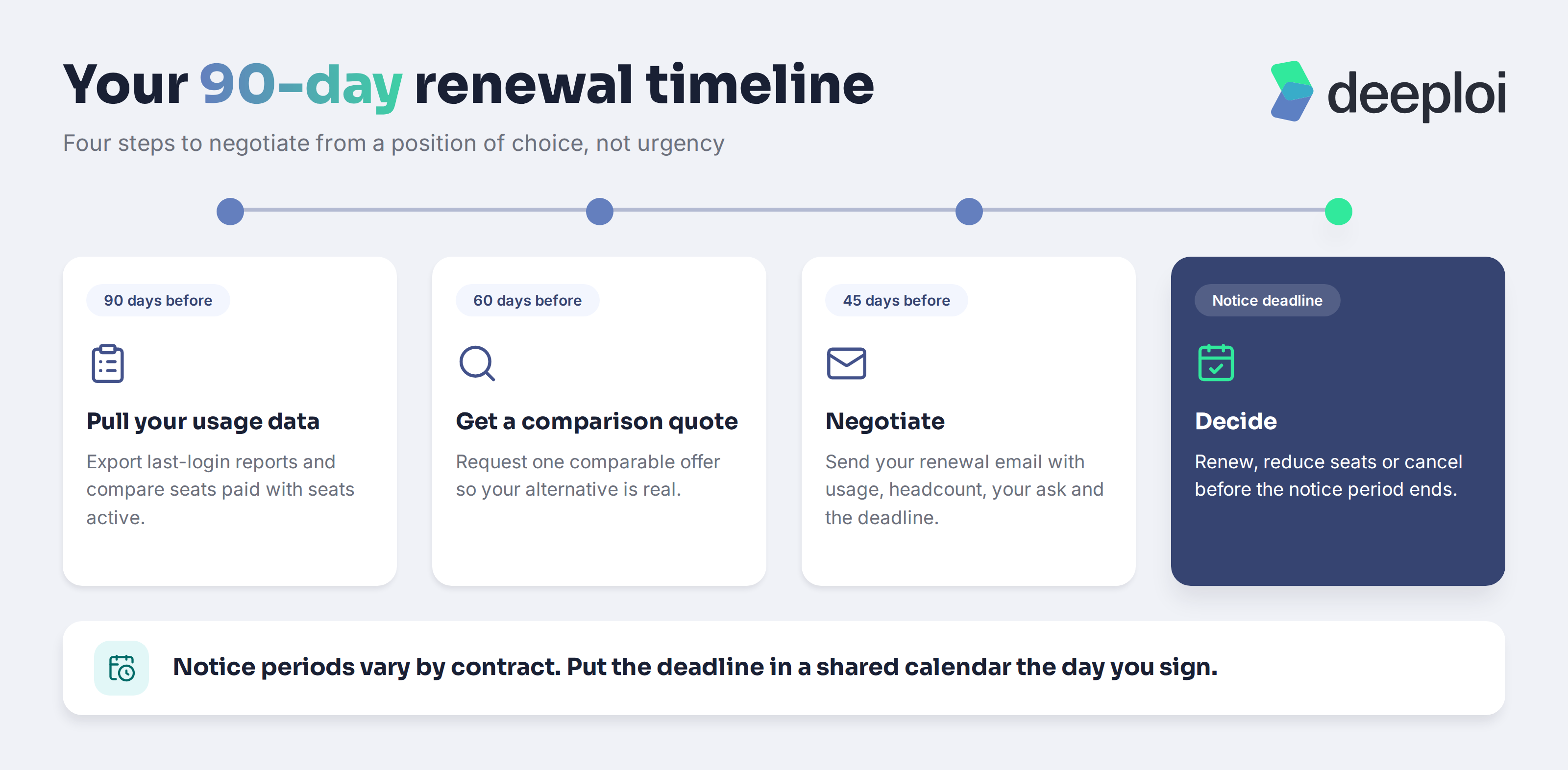
Put every contract end date in a shared calendar, then set a reminder 90 days earlier. Three months gives you time to pull usage data, request a competing quote, and still cancel within the notice window if the talks go nowhere.
A simple schedule works well: pull usage data 90 days before renewal, request a comparison quote at 60 days, send your renewal email at 45 days and decide before the notice deadline.
Add a 30-minute quarterly review where the owner of each top-five vendor reports seats held, seats active, and cost per active user. It is a small meeting with an outsized effect, and it applies to service contracts as much as software: the same discipline is what makes IT support pricing comparable between providers. More practical guides on running IT without a dedicated team live in the deeploi IT magazine.
Frequently asked questions
How much can an SMB realistically save by negotiating software contracts?
It depends on your size and how many tools you run. The fastest savings almost always come from removing unused seats rather than from the discount itself, because you control that side completely. Price negotiation is the second step. Avoid planning around a fixed percentage until you have measured your own usage.
Should I negotiate directly or hire a procurement consultant?
For most teams under 100 people, a well-prepared internal person with accurate usage data handles this fine. Consultants earn their fee on complex enterprise agreements, multi-year commitments, or when you are negotiating several large contracts at once. Preparation beats experience in a first negotiation.
What if the vendor will not move on price?
Ask for value instead. Waived onboarding or implementation fees, a shorter term, extra seats at the current rate, a better support tier, or free access to a higher plan for a trial period are all realistic. For self-service tools with fixed public pricing, your levers are seat count, plan level, and billing cycle.
When is the best time to start negotiating?
About 90 days before renewal. That leaves room to pull your usage data (90 days before), get a comparable quote (60 days before), send your renewal email (45 days before) and still give notice if you decide to leave. Starting two weeks out means you negotiate under pressure, and vendors can tell.
Which contract terms matter besides the price?
The data processing agreement, where your data is stored, support response times, your rights to export and delete data when you leave, and the cancellation notice period. These five decide how much freedom you have at the next renewal.