






Direct Answer
Digitalization offers SMEs major opportunities, but limited resources, lack of IT expertise, and growing complexity often slow progress. With a clear strategy, automated processes, and solutions like deeploi, companies can build more efficient, secure, and scalable IT without having to establish an in-house IT team.
Key Takeaways
- Limited resources and missing IT expertise are slowing progress. Many SMEs in Germany are falling behind when it comes to digitalization, while the digital gap between large and small companies continues to widen.
- IT infrastructure, software management, support, and data security form the foundation of successful digitalization. Modern solutions automate time-consuming processes and noticeably reduce the workload for your team.
- Funding opportunities are available. Federal and state programs support SME digitalization through initiatives such as go-digital, ERP development loans, and regional grants.
- deeploi takes over your operational IT management, from automated onboarding and centralized device management to fast, reliable support, so you can focus on your core business.
Digitalization offers companies enormous opportunities: higher efficiency, lower costs, and entirely new business models. At the same time, many small and medium-sized enterprises struggle with limited resources and a lack of IT expertise. This article shows you a practical path to effective digitalization, from assessing your current setup to concrete actions and successful implementation with measurable results.
Digitalization for SMEs: Where does the German mid-market stand?
Germany’s SME sector is the backbone of the economy. More than 99% of all companies are small or medium-sized, they provide 58% of all jobs, and generate nearly one third of total revenue. Yet when it comes to digitalization, there is still significant catching up to do.
Recent studies paint a mixed picture. According to the KfW Digitalization Report 2024, 35% of mid-sized companies have carried out digitalization projects, an increase of five percentage points compared to the pre-pandemic period. At the same time, the data reveals a growing imbalance. While larger mid-sized companies with more than 50 employees increased their share of digitalization spending from 37 to 41%, the share among smaller companies dropped from 31% to just 20%.
The challenges are diverse. A lack of IT expertise, time constraints, and limited budgets slow down progress. Another factor adds pressure: digitally active companies are more likely to struggle with filling open positions, especially when specific digital skills and qualifications are required.
Digitalization in the SME sector is developing unevenly. Early adopters are already benefiting from efficiency gains and new business models, while others are losing ground. In the long term, this trend threatens the competitiveness of many SMEs in Germany.
More than 200 companies are already digitalizing their IT processes with deeploi. Book a consultation and learn how you can automate your IT operations, even without an in-house IT team.
The core areas of digitalization for SMEs
Successful digitalization in mid-sized companies is built on four closely connected areas that together create a modern and efficient IT environment. The goal is to work more efficiently, make better decisions, and remain competitive over the long term.

IT infrastructure and workspace management
A stable and scalable IT infrastructure is the foundation of digital workflows in small and medium-sized companies. This includes not only hardware and networks, but above all the centralized management of end devices and digital workspaces.
- Cloud technologies and mobile device management solutions make it possible to configure, monitor, and secure laptops, smartphones, and tablets centrally, regardless of whether employees work from the office or remotely.
- Instead of operating their own servers, companies benefit from high availability, automatic updates, and professional security standards, without having to carry high investment and maintenance costs themselves.
- At the same time, scalable IT systems replace isolated single solutions. New users, locations, or business units can be integrated flexibly without having to rebuild the existing infrastructure. This allows IT to grow alongside the company and remain powerful, secure, and cost-effective in the long run.
Software and license management
Uncontrolled software growth is a real challenge for many SMEs. Who has which licenses? Which tools are actually being used? Where are subscriptions about to expire? Structured software management creates transparency and control.
- Centralized platforms allow all app packages to be managed in one place.
- Employees get easy access to approved applications, while IT owners retain full visibility into costs and usage.
- Automated updates and patches ensure that all systems stay current and secure without manual effort.
This level of automation not only reduces operational work but also minimizes security risks caused by outdated software.
IT support and helpdesk
When a laptop crashes or access to a critical tool is missing, every minute counts. Technical issues such as device failures or missing access rights can significantly disrupt workflows and should be resolved quickly.
Responsive IT support is therefore essential. Modern helpdesk setups rely on clearly defined processes, ticketing systems, and transparent communication. Requests are documented, prioritized, and handled in a traceable manner. In addition, proactive monitoring helps identify and resolve potential issues early, before they impact day-to-day operations.
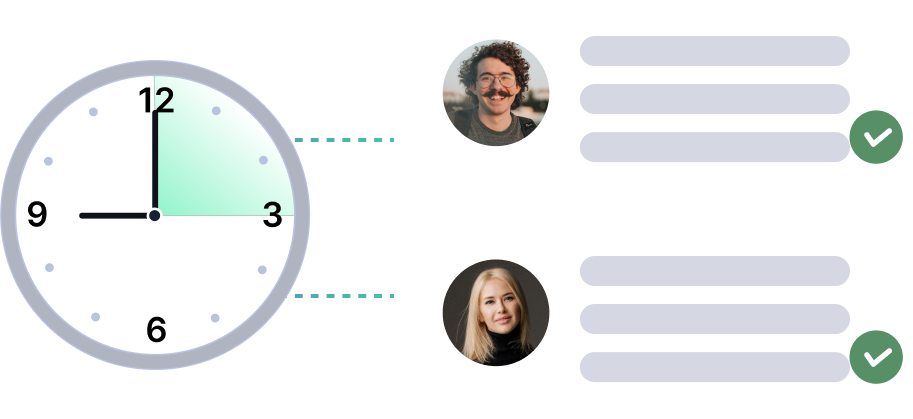
With deeploi, you get a fully fledged human IT support team that responds quickly and works in a structured way. An average response time of 12 minutes, transparent ticket handling, and proactive monitoring ensure that technical issues do not slow your team down.
Data backup and disaster recovery
Data loss caused by hardware failures, cyberattacks, or human error can be existentially threatening for companies. This makes automated backup strategies and clearly defined emergency plans all the more important. Modern cloud backup solutions continuously secure data and enable fast recovery when it matters most.
Disaster recovery defines processes and responsibilities in the event of a major IT incident and ensures that your company can return to operational capability quickly, even after serious disruptions.
With deeploi, you benefit from automated backup solutions as well as the ability to remotely lock or wipe lost devices. This ensures your data is continuously protected and can be restored quickly in an emergency.
Benefits of digitalization for small and medium-sized enterprises
Digitalization offers numerous advantages for small and medium-sized enterprises and has become a key factor for remaining competitive today.
- Increased efficiency and time savings: Digitalization helps SMEs make internal processes faster and more structured. Many workflows such as invoicing, scheduling, or document management can be automated. This saves valuable time for employees and allows them to focus more on strategic tasks and core business activities.
- Cost reduction through optimized processes: Digital solutions reduce costs in the long term by using resources more efficiently. Lower paper consumption, reduced administrative effort, and better coordinated production or delivery processes enable companies to operate more economically. For SMEs in particular, this is a critical factor for sustainable success.
- Better decision-making through data and analytics: Digital systems provide valuable insights into customer behavior, sales figures, and market trends. These data points help companies make well-founded decisions and continuously refine their offerings.
- Innovation and new business models: Digitalization creates opportunities for new products, services, and business models. Whether digital platforms, automated services, or new sales channels, SMEs can grow through innovation and position themselves for the future.
- More flexible working models and greater employer attractiveness: Digital tools enable mobile work and remote setups, making work environments more flexible. This allows companies to respond more quickly to change and become more attractive employers, especially for younger professionals.
Challenges for SMEs in digital transformation
While digital transformation opens up many opportunities for small and medium-sized enterprises, it also comes with challenges. A survey conducted by YouGov Deutschland GmbH shows that the biggest obstacles are costs, a lack of know-how, time constraints, and concerns around data protection and security.

Limited financial resources
For nearly half of all companies, costs are the biggest obstacle to digitalization. Digital initiatives require investment in new software, modern IT infrastructure, and cybersecurity measures. Hiring an internal IT specialist is also expensive, with average annual costs of around 55,000 EUR plus social security contributions. For many SMEs, balancing these expenses while keeping daily operations running is a major challenge.
Traditional IT service providers often rely on opaque pricing models, hidden fees, and project-based billing that is difficult to predict and budget for.
deeploi takes a different approach with transparent pricing models and clear cost structures, so you know exactly what to expect from the start.
Lack of IT expertise
Missing know-how is one of the most common reasons why digitalization projects fail or never get started at all. Many companies lack specialized staff or experience to introduce digital technologies strategically. Without sufficient expertise, there is a high risk of choosing the wrong tools or failing to unlock the full potential of digital solutions.
Selecting the right technologies, integrating different systems, and assessing security risks all require expertise that many SMEs simply do not have. This often leads to uncertainty and hesitation when making critical digitalization decisions.
With deeploi, you do not need to build this expertise internally. The platform automates complex IT tasks based on proven standards and security practices. This gives you professional IT structures without having to set up and manage your own IT team.
Lack of time in day-to-day operations
Time is one of the scarcest resources in mid-sized companies. Founders and managing directors who have to manage IT on the side, often referred to as accidental IT owners, are frequently overwhelmed by this additional responsibility.
As a result, IT projects are postponed, implemented half-heartedly, or never move beyond the planning stage. Employees spend valuable time dealing with technical issues instead of focusing on their actual responsibilities.
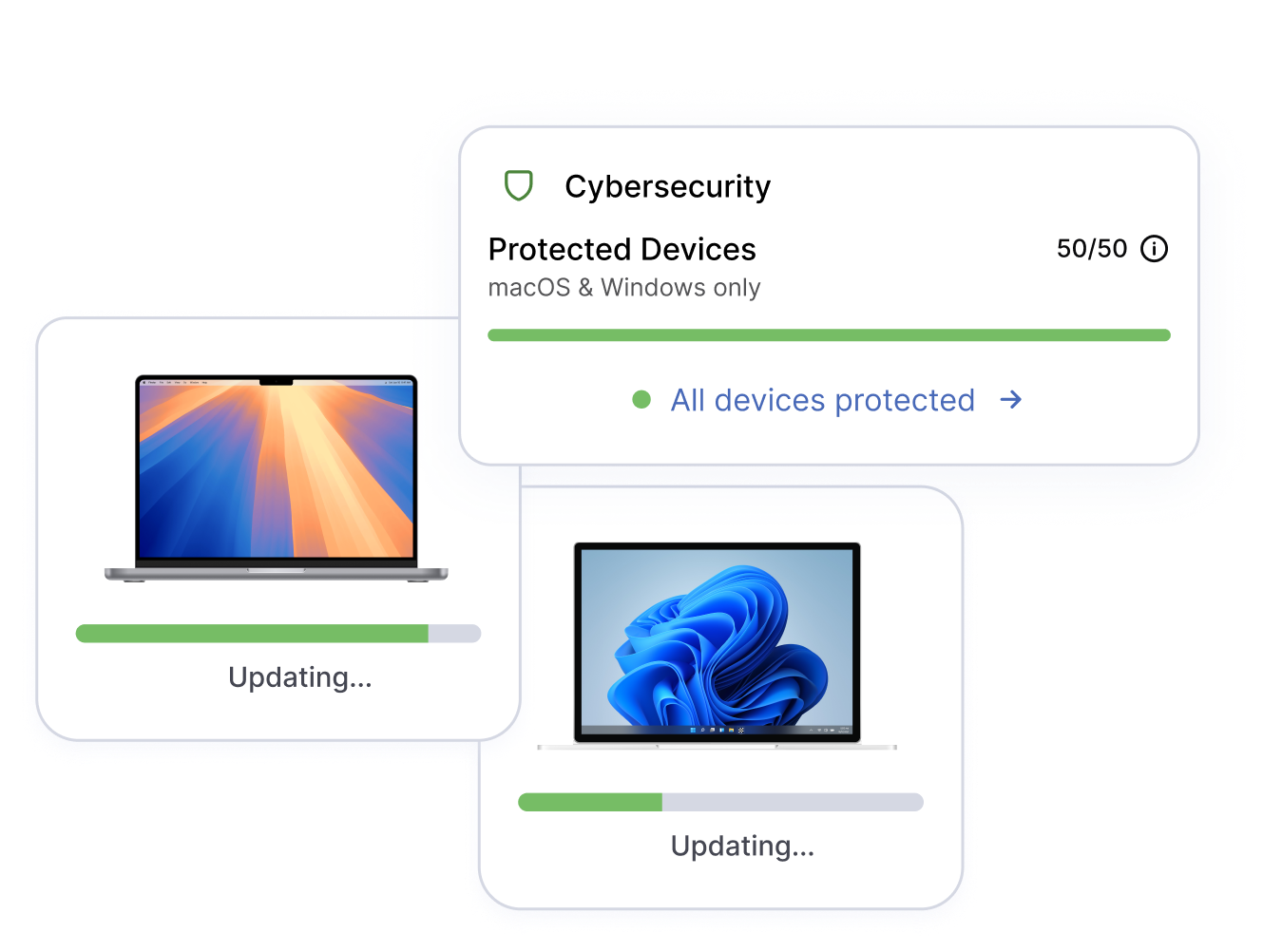
The solution lies in outsourcing to specialized partners like deeploi, who provide both a platform and the necessary expertise.
deeploi automates your IT processes without requiring you to build internal capacity, saving time and preserving valuable resources.
Concerns about data protection and IT security
As digitalization increases, so do the requirements for data protection, information security, and regulatory compliance. SMEs must meet high standards when using cloud services or processing customer data.
At the same time, small and medium-sized companies are particularly vulnerable. They often lack the personnel and technical security resources available to large enterprises, which makes them more attractive targets for cyberattacks.
Reduce IT complexity and regain focus: Let deeploi take care of your IT so your team can focus on what truly matters. With automated IT infrastructure, transparent costs, and built-in security standards, deeploi reduces operational effort by up to 97% and creates a stable foundation for sustainable growth.
Funding opportunities for SME digitalization
You do not have to finance the digitalization of your company on your own. Federal and state governments in Germany offer a wide range of funding programs and support initiatives that cover both consulting and implementation. These programs provide favorable conditions for many types of digital initiatives, from cloud solutions and software to IT security.
At the federal level, programs such as go-digital are available. They specifically support consulting services, IT security, digital business processes, and digital market development. This allows SMEs to partially offset the costs of external consulting and technical implementation.
In addition, SMEs can access subsidized loans and grants for digital investments through programs such as the ERP Digitalization Loan or the ERP Innovation Loan, which also cover hardware and software-related measures.
Another important federal initiative is the Zentrale Innovationsprogramm Mittelstand (ZIM). It supports research, development, and technological innovation in small and medium-sized enterprises and strengthens their long-term competitiveness.
Alongside nationwide programs, there are numerous regional funding schemes offered by individual federal states. Depending on location, these may include grants for digitalization projects, IT infrastructure, process automation, or employee training. In many cases, a significant portion of project costs can be covered.
For example, Schleswig-Holstein supports SMEs through the program "Förderung innovativer Digitalisierungsmaßnahmen in kleinen Unternehmen (DKU)", while Bavaria offers the Digitalbonus.Bayern. These programs are typically aimed at companies with fewer than 50 employees and an annual turnover of up to 10 million euros.
The federal government’s funding database, provided by the Federal Ministry for Economic Affairs and Climate Action, offers a comprehensive overview of all current funding programs at the federal, state, and EU level.
Digitalization strategy for SMEs: a step-by-step approach
Successful digitalization requires a clear plan. This step-by-step strategy helps you take a structured approach and use your resources effectively.
Phase 1: Assessment and goal definition
Before investing in new technology, analyze your current situation. Which IT systems are already in use? Where are the biggest pain points? Which processes consume the most time or money?
Next, define clear goals. Do you want to reduce costs, speed up processes, improve employee satisfaction, or develop new business models? The more concrete your goals, the easier it will be to measure success later on.
Phase 2: Selecting the right solution
Based on your assessment, you can now choose the appropriate technologies and partners. Pay attention to the following criteria:
- Does the solution scale with your company?
- Can existing systems be integrated?
- Is it usable for non-technical employees?
- How fast and competent is the support?
- Are costs and services clearly defined?
All-in-one solutions offer a major advantage. You work with a single provider, and all components interact seamlessly. This significantly reduces complexity and interface issues.
deeploi brings everything together in one platform, without the need to coordinate multiple vendors: device management, hardware procurement, software management, support, and security.
Phase 3: Implementation and change management
Implementation should happen step by step. Start with quick wins that deliver visible results early and motivate your team. This could be automated onboarding or the introduction of a centralized helpdesk.
Early successes build trust in the digital transformation process and make it easier to roll out further measures.
Phase 4: Monitoring and continuous improvement
Digitalization is not a one-time project but an ongoing process. Regularly measure whether you are achieving your goals. Have process times improved? Have costs decreased? Has employee satisfaction increased?
Clear KPIs make success measurable and highlight opportunities for optimization.
Best practices for successful SME digitalization
The following principles help ensure long-term success in digital transformation:
- Think holistically. Isolated solutions often create more work than they save. An all-in-one platform reduces long-term effort and costs through integrated processes.
- Leverage external expertise. You do not have to do everything yourself. Experienced partners help you avoid mistakes and move faster without building an internal IT team.
- Automate repeatable processes. Anything that happens regularly, such as onboarding and offboarding, software updates, or backups, should be automated.
- Invest in security and cybersecurity. Automated updates and centralized security configurations are essential for every SME. A single security incident can be existentially threatening.
- Stay flexible. Technology evolves quickly. Choose solutions that can grow and adapt alongside your business.
deeploi provides a scalable platform that grows with your company, without requiring you to rebuild your IT infrastructure.
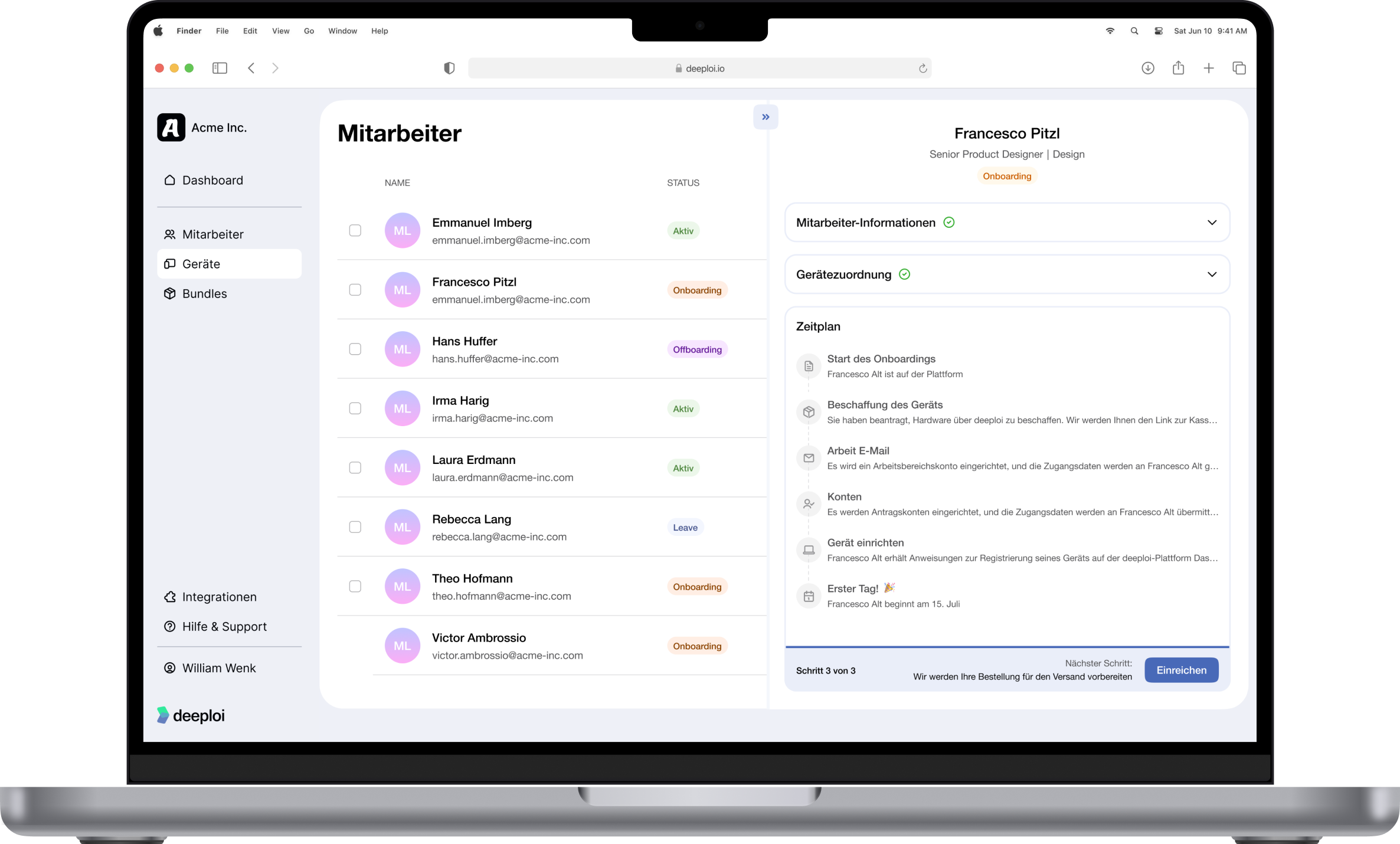
The strategy is clear. With deeploi, you can put it into practice immediately, from automated onboarding and centralized device management to professional IT support.
Digitalization without operational burden: modern IT with deeploi
As an all-in-one IT platform, deeploi reduces complexity and supports a wide range of digitalization initiatives.
What deeploi takes care of for you:
- Automated onboarding and offboarding: New employees receive ready-to-use devices in 3 to 5 minutes instead of 2 to 3 hours of manual work. All applications and access rights are preconfigured.
- Centralized device management (MDM): All laptops, smartphones, and tablets are managed, secured, and updated centrally, regardless of where your employees work.
- Software management: Automatic installation and updates of all required applications, with full transparency over licenses and costs.
- IT support with a 12-minute response time: Your team receives fast, reliable help for IT issues, with an average response time of 12 minutes instead of hours or days.
- Security and compliance: ISO 27001 certified, GDPR compliant, and backed by professional cybersecurity solutions.
The result
- Up to 95% less manual IT effort
- Up to 99% faster onboarding
- Up to 75% cost savings
.png)
More than 200 companies are already digitalizing their IT processes with deeploi. In a no-obligation conversation, you can find out how to manage your digital transformation without internal IT resources.
Conclusion: implementing digitalization successfully in SMEs
Digitalization is no longer optional for small and medium-sized enterprises that want to remain competitive. While digital maturity still varies widely, one thing is clear: the advantage belongs to those who take action now.
You do not need to reinvent the wheel or build deep IT expertise internally. Successful digital transformation means:
- Setting priorities and taking a step-by-step approach
- Making use of funding programs and external expertise
- Choosing smart solutions that serve your organization, not the other way around
deeploi is built for exactly this purpose. The all-in-one platform removes technical complexity and manages your entire IT while you focus on your core business. This saves time, reduces costs, and creates peace of mind.
FAQ
Why do many SMEs struggle with digitalization?
The most common reasons are a lack of IT expertise, limited resources, and budget uncertainty. Many SMEs cannot find or afford IT specialists and feel overwhelmed by the complexity of technology decisions. In addition, many companies lack a clear digitalization strategy, which leads to isolated solutions and inefficient investments. Holistic approaches and collaboration with specialized partners are key to overcoming these challenges.
Which digital technologies are most relevant for SMEs?
Cloud services, automated device management (MDM), centralized software management, and professional IT support systems are particularly relevant for SMEs. Data analytics tools and artificial intelligence for process optimization are also becoming increasingly important. What matters most is not the number of tools, but that they work together seamlessly and solve real problems. All-in-one platforms like deeploi offer clear advantages over standalone solutions.
How does deeploi support SMEs in their digital transformation?
As an all-in-one platform, deeploi manages your entire IT landscape: automated onboarding and offboarding in 3 to 5 minutes, centralized device management, software management, IT support with an average response time of 12 minutes, and professional cybersecurity. You can reduce IT effort by up to 95% and lower costs by up to 75% compared to traditional providers. deeploi combines modern technology with real human support and turns fragmented IT into a structured, future-ready system.
Which funding programs are available for SME digitalization?
Federal and state governments offer a wide range of funding programs for digitalization projects. At the federal level, go-digital supports consulting, IT security, and digital business processes. The ERP Digitalization Loan provides favorable financing for IT investments. In addition, individual states offer their own programs, such as Digitalbonus.Bayern or the DKU program in Schleswig-Holstein. The federal funding database provides a complete overview of all available programs.

.png)