





Direct Answer
Identity and access management (IAM) controls who can reach which systems and data across the full lifecycle of a digital identity, from onboarding to complete revocation at offboarding. For a European SMB, what matters most is that the platform is GDPR compliant, hosted in Germany or the EU, and that somebody actually runs it, for example deeploi as an All-in-One IT Management Platform.
Key Takeaways
- From day one to the last day: Identity and access management governs the entire lifecycle of a digital identity, from the first login to the on-time removal of every permission at offboarding.
- Where it runs lowers the risk: GDPR Article 32, hosting in Germany or the EU, and support in your own language make a European provider the safer choice.
- Operations decide, not the tool: Most IAM projects fail on capacity, not software. Nobody has time to keep permissions current.
- With deeploi, operations are part of the deal: The All-in-One IT Management Platform pairs IAM automation with hands-on expert support, ISO 27001 certified and GDPR compliant.
What identity and access management means for a growing SMB
Identity and access management, or IAM, is the umbrella term for every process and rule you use to manage the digital identities in your company. A digital identity is any user account that gives a person access to your systems.
IAM answers two questions:
- Authentication: who are you? The system confirms the identity, through a login and MFA.
- Authorization: what are you allowed to do? It defines which systems and which data that person can reach.
IAM follows what is known as the joiner-mover-leaver principle. An identity is created when someone joins, it changes when they move into a new role, and it has to be fully deactivated when they leave.
The four areas of IAM, and what SMBs actually need
Professional IAM platforms separate four categories:
- Access management: central login through single sign-on (SSO, one login for every tool) and protection through multi-factor authentication (MFA, a second confirmation at login, usually through an app).
- Identity governance and administration (IGA): defines who gets which permissions and keeps a traceable record of it.
- Privileged access management (PAM): tighter control over administrative and special rights.
- Customer IAM (CIAM): identity management for your customers, which most SMBs never need.
A company with 30 to 200 employees rarely needs these four areas as four separate tools. Four tools mean four contracts, four interfaces and somebody on your team who sets them up and keeps them current. The cost is rarely in the purchase, it is in running them. For most SMBs, the identity provider you already have (Microsoft 365 or Google Workspace) plus somebody who operates it is enough, and that is exactly where an integrated platform like deeploi fits.
Why a European SMB should choose a European provider
Several arguments point toward a provider based in Germany or the EU:
- GDPR obligation, Article 32: Article 32 of the GDPR requires technical and organizational measures to protect personal data. Active accounts belonging to former employees are a real liability. Anyone who keeps access to customer data for months after they stop needing it leaves the company exposed. The same principle applies to the data you keep about former employees.
- Data sovereignty: When identity and access data is hosted on servers in Germany or the EU, German and European data protection law applies to it throughout, with no detour through third-country transfer mechanisms.
- Support and contracts in your jurisdiction: Support in German or English, plus contracts and invoicing under German law, remove friction on the day something needs to move fast.
- Enterprise tools do not include the operations: Large international vendors such as Okta, JumpCloud and Microsoft Entra ID are technically strong, but they are built for companies that have their own IT department. What an SMB is missing is the operational layer: somebody who creates accounts, maintains roles, and removes every permission on the leaving date.
{{cta}}
What a good identity and access management setup has to deliver
For an SMB, the only question that matters day to day is whether the thing works. These are the criteria worth checking:
That last criterion is the real difference between buying software and buying IT as a service. A good setup also connects to your HR system, for example Personio, Factorial, HiBob or BambooHR, so the joiner-mover-leaver process never starts manually in the first place. deeploi meets that last criterion directly, because deeploi does the operational work and connects your HR system, instead of handing you software and wishing you luck.
Where identity and access management usually breaks down
In most SMBs the technology is already in place. The processes behind it are not. The result is security gaps, compliance exposure and a pile of manual work. Four failures come up again and again:
- Neglected offboarding: Accounts are not fully deactivated when somebody leaves. Former employees keep access to Slack, Google Drive or SaaS tools, sometimes for weeks or months.
- Privilege creep: Permissions are granted at every role change and never taken back. Over a year, people accumulate access far beyond what their job needs.
- IAM reduced to MFA: Multi-factor authentication gets treated as the whole answer. But MFA only addresses "is the right person logged in?", never "should this person still have access at all?"
- Oversized tool choices: An enterprise platform gets bought even though nobody has the capacity to configure and maintain it. The license renews while the tool gathers dust.
A concrete scenario: an employee leaves the company. Her Google account is deactivated, but Slack, the project management tool and the shared drive stay live. Nobody has a full list of her accounts, so nobody removes every permission. That gap is a GDPR risk, and closing it is exactly what end-to-end identity and access management does.
deeploi: identity and access management as part of your IT operation
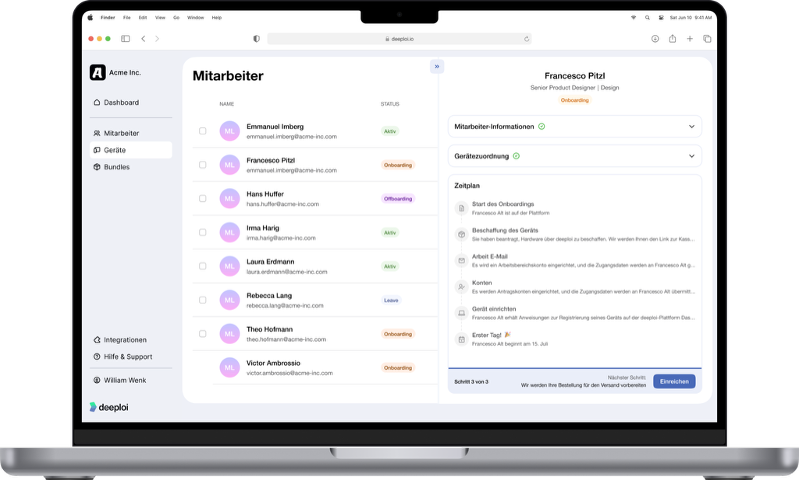
deeploi is an All-in-One IT Management Platform for SMBs, with or without an in-house IT team: device management, software deployment, patch management and IT support in one place, including identity and access management.
Important: deeploi does not replace your identity provider, whether that is Microsoft 365 or Google Workspace. The platform takes on the operational work behind it: creating accounts, assigning roles, and running offboarding on the date it is due. If you already run Microsoft Entra ID or Intune, deeploi sits on top of it rather than replacing it.
Onboarding takes 3 to 5 minutes with deeploi, offboarding 2 to 5 minutes, against the 2 to 3 hours the same work costs by hand. Implementation takes a few days to 2 or 3 weeks depending on company size, guided by the support team.
The same logic works from either starting point. Companies without their own IT team hand over the whole operation. Companies with an IT team take password resets and routine permission questions off their colleagues' plates, so those colleagues can work on the projects that need them.
When something does get complicated, IT support replies in German or English in an average of 12 minutes, against a 30-minute SLA. The first point of contact is Sam, deeploi's AI agent, available 24/7 with an instant reply. Sam does more than answer: he acts directly in the workspace, suspending users or managing group memberships, and every action he takes needs sign-off from your IT owner. Anything he cannot resolve goes straight to the human expert team.
The facts behind the trust:
- ISO 27001 certified and GDPR compliant
- Hosting on servers in Germany and the EU
- More than 200 customers, over 17,000 managed users and more than 3,500 supported onboardings
- 4.7/5 on OMR Reviews from 46 verified customer reviews. In the platform's current category ranking (Q4/26), deeploi is also named a Leader in IT Asset Management and Offboarding.
- Predictable pricing: a fixed monthly amount per active team member, with no per-ticket billing and no hidden extras.
{{quote}}
Conclusion: with deeploi, nothing stays open by accident
The identity and access management setup that works in a European SMB is the one where somebody takes on the work behind it: creating access automatically, keeping roles current, running offboarding on time. For a company without a large IT team, that means less risk, less manual work and access management that holds up on an ordinary Tuesday. deeploi brings both halves together, the automation of the joiner-mover-leaver process and a support team that runs it, GDPR compliant, ISO 27001 certified and hosted in Germany and the EU.
FAQ
Why should a European SMB choose a provider based in Germany or the EU?
Identity and access data is personal data and falls under the GDPR. When the provider's headquarters and servers are both in Germany or the EU, European law applies to it throughout, and you get support in your own time zone and short lines of communication. With a provider owned by a US parent company, the US CLOUD Act can apply, which permits data access from the United States even when the servers sit in Europe. Worth checking in either case: the provider's sub-processor list and where each of those sits.
What does identity and access management cost an SMB?
That depends on the model. Platforms like deeploi work with a fixed monthly price per active team member and no per-ticket billing. Standalone IAM tools usually come with license costs plus the effort of configuring and running them, and in a company without an IT team that effort quickly becomes the real cost driver.
How long does rollout take, and who guides it?
A few days to 2 or 3 weeks, depending on company size. The deciding factor is less the technology than getting clean roles and processes in place. At deeploi, the support team guides the switch, so your permission model and your joiner-mover-leaver process are working from the start.
Can we keep Microsoft Entra ID or Intune?
Yes. deeploi does not replace your identity provider. Microsoft 365 and Google Workspace stay where they are, and deeploi runs the operational layer on top: creating accounts, assigning roles, revoking access on the leaving date.
Who handles access management if we have no IT team of our own?
Then you need something that is more than software and brings the operation with it. A platform like deeploi creates accounts, maintains roles and removes access on time when somebody leaves, without anyone on your team having to be an IT expert. When it gets complicated, expert support takes over, with a 12-minute average response time against a 30-minute SLA.