






Direct Answer
The biggest HR-IT onboarding problems come from unclear ownership, manual handoffs between disconnected tools, and a lack of visibility into employee status. A standardized process that automatically triggers IT tasks when a new hire is confirmed in the HR system can close these gaps, covering device provisioning, account creation, software licenses, and access rights. The same principle should apply to offboarding, ensuring access is revoked and devices are recovered promptly when an employee leaves.
Key Takeaways
HR and IT don't miscommunicate: they never communicate in the same place. HR owns the hiring data, IT owns the technical setup, and the two live in separate systems with no shared trigger between them.
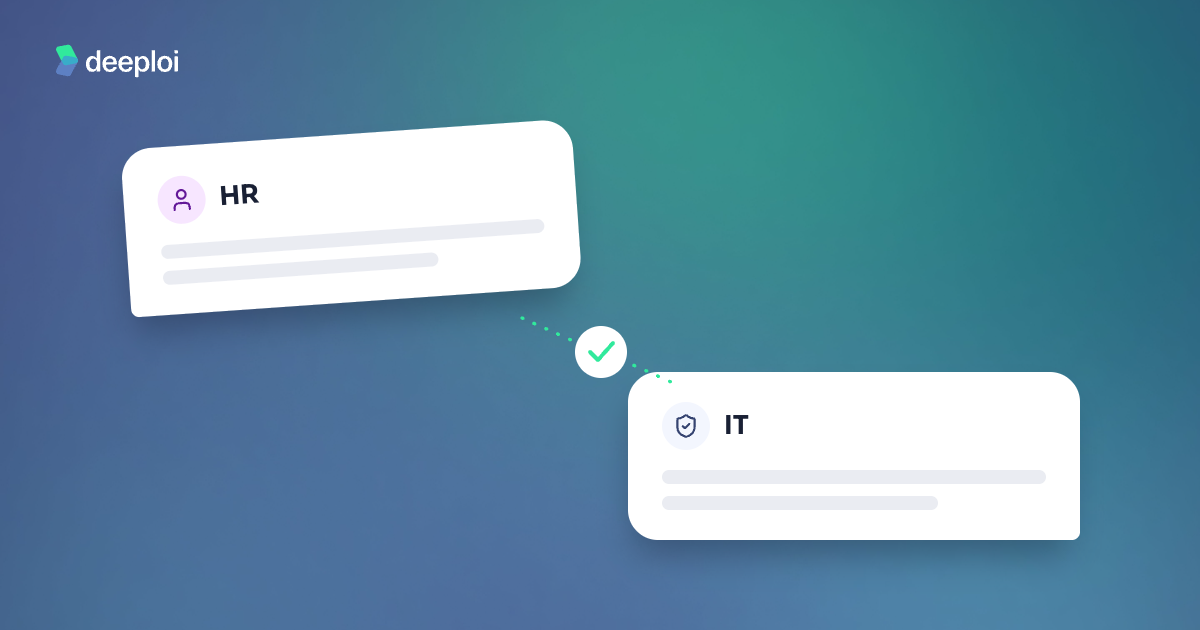
Three failure points cause almost every broken handover: no clear owner for the tasks between "contract signed" and "day one," manual ticket relays between disconnected tools, and no single place where either team can check whether an employee is actually set up.
The right trigger for IT onboarding is the signed contract, not the start date. Starting a few days before day one leaves no room for hardware lead times, account setup, and testing, which is why laptops arrive late.
Offboarding fails the same way, but the stakes are security rather than productivity. A late laptop costs a day of work; a former employee with active credentials keeps access to company data until someone remembers to revoke it.
Connecting the HR system to IT provisioning removes the handover entirely. With deeploi, a new hire created in Personio, BambooHR, HiBob, etc., automatically triggers accounts, software, security policies, and a preconfigured laptop: 3 to 5 minutes of review instead of 2 to 3 hours of manual setup.
A new hire shows up on Monday morning. There's no laptop on the desk, no email account, and the Wi-Fi password is still sitting in someone's drafts. Two floors up, a colleague who left three weeks ago still has full Slack access and can download shared drives. Both situations trace back to the same root cause: HR and IT each own a piece of the employee lifecycle, but they work from different systems, different timelines, and different definitions of "done."
This isn't a people problem. It's a structural one. And it's remarkably common. According to (Gallup), only 12% of employees strongly agree their organization does a great job onboarding new hires. A large share of that gap starts with the invisible handoff between HR and IT, where tasks slip through the cracks before anyone notices.
Where exactly does the HR and IT handover break?
When you look closely at how onboarding actually works in most SMBs, three failure points show up again and again: unclear ownership of tasks, manual ticket relays between disconnected tools, and no shared source of truth for employee status. Each one is fixable, but together they create a compounding mess.
Ownership gaps nobody notices until something goes wrong
HR marks the contract as signed. IT needs to provision equipment, create accounts, and assign software licenses. Between those two events sits a grey zone where neither team feels fully responsible. Who orders the laptop? Who decides which SaaS tools a marketing hire needs versus a finance hire? Who confirms the start date with enough lead time for IT to act?
In companies with a dedicated IT department, there's usually a ticket. In SMBs without one, there's a Slack message, maybe an email, sometimes nothing at all. The result: the new hire's laptop setup starts too late, or the wrong software bundle gets installed, or accounts are created with permissions copied from a random colleague's profile rather than scoped to the actual role.
Research from (Enboarder) found that nearly 1 in 3 HR leaders have seen a hiring manager fail to provide a new hire with any guidance or training at all. If managers drop the ball that visibly, imagine how often the quieter, behind-the-scenes IT handoff gets missed entirely.
The hidden cost of ticket ping-pong
Even when ownership is technically clear, the relay between tools introduces delay. HR logs a request in their system. IT picks it up in a separate ticketing tool. Someone asks a clarifying question via email. The answer comes back a day later. Multiply that by five new hires in a month, and you've burned hours on status-check messages alone.
For example, before automating their IT, The Female Company had an HR employee spending roughly half their week on IT tasks – around 30 hours a month on provisioning, access requests, and chasing status. After moving onboarding and offboarding onto a single automated process with deeploi, that dropped to under 60 minutes a month, alongside a 62% reduction in IT costs. The work didn't disappear; the relay between HR and IT did.
{{cta}}
The costs go beyond wasted time. Delayed onboarding means a new employee sits idle for one, two, sometimes three days before they can actually work. On the offboarding side, the same relay problem means revoking access happens slowly, if it happens at all. An ex-employee with active credentials is a security incident waiting to happen, especially in companies handling customer data or operating under compliance requirements like GDPR.
Nobody can answer "is this person set up?"
Ask a simple question in most SMBs: "is Anna fully set up?", and there's no place to look. HR's system says the contract is signed. The IT side shows a laptop assigned and three of five accounts created. Neither view is complete, so answering takes a message to a person who then checks manually. The same gap runs in reverse: HR knows Tom left last Friday, but nothing on the IT side reflects it until someone mentions it out loud.
This is what makes the first two problems compound. You can't close ownership gaps you can't see, and you can't shorten a relay you've never measured. Without one place where employee status is visible to both teams, every check becomes a conversation, and every conversation is another chance for something to be missed.
What does a complete IT onboarding checklist actually include?
Before you can fix the handover, you need clarity on what IT onboarding actually involves. Many SMBs treat it as "give them a laptop and a password," but the real scope is broader. Here's what a thorough onboarding checklist covers:
Hardware provisioning: order, configure, and test the laptop or desktop before day one. Include peripherals like monitors, headsets, or docking stations based on the role.
Account creation: set up the business email, identity provider account, and cloud workspace. Assign the employee to the correct groups and security policies.
Software licensing: activate licenses for the tools the role requires: communication platforms, project management, CRM, design tools, or finance software.
Access rights: apply the principle of least privilege. A new sales rep needs CRM access, not admin rights to the company's billing system. Scope user access from the start.
Device security: enroll the device in mobile device management, enable disk encryption, enforce multi-factor authentication, and push security policies.
Security awareness training: schedule a short introduction to phishing recognition, password hygiene, and data handling rules within the first week.
The critical distinction here is between what HR triggers and what IT executes. HR knows who is joining, when, and in which role. IT knows how to translate that into the right technical setup. The checklist only works when both sides see the same information at the same time.
How to standardize and automate IT onboarding for SMBs
The fix isn't another status meeting or a longer checklist. It's replacing manual handoffs with a single shared process: one trigger (a new hire confirmed in the HR system) kicks off all downstream IT tasks automatically. That means no separate request form, no Slack message, no waiting for someone to remember.
Organizations with strong onboarding processes see dramatically better results. A (Brandon Hall Group) study found that companies with well-structured onboarding improve new-hire retention by 82% and boost productivity by 70%. The difference is process design.
Here's how to get there:
Map every task and its owner. Write down each step between "contract signed" and "employee is fully productive." Mark who does it, when it needs to happen, and which tool it lives in.
Identify the gaps. Look for tasks with no clear owner, steps that depend on a manual message, and anything that happens "when someone remembers."
Build a single sequence. Reorder the tasks so they flow logically: HR confirms the hire, the IT provisioning process begins, accounts and devices are prepared in parallel, and the employee arrives to a working setup.
Automate the trigger. Connect your HR system directly to your IT provisioning workflow so the sequence starts without anyone sending a message. This is where the HR-IT gap actually closes: not with better communication, but by removing the point where communication was required.
What this looks like in practice
deeploi was built for exactly this handover. It connects to Personio, BambooHR, HiBob, or Factorial – a setup that takes one to two minutes – and treats the HR record as the single source of truth for the entire employee lifecycle.
When a new hire is created in the HR system, the process starts on its own: the workspace account (Google Workspace or Microsoft 365) is created, the role-based software bundle is assigned from a package you defined once, security policies and device encryption are enforced from first login, and the laptop is shipped preconfigured to the employee's home or office address, ready to use at first startup. The IT owner's remaining job is reviewing and approving the setup, which takes 3 to 5 minutes per person, compared to the 2 to 3 hours the same setup takes manually.
Picking the right trigger point between HR and IT
The most common mistake is waiting too long. Many companies treat IT onboarding as something that starts a few days before the new hire arrives. By then, there's not enough time to order hardware, configure accounts, and test everything.
The better trigger is the moment the signed contract lands. That's when HR has confirmed the hire, the start date, and the role. That's also when IT needs to begin: ordering the device, preparing the software bundle, and setting up the onboarding workflow. With an HR integration in place, that trigger point isn't a decision anyone has to make. The signed contract creates the record, the record starts the IT process, and hardware lead time stops being a gamble. On deeploi, this is the default behavior rather than a policy someone has to enforce, which matters, because policies are exactly what break when everyone gets busy.
Why the same fix works for offboarding
Everything that breaks in onboarding breaks worse in offboarding, because the stakes shift from productivity to security. A new hire without a laptop loses a day of work. A former employee with active admin credentials can access confidential data indefinitely.
The solution is structurally identical: tie the IT offboarding to the same shared process. When HR updates the employee's status to "departing," the offboarding workflow should trigger automatically, covering account deactivation, license recovery, and device collection. One trigger, one process, zero reliance on someone remembering to send a ticket.
In practice, that means a defined set of actions firing from one date change. On deeploi, entering a leaving date in the HR system surfaces the offboarding in the dashboard, where the IT owner selects what should happen: the workspace license is downgraded, email forwarding is routed to the successor, documents and calendar entries are transferred, SaaS accounts are deactivated centrally, and the device is remotely locked and prepared for return. Licenses are reclaimed immediately rather than quietly renewing for months. Nothing is deleted unless it's explicitly selected, the point is removing the cognitive load of remembering which accounts still exist, not removing the decision.
The whole input takes 2 to 5 minutes. The alternative is a chain of emails spread over three weeks, which is how ex-employees keep their Slack access.
{{cta}}
FAQ
Which IT tasks should be finished before a new hire's first day?
At minimum, the laptop should be configured and tested, the business email and identity provider accounts should be active, all required software licenses should be assigned, the device should be enrolled in device management with security policies applied, and access rights should be scoped to the role. Ideally, the new hire logs in on day one and everything works. Security awareness training can follow during the first week.
How do we stop ex-employees from keeping system access?
Tie your IT offboarding to the same trigger as your onboarding. When HR records a departure date, the IT deprovisioning process should start automatically: deactivate accounts, revoke app access, recover licenses, and initiate device return or reset. Manual follow-up messages are the reason access lingers for weeks.
Do SMBs really need automation, or is a checklist enough?
A checklist is the essential starting point. It makes the process visible and repeatable. But a checklist still depends on someone executing each step manually and communicating status between HR and IT. Automation removes the human relay that causes delays and security gaps. For companies hiring even a handful of people per quarter, the time savings and risk reduction make automation worthwhile quickly.
What role does IT support play during onboarding?
IT support covers what happens after the setup: login problems, software conflicts, permission questions, and the "how do I connect to the printer" moments that fill a new hire's first week. The volume is highest in the first few days, which is also when a new employee is least able to work around a blocker on their own.
Speed matters more here than anywhere else in the lifecycle. On deeploi, the first point of contact is Sam, deeploi's AI IT support agent, who answers instantly and is available 24/7. He does more than answer questions, he can read live device data, adjust mailbox access, and manage group memberships directly, always with sign-off from the customer's IT owner. Anything he can't resolve goes to deeploi's IT experts, who respond within 30 minutes under SLA and 12 minutes on average. Requests are unlimited and included in the flat per-user price, in German and English.
The problem is structural, not personal
HR and IT aren't talking past each other because they don't care. They're doing it because they work in separate systems with separate workflows and no shared trigger connecting the two. The fix isn't more meetings. It's one process that both teams follow, fired by one event, visible in one place.
Start by mapping your current handoff. Write down every step, every owner, every tool. Find the gaps where tasks have no clear owner or depend on someone remembering to send a message. Then build a single onboarding sequence that starts the moment a contract is signed and covers everything through the new hire's first productive day. That's how you stop laptops from arriving late and ex-employees from keeping access they shouldn't have.
If you'd rather not build that sequence from scratch, it already exists as a product. deeploi is an all-in-one IT management platform for SMBs without their own IT department, combining automation with a real support team, and the HR-to-IT handover is the specific problem it was designed around. Over 200 companies across Europe run their employee lifecycle on it. See how onboarding works →

.png)

%402x.png)