








Direct Answer
Managing IT as a founder costs 15,600 euros in misallocated time per year at two hours per week and a 150 euro opportunity cost - five signals show it's time to hand IT over: onboarding takes more than an hour, someone is doing IT as a side job, there has been a security incident, enterprise customers are asking about your security posture, or you're hiring remotely; deeploi takes over the entire IT operation on one platform and reduces manual workload by up to 97% - without a dedicated IT team.
Key Takeaways
- Doing IT yourself feels free — it isn't: every hour a founder spends on IT tasks has an opportunity cost. At a conservative €150/hour, two hours of IT troubleshooting per week equals €15,600 of lost strategic time per year.
- There are five clear signals it's time to hand IT over: onboarding takes more than an hour, a team member is doing IT on the side, you've had a security scare, customers are asking about your security posture, or you're hiring remotely.
- The right moment is earlier than most founders think: the average company waits until after the first IT crisis to act. By then, the cost is always higher than prevention would have been.
- Handing IT over doesn't mean losing control: with the right platform, founders get more visibility — not less — over who has access to what, which devices are secure, and what IT is costing.
- deeploi is built for exactly this transition: from founder-managed chaos to structured, automated IT — onboarding in 3–5 minutes, 12-minute average support response time, transparent flat-rate pricing from €19/user/month.
You built the company. You set up Google Workspace, bought the first laptops, figured out the VPN, helped the third employee get their email working. That's what founders do in the early days — you do everything yourself because there's nobody else and because staying lean matters.
But at some point, doing IT yourself stops being pragmatic and starts being a hidden tax on your growth. The question isn't whether you're capable of managing IT — most founders are. The question is whether you should still be doing it, and what it's costing you not to hand it over. This article gives you a clear-eyed answer.
Why Founders End Up Managing IT in the First Place
It happens gradually. On day one, you set up your own email. On day ten, you connect the HR system. On day thirty, you help a new hire get their laptop working. By day ninety, you're the de facto IT department for a ten-person company — not because you planned it, but because nobody else stepped up and you were capable enough to handle it.
This is the Accidental IT Owner problem. And founders are among the most common examples. The tradeoff makes sense early on: spending two hours setting up an employee's laptop costs nothing on paper. But that framing is wrong. It costs two hours of founder time — and founder time is the most expensive resource a startup has.
Research shows that at a modest €300/hour founder opportunity cost, administrative and operational tasks done by founders add up to hundreds of thousands of euros in misallocated time per year. IT is rarely the only area where this happens, but it's consistently one of the last areas founders let go of — because it feels too technical to delegate and too important to ignore.
The Hidden Cost of DIY IT
Managing IT yourself appears free because there's no monthly invoice. That's the trap. The hidden expense is measured in lost revenue and security exposure. If technology troubleshooting interrupts your revenue-generating work even once a week, the arrangement is already costing you more than a professional service.
Here's a concrete calculation for a 20-person company where the founder handles IT:
That's before counting the security risk from ungoverned devices, forgotten offboarding, or unpatched software — all of which become more likely when nobody is accountable for IT full-time.
The average small business experiences approximately 14 hours of IT downtime per year, with 78% of SMBs reporting that a single hour of downtime costs them over $10,000. A company where the founder is managing IT reactively is almost always closer to the higher end of that downtime figure.
5 Signals It's Time to Hand IT Over
These aren't theoretical thresholds. They're the moments our customers describe as the turning point — the situation that finally made them act.
1. Onboarding a new hire takes more than an hour
When you started, setting up a laptop and creating an account took 30 minutes. Now you have software bundles to configure, HR systems to connect, security policies to apply, and three different people waiting on access. If onboarding a new team member regularly takes more than an hour of IT effort — from anyone on the team — the process has broken down.
The benchmark: structured IT onboarding automation should take 3–5 minutes of active input. If you're not there, every hire is costing you time you don't have.
2. Someone on your team is doing IT as a side job
This is the most common symptom in companies between 15 and 40 people. The most technical person on the team — often an engineer, sometimes the office manager — has quietly become the go-to for IT questions. They're doing their real job and IT on top of it, and they're not happy about either.
The person responsible for DIY IT is typically an engineer, a programmer, or a founder. Every hour they spend on IT is an hour not spent on their primary role. That opportunity cost is rarely measured, but it is real and it compounds.
When you notice this pattern, the question isn't how to better distribute IT tasks among non-IT people. It's how to take IT out of the hands of everyone who shouldn't be doing it.
3. You've had a security scare
A laptop was lost and you weren't sure if it was encrypted. An employee left and it took two weeks to find and close all their accounts. A phishing email got clicked and nobody had a clear response plan. A customer asked you about your security posture and you weren't confident in the answer.
Any one of these is a warning sign. Together, they indicate that your IT is ungoverned — and ungoverned IT is a liability that grows with every person you add. According to Gartner, over 60% of SMBs that suffer a cyberattack close their doors within six months. Many breaches stem from simple oversights like missed updates, weak password policies, or unsecured remote access.
4. Enterprise customers are asking about your security
If you're selling to larger companies, at some point their procurement team will send a vendor security questionnaire. They'll ask about your MDM policy, your offboarding process, your encryption standards, your incident response plan, and whether you're ISO 27001 certified or working with a certified provider.
If you can't answer those questions confidently, you're losing deals — quietly, without anyone telling you why. Structured IT management, including working with a certified IT partner, is increasingly a prerequisite for B2B sales above a certain contract value.
5. You're hiring remotely or in multiple cities
Setting up a laptop for someone in the same office is manageable. Coordinating device procurement, configuration, and delivery to a remote hire in a different city — and making sure everything works when they switch it on for the first time — is a different problem entirely.
Zero-touch provisioning solves this: the device arrives pre-configured and ready to use. Without it, every remote hire is a logistics puzzle that someone on your team has to solve manually.
What Handing Over IT Actually Looks Like
The fear most founders have is losing visibility and control. It's understandable — IT touches everything: who has access to what, which devices are secure, what software is licensed. Giving that to someone else feels risky.
But the opposite is true. When IT is managed by the founder on a best-effort basis, there is no documented overview of devices, no audit trail of access changes, no structured offboarding process. Things get done when they're noticed, not systematically.
A managed IT platform like deeploi gives you more visibility than you had before — a central dashboard showing every device, every user, every licence, every update status. You set the policy. We run the operation.
Here's what the transition looks like in practice:
Book a demo and see what the handover looks like for your company
The Cost of Waiting
Most founders know they should delegate. They just do not do it. The most common reasons: perfectionism, the belief that no one can do the task as well as you, and the feeling that it's faster to do it themselves. In the short term, that's true. In the long term, it's the constraint that stops the company from scaling. SafariStar Staging
The companies that hand IT over at the right moment — typically when the first of the five signals above appears — save significantly compared to those that wait for a crisis. A security incident, a compliance failure, or a chaotic offboarding that leaves sensitive data accessible to a former employee all cost far more to fix than to prevent.
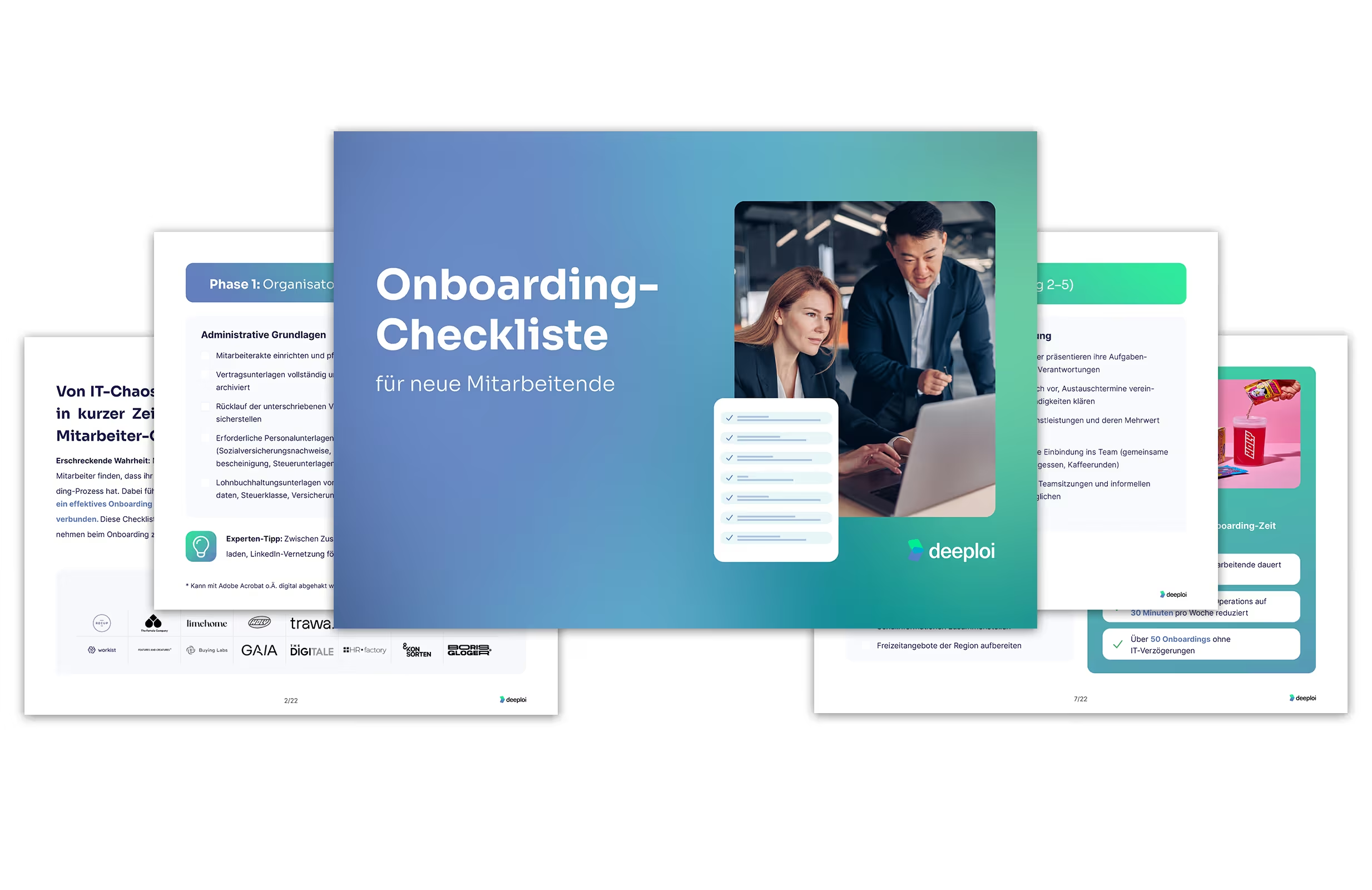
HOLY Energy waited until the team had grown to the point where colleagues were informally helping each other with IT — the classic "whoever knows best" model. After switching to deeploi, their People Ops Manager handled more than 50 onboardings and 15 offboardings without delays and without meaningful IT effort. Instaffo reduced their IT costs by 75% and their manual IT workload by 97%.
Neither of those results required an IT department. They required the right partner.
How to Make the Handover
If you've recognised yourself in two or more of the five signals, here are the practical next steps:
Step 1 — Audit what you're currently managing. List every IT task you or someone on your team handles: device setup, account creation, offboarding, software licensing, security updates, support requests. This becomes the handover list.
Step 2 — Choose between tool-based and service-based. If you want to manage IT yourself but more efficiently, invest in the right tools (MDM, password manager, endpoint protection). If you want IT off your plate entirely, choose a managed IT platform that runs the operation for you.
Step 3 — Start with onboarding and offboarding. These two processes have the highest impact per hour invested. Automating them — so devices arrive ready and accounts are closed on the last day — eliminates the most time-consuming and error-prone IT tasks immediately.
Step 4 — Set expectations with the team. When IT support has a defined channel and defined response times, the informal "tap someone on the shoulder" habit fades. That's a feature, not a loss.
Explore how deeploi manages the full IT handover
Conclusion
The right moment to hand over IT is before you need to. Most founders hand it over after the first crisis — a security incident, a failed offboarding, a lost deal because procurement asked questions you couldn't answer. By then, the cost is already higher than prevention would have been.
If you're spending more than two hours a week on IT, if someone on your team is doing IT as a side job, or if your last three new hires involved a laptop setup that took longer than it should have — it's time.
Book a demo and see what structured IT looks like for your stage
Frequently asked questions
At what company size should a founder stop managing IT themselves?
There's no universal headcount — the trigger is workload, not size. The clearest indicator is when IT tasks are taking more than two hours of founder or team time per week on a recurring basis. For most companies, that happens somewhere between 10 and 20 employees, or as soon as remote hires or multiple offices are added. Explore how other SMBs have made the transition.
Does outsourcing IT mean losing control over who has access to what?
The opposite. When IT is managed ad hoc by the founder, there is typically no documented overview of devices, access rights, or licence assignments. A managed IT platform like deeploi gives you a central dashboard showing every device, every user, and every access change — more visibility than most founder-managed setups provide.
What's the real cost of a founder managing IT themselves?
At a conservative €150/hour opportunity cost, two hours of IT work per week equals €15,600 per year in misallocated founder time — before counting the cost of security gaps, missed offboarding steps, or downtime. Most founders significantly underestimate this number because there's no invoice for it.
Can I keep my existing tools and devices when switching to deeploi?
Yes. deeploi integrates with Google Workspace and Microsoft 365, HR systems like Personio and HiBob, and the SaaS tools your team already uses. Existing devices can be enrolled into the platform without replacement. Migration typically takes 1–2 weeks without disrupting operations.
What happens during the transition period?
deeploi handles the migration. The typical process: we audit your current setup, connect your HR system and workspace, enrol existing devices, and define software bundles per role. New hires from that point onward are fully automated. For existing team members, the experience improves gradually as devices are enrolled and processes are standardised.

.png)