







Direct Answer
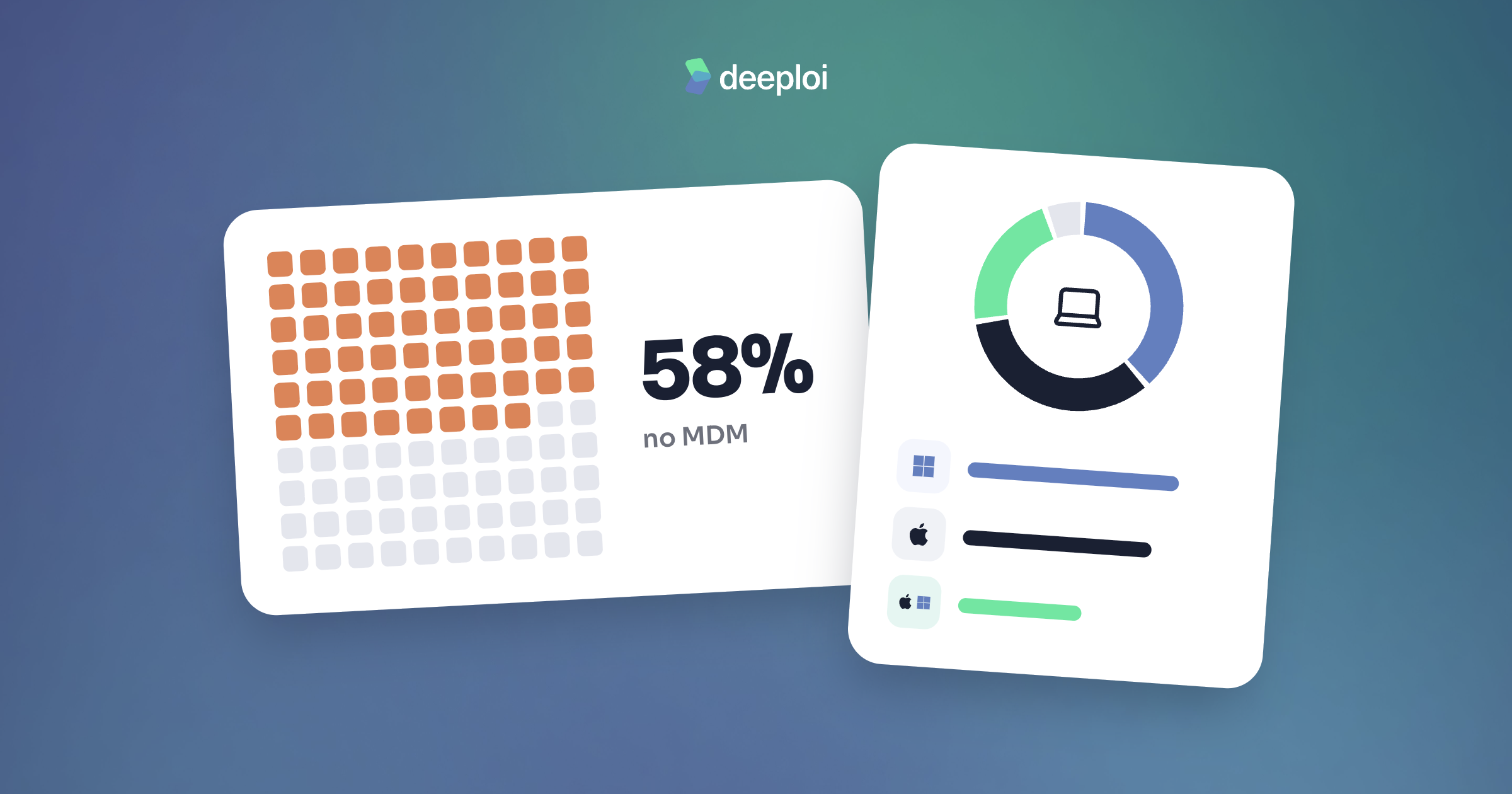
deeploi data on 980 mid-sized companies from 2024 to 2026 shows that 58% ran no mobile device management (MDM) tool at all. Those companies split almost evenly between Mac-dominant and Windows-dominant device fleets, at 34% and 38%, with a further 22% running macOS and Windows side by side. Mixed fleets at that scale are why single-platform device management tools fit most of these companies poorly.
Key Takeaways
- Most companies in the deeploi dataset manage no devices centrally. 58% of mid-sized companies in the deeploi dataset have no MDM tool in place (n = 980).
- Mixed Mac and Windows fleets are common. 22% of mid-sized companies in the deeploi dataset run macOS and Windows in roughly equal numbers (n = 946).
- No independent MDM adoption study for German mid-sized companies exists. Most figures circulating online come from vendor blogs that cite no research.
- deeploi manages macOS, Windows, iOS, and Android from one platform, with expert IT support included, so a mixed fleet does not require a separate tool and a separate specialist per operating system.
MDM adoption rate in mid-sized companies
MDM, short for mobile device management, is software that configures, updates, secures, and if necessary wipes a company's laptops and phones from one place. Without MDM, each device is set up by hand and then runs unsupervised.
58% of mid-sized companies run no device management tool at all. In a company of 50 people, that means roughly 50 to 100 devices that cannot be patched centrally, cannot be encrypted by policy, and cannot be locked remotely when an employee loses a laptop (deeploi data, n = 980).
For a further 8% of companies in the deeploi dataset, it was unclear whether any device management was in place. That figure is a finding rather than a gap in the data, because when the person responsible for IT cannot name the tool, there is usually no tool (deeploi data, n = 980).
Two thirds of the companies in the deeploi dataset therefore have no reliable central control over the devices their employees use.
Mac vs. Windows share in mid-sized companies
34% of mid-sized companies in the deeploi dataset run a Mac-dominant device fleet, against a combined Apple desktop share in Germany of roughly 16% of web page views according to StatCounter (September 2026). These fleets are considerably more Apple-heavy than consumer web traffic suggests, though part of that gap likely comes from the dataset itself, since younger and more digital companies are more likely to look for an IT management platform (deeploi data, n = 946).
22% of mid-sized companies run macOS and Windows in roughly equal numbers. Most established MDM tools were built for one platform or the other: Jamf, Kandji, and Mosyle are Apple-native and do not manage Windows, while Microsoft Intune is strongest on Windows and weaker on macOS in practice. A mid-sized company with an even split either runs two tools or accepts that half the fleet is managed badly (deeploi data, n = 946).
Phones usually sit outside device management entirely. Even in companies that manage laptops, iOS and Android devices are frequently unmanaged, and those phones hold the same email and the same documents as the laptops.
deeploi manages macOS, Windows, iOS, and Android from one platform, which removes the two-tool problem for companies running an even split and brings company phones into the same policy set as the laptops. Device setup, patching, encryption, policy enforcement, and remote lock work the same way across all four operating systems, and deeploi's IT experts configure and operate that setup while the customer keeps full visibility through the platform dashboard. Linux is not supported.
{{cta}}
Most used MDM software in mid-sized companies
Microsoft Intune is the most used device management tool in mid-sized companies, in place at 21%. Intune is bundled into Microsoft 365 Business Premium, so many mid-sized companies already own a license whether or not they use it (deeploi data, n = 980).
Intune's share in mid-sized companies sits well below its global share. According to Enlyft (2026), Microsoft Intune holds between 37% and 47% of the worldwide MDM market, and those two figures come from the same provider using different methodologies. Among these companies, Intune's real competition is not Jamf or NinjaOne but the 58% that manage nothing at all.
Jamf is in place at 6% of companies in the deeploi dataset and appears almost entirely in Apple-led fleets. The remaining 7% spreads across a long list of tools, with no single product reaching 2%, which is a remarkably flat distribution for a market with dozens of vendors (deeploi data, n = 980).
Owning an MDM tool and operating one are different things, which is why comparing MDM software on features alone tends to mislead. The question that decides the outcome is who operates the tool after the trial ends.
Internal IT vs external IT service provider in mid-sized companies
44% of mid-sized companies work with an external IT service provider, and the remaining 56% handle IT internally, which in practice ranges from a one-person IT team to an office manager who learned Microsoft 365 by trial and error (deeploi data, n = 1,016).
The part of that group without a dedicated IT person is what deeploi calls accidental IT owners: the HR lead, operations manager, or founder who inherited IT because nobody else would take it. Accidental IT owners are the people least likely to know which MDM is running, which is not a criticism of them. Running device management across four operating systems is a specialist job added on top of somebody's actual job.
Working with an external IT service provider solves part of the problem and creates another. Before signing, it is worth checking how fast the provider responds, whether billing is per ticket, and whether you can see into the setup yourself. deeploi's IT support answers within a 30-minute SLA, with a 12-minute average response time, and every request is included in a flat monthly price per employee.
Endpoint security software adoption in mid-sized companies
42% of mid-sized companies in the deeploi dataset have no dedicated security software in place, and for a further 36% it was unclear what security software was running (deeploi data, n = 265).
Unmanaged devices and absent endpoint protection usually appear together. Devices get bought, handed out, and then run unsupervised for three or four years, patching depends on whether the employee clicks "update later," and encryption depends on whether somebody switched it on during setup.
Missing device management becomes a compliance problem as soon as an audit starts. NIS2 and ISO 27001 both require evidence of which devices are encrypted and patched, and that evidence has to come from a system rather than from memory.
Choosing device management for a mid-sized company
Three questions are worth answering before evaluating any MDM product.
Can you produce a current list of every device, who holds it, and what is installed on it? If that takes more than a minute, there is no device management in place, only a spreadsheet that is already out of date.
What happens when somebody leaves on a Friday afternoon? Central device management is the difference between revoking access in a few clicks and remembering, over the following weeks, which accounts still need closing. deeploi automates that in employee onboarding and offboarding.
Who operates the tool? Most MDM projects stall here. The software gets bought, a pilot runs, and the person who configured it moves on to something else. A platform with expert support attached avoids that, because operating it is somebody's actual job.
{{cta}}
Methodology
Source. deeploi data, extracted November 2026.
Samples. Device management, n = 980 companies. Operating system profile, n = 946 companies. External IT service provider, n = 1,016 companies. Security software, n = 265 companies. Each figure states its own sample size, because not every data point is available for every company.
Who is in the sample. The deeploi dataset covers around 1,000 mid-sized companies, predominantly in Germany, Austria and Switzerland, from 2024 to 2026. It consists of companies that were exploring how to manage their IT, so it skews toward organizations with an unsolved IT problem and does not represent the German Mittelstand as a whole.
Privacy. All figures are aggregated and anonymized. No individual company is identified, and no figure is broken out to a group small enough to make one identifiable.
Limitations. This is not a random sample of German companies, and the true MDM adoption rate across all German mid-sized companies is likely higher than 42%. Figures are self-reported, not measured on the devices themselves. Operating system profiles are recorded per company rather than per device, so the Mac and Windows shares describe fleet composition rather than device counts.
How to cite. Please cite these figures as "X% of mid-sized companies in the deeploi dataset (deeploi data, n = ...)", not as figures for German SMBs overall.
Frequently asked questions
What percentage of mid-sized companies use MDM?
Among mid-sized companies in the deeploi dataset, 42% have a device management tool in place and 58% have none (n = 980). Across all German mid-sized companies the share with MDM is likely higher, because companies looking into IT management are more likely to have a gap.
What is the most used MDM software in mid-sized companies?
Among mid-sized companies in the deeploi dataset, Microsoft Intune is the most used MDM software at 21%, followed by Jamf at 6% (n = 980). Intune's lead comes largely from being bundled into Microsoft 365 Business Premium, which means many companies own a license without actively using it.
Does a 50-person company need MDM?
The trigger is rarely the device count on its own. It is usually a lost laptop, a failed security questionnaire from a customer, or an offboarding where accounts stayed open for weeks. Manual device management tends to break down once a company passes a few dozen employees, because the number of devices, accounts, and software licenses grows faster than the time available to manage them by hand.
What is the difference between MDM and an IT management platform?
MDM manages devices. An All-in-One IT Management Platform like deeploi covers the devices plus everything around them, including employee onboarding and offboarding, accounts and licenses, software, security policies, compliance documentation, and the IT support that keeps all of it running. deeploi includes MDM rather than being one, because buying MDM software still leaves a company needing somebody to operate it.
Can one platform manage both Mac and Windows?
deeploi manages macOS, Windows, iOS, and Android from one platform, which matters for the 22% of mid-sized companies in the deeploi dataset that run macOS and Windows in roughly equal numbers (n = 946). Many MDM tools cannot: Jamf, Kandji, and Mosyle are Apple-native and do not cover Windows at all. deeploi does not support Linux.