








Direct Answer
When switching to a new IT provider your devices stay intact - for macOS devices running macOS 26 or later the migration runs via Apple Business Manager without a factory reset, Windows devices are re-enrolled without a wipe; a well-structured migration runs in three phases (audit, parallel operation, cutover) and typically takes one to two weeks without operational disruption, because your IT infrastructure belongs to you - not the old provider.
Key Takeaways
- Your devices belong to you — not your IT provider. Any IT partner who implies otherwise, or who makes it difficult to retrieve your own configuration and access data, is creating an artificial dependency that doesn't hold up legally.
- The three things to secure before switching: admin credentials for all systems, full device inventory documentation, and all licence and software agreements. Without these, the migration is harder than it needs to be.
- For macOS devices running macOS 26 or later, Apple Business Manager now supports native MDM migration — devices can move from one provider to another without a factory reset. This is a significant improvement over previous workflows.
- A well-structured migration runs in three phases: documentation and audit, parallel operation during handover, and full cutover. Rushed migrations that skip phase one cause most of the problems.
- With deeploi, existing devices are enrolled into the platform without disruption — no factory reset required for macOS 26+ devices. The migration typically takes one to two weeks without interrupting day-to-day operations.
The most common reason SMBs don't switch IT providers when they should is a fear that their devices will be wiped, their data lost, or their operations disrupted for days. It's a legitimate concern — especially if the current provider has never shared proper documentation and the devices have been managed in a black box.
But the fear is almost always bigger than the reality. If you're switching from a reactive, opaque IT setup to a structured managed service, here's exactly what happens to your devices, your data, and your operations — and what you need to do in advance to make the migration smooth.
What Belongs to You — and What Doesn't
Before discussing devices specifically, one thing needs to be clear: your IT infrastructure belongs to your company, not your IT provider. This includes:
- All hardware your company has purchased or leased
- All software licences purchased in your company's name
- All admin credentials and access rights to your own systems
- All documentation about your IT environment
- All data stored on your systems
The previous IT provider is in principle obligated to participate in an orderly handover. A professional IT partner will not refuse to hand over admin rights, credentials, or accounts with third-party providers — after all, your IT structure belongs to your company. If there are blockages, the situation can often be resolved with a clear legal letter. Collaborative
If your current provider has never given you your own admin passwords, or if you've never received proper documentation of your IT environment, this is a problem to address proactively — not a reason to stay.
What Happens to Your Devices During a Switch
This is the question most companies have, and the answer depends on which operating system and MDM platform your devices are enrolled in.
macOS devices (Apple Business Manager)
This is where there's genuinely good news. With the release of macOS 26, Apple introduced native MDM migration — for the first time, organisations can move iPhones, iPads, and Macs from one Mobile Device Management (MDM) solution to another without wiping the device or resorting to complex manual processes. Jamf
Previously, the only way to migrate an Apple device from one MDM to another was to remove it from the original MDM, factory reset it, and then manually re-enrol it. That process was time-consuming and disruptive for users. On macOS 26 and iOS/iPadOS 26, it works like this:
- The new MDM provider is configured and set up
- In Apple Business Manager, the device is reassigned to the new MDM server
- The user receives a notification to complete the migration
- The device re-enrols into the new MDM without a wipe — personal data, files, and installed apps remain intact
- The new MDM's security policies and configuration profiles are applied
The practical implication: if your devices are running macOS 26 or later and are enrolled in Apple Business Manager, migrating to deeploi requires no factory reset and no user downtime. The device is reassigned in ABM, the user completes a brief guided process, and the new configuration applies.
Windows devices
Windows device migration between MDM providers is handled differently. Devices enrolled via Microsoft Intune or another MDM can be migrated by re-enrolling them into the new provider. In most cases this doesn't require a wipe — but it does require the new MDM to be properly configured first, and the old enrolment to be cleanly removed. For company-owned Windows devices, the central device management platform handles this systematically across the fleet.
Devices not currently enrolled in any MDM
If your current IT provider has been managing devices manually — without MDM — then there is no enrolment to migrate. Devices are simply enrolled fresh into the new MDM platform. Depending on the device and the approach, this may or may not require reinstalling the OS. For macOS devices purchased through Apple or an authorised reseller and registered in Apple Business Manager, Zero-Touch enrolment is possible. For older or unregistered devices, deeploi's team handles enrolment during the onboarding phase.
The Three Phases of a Clean Provider Switch
Whoever approaches the switch spontaneously or without clear responsibilities risks unnecessary outages, missing access, data loss, or duplicate costs. A structured migration runs in three phases: Juunit
Phase 1 — Documentation and audit (before you give notice)
This is the phase most companies skip — and where most migration problems originate. Before you give notice to your current provider, gather:
Device inventory: A full list of every device in the company — laptop, desktop, mobile — with serial number, assigned user, OS version, and warranty status. If your current provider can't or won't provide this, it's a red flag. Demand it in writing.
Admin credentials: Every system admin account, every cloud service admin login (Google Workspace, Microsoft 365, your CRM, your firewall), every router and network device. These belong to you. If they're not in your hands, ask for them now.
Software and licence list: Every SaaS tool, every software licence, every third-party service your company pays for and what email address and payment method they're connected to. This is also the time to do a software licence audit — you'll likely find licences you didn't know existed.
Backup configuration: Where your backups are, how often they run, where they're stored, and how long recovery would take. If your current provider runs backups, ensure you have independent access to the backup repository or a complete recent export.
Network documentation: IP addresses, firewall configuration, WLAN setup, VPN access. If your office network was configured by the current provider, you need this documentation to maintain it independently during the transition.
Bitten Sie den bisherigen Dienstleister um eine vollständige Übergabedokumentation covering all devices with location, user, and warranty status, server and network documentation, software and licence list, backup configuration, and access permissions for email, files, and admin systems. ManageEngine
Phase 2 — Parallel operation and handover
Once you've selected the new provider and the documentation is in order, the migration itself begins. A sensible approach: the previous IT provider is still active in the background while the new one already takes on first responsibilities. A defined handover period involves both sides. ManageEngine
During this phase:
- The new provider audits what they've received and identifies gaps
- Systems are migrated one category at a time — not everything simultaneously
- Devices are enrolled into the new MDM in batches, typically starting with a pilot group
- Any discovered weaknesses (outdated software, missing patches, open access rights) are remediated
- The old provider's access is progressively restricted as the new provider takes over
A typical mistake in this phase: too many changes at once. If systems are migrated, adapted, and restructured in parallel, the risk of problems increases significantly. Better is a clear, step-by-step transition. ManageEngine
Phase 3 — Full cutover and documentation
The final phase is the clean break: the old provider's access is fully revoked, all remaining systems are live in the new provider's platform, and the IT documentation is updated and owned by your company. Critical for long-term protection: the documentation should be held by you, not only by the provider. If you switch again in three years, you should have everything you need.
What deeploi Does When You Switch to Us
At deeploi, we've onboarded companies from a wide range of starting points — from structured MSPs with clean documentation to years of founder-managed ad-hoc IT with no documentation at all. The process is always the same three phases, but the starting conditions vary widely.
Here's what the migration looks like in practice:
Week 1 — IT audit: deeploi conducts a full audit of your current setup. We connect to your Google Workspace or Microsoft 365 environment, inventory all devices, identify which ones are already in Apple Business Manager, and map your current software stack. If documentation is missing, we build it from scratch. This is the phase where most companies discover unexpected things — forgotten licences, old admin accounts, devices that were never properly enrolled.
Week 1–2 — Parallel setup: We configure your deeploi environment — MDM profiles per role, security policies, software bundles, HR system integration. Existing devices are enrolled either via Apple Business Manager migration (macOS 26+) or fresh enrolment. New devices are ordered if needed and configured for Zero-Touch delivery. Your old IT provider is still reachable for escalations during this period.
Week 2 — Cutover: By the end of week two, all devices are enrolled, all policies are applied, all accounts are visible in the dashboard, and deeploi IT support is the single point of contact. The old provider's access is revoked. Your patch management is automated from this point forward.
No device needs to be wiped for macOS 26+ devices. No working day is lost. Employees experience the transition as a brief notification on their device and a new IT support channel.
Book a demo to see how the deeploi migration process works for your setup
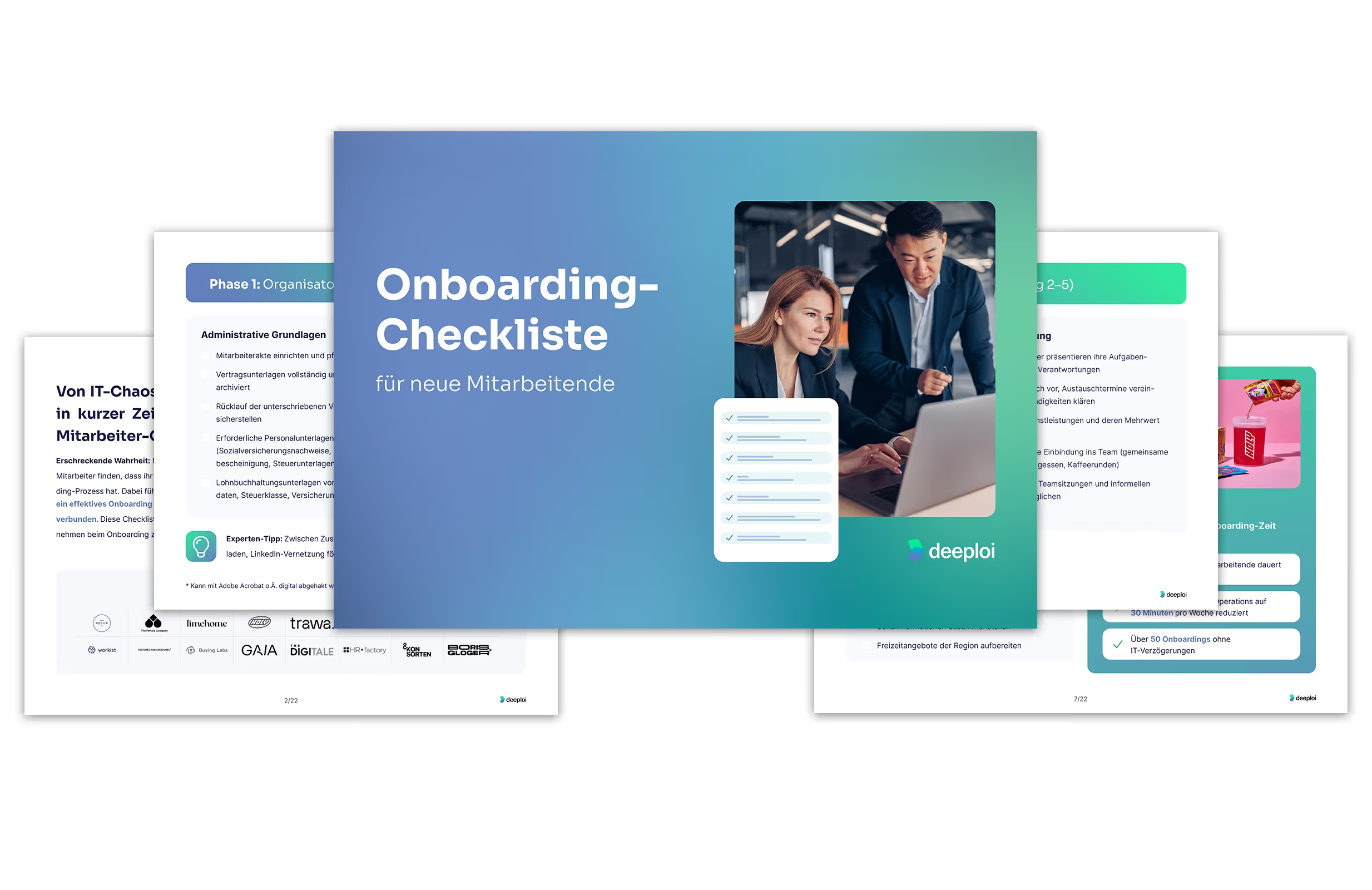
The Migration Checklist
Common Concerns — Answered Honestly
"Will my devices be wiped?"
For macOS 26+ devices enrolled in Apple Business Manager: no. Migration is handled natively via ABM without a factory reset. For older devices or devices not in ABM, the answer depends on the specific setup. In most cases, re-enrolment is possible without a wipe. deeploi's migration team assesses each device fleet individually before making any changes.
"Will there be downtime?"
A well-planned migration causes no downtime. The parallel operation phase ensures the new provider is fully set up before the old one's access is removed. The only user-facing disruption is a notification on their device during MDM migration — which takes a few minutes.
"What if my current provider doesn't cooperate?"
The previous IT provider is obligated to participate in an orderly handover and must not refuse to hand over admin rights or credentials. If there are blockages, the situation can often be resolved with a clear legal letter. In practice, most providers cooperate professionally. The rare cases of non-cooperation almost always involve providers who have tied their service model to keeping clients dependent on them — a model that doesn't withstand legal scrutiny. Computerworld
"What happens to my data?"
Data stored on devices stays on devices during migration (for macOS 26+ devices, explicitly confirmed by Apple). Data stored in cloud services (Google Workspace, Microsoft 365, your CRM) is not affected by an IT provider switch at all — it lives in your cloud accounts, not on the provider's systems. Data stored on the old provider's servers (if any backups were hosted there) should be exported before switching.
Conclusion
Switching IT providers is less disruptive than most companies expect — if it's planned properly and the right documentation is in place. The devices stay, the data stays, and the operations continue. What changes is who manages the platform, who responds to support requests, and whose automation keeps your patch management, offboarding, and security policies running.
The fear of switching is almost always larger than the switching itself. And staying with a provider that's not working because you're afraid of the migration is the more expensive choice.
Book a demo — see how deeploi handles the migration from your current setup
Frequently asked questions
Can I keep my existing devices when switching to deeploi?
Yes. For macOS devices running macOS 26 or later and enrolled in Apple Business Manager, migration happens without a factory reset via Apple's native MDM migration. For other devices, deeploi's team assesses the best approach individually — in most cases, re-enrolment without a wipe is possible. You never need to replace devices to switch providers.
How long does a migration to deeploi take?
Typically one to two weeks, depending on fleet size and the state of the existing documentation. Companies with clean documentation and Apple Business Manager enrolment migrate faster. Companies coming from unstructured, ad-hoc IT setups take slightly longer because the audit and documentation phase is more involved. Either way, operations continue normally throughout.
What do I need from my current IT provider before switching?
At minimum: full device inventory with serial numbers, admin credentials for all systems and cloud services, software and licence list, backup configuration and access, and network documentation. Your provider is legally obligated to provide these — they belong to your company, not to the provider.
Will my employees notice the switch?
The only user-facing element is a brief notification during MDM migration on their device (for Apple devices on macOS/iOS 26+). They tap to confirm, the new configuration applies, and they're done. IT support moves to a new channel. Most employees notice the change as an improvement rather than a disruption.
What if my company has no proper documentation?
This is more common than you'd think. deeploi's onboarding process includes an IT audit that builds documentation from scratch if needed — inventorying devices, mapping accounts, identifying gaps. The migration takes slightly longer but the outcome is a fully documented, properly managed IT environment.