








Key Takeaways
- Onboarding starts the moment the contract is signed: In recruiting, the clean handover to HR, the line manager, and IT determines whether preboarding, day one, and the onboarding period run smoothly – or don't.
- A clear checklist prevents chaos and early turnover: Fixed tasks, defined ownership, and a binding timeline reduce missing access credentials, delayed hardware, and unnecessary back-and-forth.
- IT belongs in every recruiting onboarding checklist: Devices, email accounts, software, security policies, and role-specific access must be ready before the start date – not after.
- deeploi is the optimal solution for modern onboarding: With automated onboarding in 3–5 minutes, role-based software packages, HR integrations like Personio, and central device management, deeploi meaningfully reduces the burden on HR, Ops, and IT.
Between a successful hire and a great first day, there's a critical gap most companies haven't properly addressed. The contract is signed, everyone is excited – but nobody has clearly defined who is responsible for what. That's exactly where an onboarding checklist makes the difference. It connects recruiting, HR, the line manager, and IT into a coherent process, so that on day one there's no missing laptop, no broken access credentials, and no information vacuum. This is especially important for HR, office, and ops teams who often manage IT as a side responsibility. Because good onboarding isn't just an organisational exercise – it directly impacts retention, productivity, and security.
Why onboarding starts where recruiting ends
Many teams treat recruiting and onboarding as two separate worlds. That's the mistake. The moment an offer is accepted, candidate communication must become a structured handover process. When that handover doesn't happen, preboarding starts too late – or not at all. The consequences are familiar: radio silence after the signature, no clear welcome, no prepared access, and a chaotic day one.
That's not just unprofessional – it's expensive. Studies show that 36% of employers experience dropouts before the first day of work. The average cost of a mis-hire sits at around €14,900 per role. And 44% of new employees already feel regret about their decision within their first week. A good onboarding checklist isn't a nice-to-have document – it's a genuine management tool.
What information must be handed over from recruiting
- Start date, work location, and working model (office, hybrid, or remote)
- Role, team assignment, and direct line manager
- Contract type, working hours, and relevant deadlines
- Hardware requirements, preferred operating system, and any special equipment needs
- Software requirements based on role – not gut instinct
- Contact plan for preboarding, buddy assignment, and the first week
The cleaner this handover is structured, the less friction downstream.
Preboarding checklist: what must happen between offer acceptance and day one
The most important phase in the recruiting-to-onboarding journey is often the quietest: the time between contract signature and the start date. This is where new employees either feel anticipation or uncertainty. Good teams use this phase actively. Poor teams wait it out. For SMBs, a clear preboarding checklist is worth its weight in gold.
Checklist for recruiting, HR, and the business unit
- Verify contract details and internally approve the final version
- Trigger the formal handover from recruiting to HR, the line manager, and IT
- Send a welcome email with start time, dress code, key contacts, and the day-one schedule
- Assign a buddy and organise a pre-start introduction
- Prepare the calendar for day one, week one, and key upcoming milestones
- Inform the team so they can prepare for the new arrival
Checklist for IT and operations
- Prepare the device and confirm the delivery address
- Set up email account, chat access, and core tools
- Assign role-specific software – for example, for sales, marketing, or HR
- Grant access rights on a least-privilege basis
- Activate security policies, encryption, and password requirements
- Prepare data protection documentation and mandatory onboarding documents
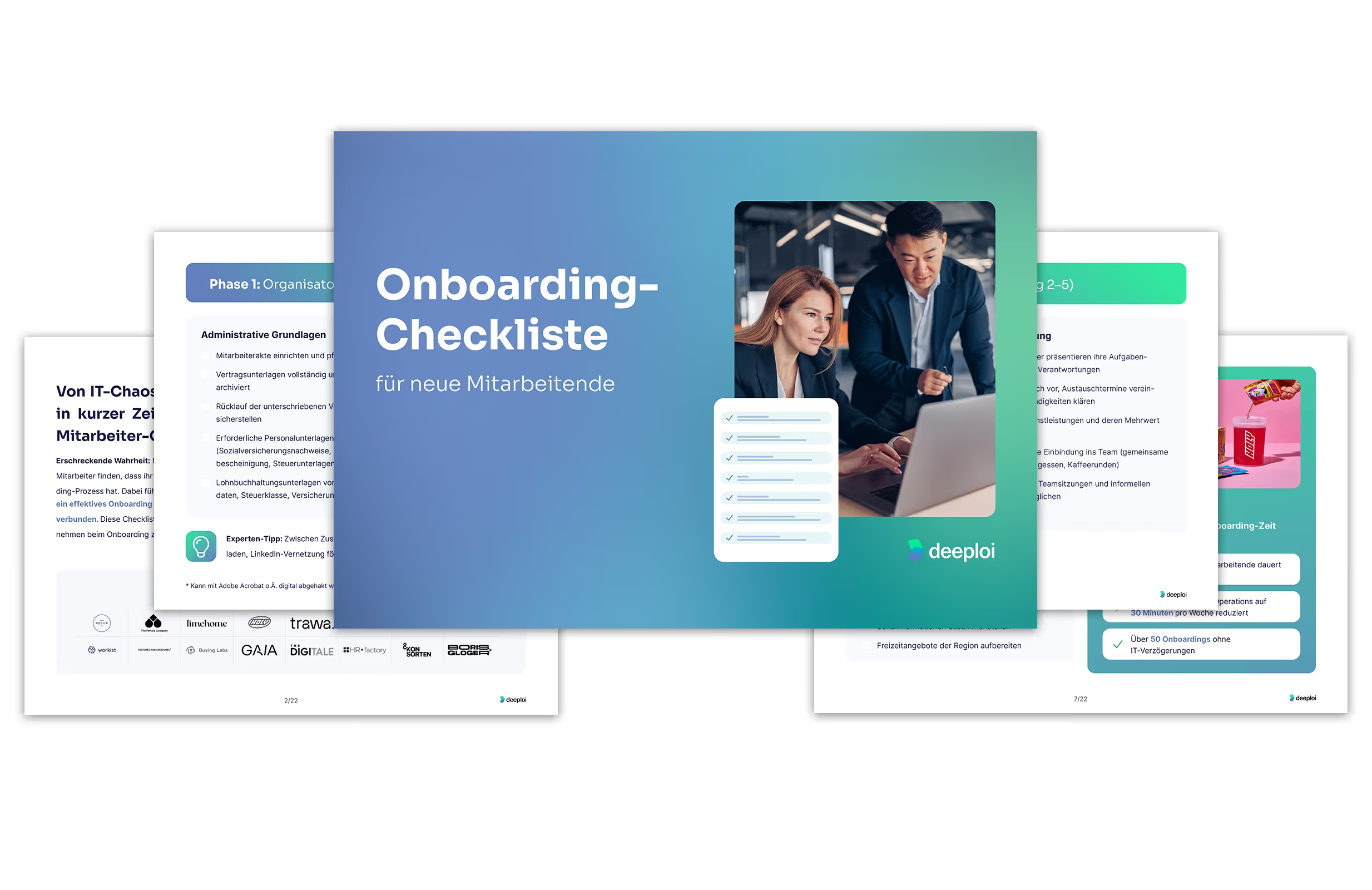
If you're still missing a general template, you'll find a detailed onboarding checklist. For companies that want to standardise the process immediately, a central onboarding solution is significantly more efficient than Excel spreadsheets, email chains, and ad-hoc coordination.
Day one and the first 100 days: turning a recruit into a productive team member
A good first day should provide orientation – not overwhelm. New employees need to know what to expect, who to go to with questions, and where to begin. But the real onboarding doesn't end after the welcome session. It continues through the first weeks and months. A solid onboarding checklist therefore covers three layers: day one, the first few weeks, and the first 100 days.
Checklist for day one
- Personal welcome by the line manager and team
- Hardware handover – or successful device check for remote starts
- Login test for email, chat, calendar, and core tools
- Introduction to the role, expectations, and immediate priorities
- Briefings on data protection, confidentiality, and workplace safety
- Social integration – for example, a team lunch or buddy check-in
Checklist for weeks 1–4
- Role-specific onboarding with clear learning objectives
- Schedule recurring check-ins with the line manager and buddy
- Collect feedback after day one, week one, and month one
- Refine system access based on actual usage
- Gradually hand over first areas of responsibility
Checklist for 30, 60, and 90 days
- 30 days: Orientation complete; first independent tasks handled confidently
- 60 days: Team collaboration stable; tools in routine use
- 90 days: Clear assessment of performance, fit, and further development needs
This makes onboarding plannable and measurable – rather than a loose collection of individual tasks.
IT onboarding is the bottleneck most recruiting checklists overlook
Most templates reduce IT onboarding to two lines: order laptop, create email account, done. The reality is far more complex. A productive start requires a device, an operating system, security configuration, access credentials, an email account, the right software, updates, and clean permissions management. This is where HR and office teams routinely lose several hours per person. Worse: mistakes often only surface on day one.
That's why IT deserves to be treated as a fixed component of every recruiting onboarding checklist – not an afterthought. Helpful foundations include centralized processes for device management, a clear approach to MDM, clean software license management, and reliable patch management. Together, they turn a series of individual tasks into a repeatable standard process.
This is exactly where deeploi comes in: with HR integrations like Personio, role-based software packages, central device management, and automated provisioning of all access credentials, on- and offboardings that previously took 2–3 hours can be completed in 3–5 minutes. For teams without a dedicated IT department, that means up to 95% less IT overhead.
Compliance checklist: legal obligations you need on your radar from day one
Most onboarding checklists almost completely ignore the legal dimension. But data protection doesn't begin during the employment relationship – it begins with the first data capture for the employment contract, personnel file, and system access. For SMBs without a dedicated legal or data protection team, a compact checklist helps ensure no obligation falls through the cracks.
The key principle: under § 26 BDSG and the requirements of the GDPR, you should only collect data that is genuinely necessary for establishing and executing the employment relationship. Additionally, new employees must be informed about the processing of their personal data in accordance with Art. 13 GDPR. Also practically relevant: the German Evidence Act (Nachweisgesetz), safety briefings under occupational health and safety law, and clean permissions management. For specific legal interpretation, consult data protection or legal counsel – but the operational preparation belongs in every onboarding checklist.
Additional points to keep in mind:
- Review data processing agreements if HR or IT service providers handle employee data
- Set up working time tracking from day one
- Involve the works council where staff questionnaires or processes are subject to co-determination rights
Who does what? Clarifying responsibilities in recruiting onboarding
A good onboarding checklist only works if it's clear who actually owns each task. In many SMBs, the chaos isn't caused by lack of motivation – it's caused by unclear ownership. HR assumes the line manager is handling the process. The line manager is waiting on IT. IT doesn't even know the start date. That's why tasks must always be assigned to specific roles, even when one person wears multiple hats in a small company.
This is especially important for so-called accidental IT owners – employees from HR, office management, or ops who handle IT on the side. Here, standardisation helps far more than additional one-off solutions. Instead of email chains, support tickets, and spreadsheets, what's needed is one central process that runs cleanly from the recruiting trigger all the way through to hardware and software provisioning.
- Accidental IT owner setup (HR or office manages IT): standardise and automate as much as possible
- MSP setup (external IT involved): share start dates and role requirements earlier and in a more structured format
- Internal IT team (scaling is the challenge): work with role-based packages and clear triggers
The less room for interpretation, the more easily your onboarding scales with growing hiring volumes.
Remote and hybrid onboarding needs its own checklist
Remote and hybrid starts amplify the typical onboarding pain points. When nobody is in the office, a missing access credential or an unconfigured device hits much harder. That's why your checklist for distributed teams needs additional items: confirm the delivery address, align on delivery timing, pre-configure the device, schedule early video calls, and clearly name the technical point of contact.
Zero-touch provisioning is particularly important here. Devices arrive fully configured directly with the new employee – no manual setup required by anyone in the office. Combined with central management for Windows, macOS, and iOS, remote configuration, and remote lock and wipe capabilities, this creates a significantly more secure process. This is especially relevant for distributed teams, BYOD scenarios, and high-velocity hiring.
deeploi supports exactly this kind of setup with central management, automated device encryption, policy enforcement, and active threat detection in partnership with SentinelOne and Acronis. When questions do come up, the average support response time is 12 minutes. For recruiting teams, that translates to one thing above all: fewer last-minute escalations in the days before a new hire starts.
Conclusion
An onboarding checklist for new employees in recruiting is only truly effective when it doesn't start on day one. It closes the gap between contract signature, preboarding, IT provisioning, compliance, and role-specific onboarding. That's exactly how you avoid dead time, uncertainty, and avoidable early turnover. If you're ready to stop managing this process manually through spreadsheets, emails, and ad-hoc conversations, deeploi is the natural next step as an all-in-one solution. More than 200 customers already trust deeploi, with 17,000+ managed users and 3,000+ supported onboardings.
FAQ
What belongs in an onboarding checklist for recruiting?
At minimum: the handover from recruiting, all preboarding tasks, hardware and software preparation, mandatory documents, role-specific responsibilities for day one, and a plan for the first few weeks. Importantly, it's not just HR tasks that need to be covered – IT, security, and the line manager all have a role to play.
When should onboarding begin?
Onboarding begins directly after the contract is signed – not on the first day of work. The preboarding phase is exactly when you reduce the risk of dropouts, create a sense of anticipation, and make sure all organisational and technical foundations are in place in time.
Who is responsible for onboarding?
There is rarely a single responsible person. HR or Ops typically steers the overall process, the line manager owns role clarity and onboarding quality, and IT provisions devices, access, and security. If you don't have a dedicated IT department, it's especially important to standardise responsibilities clearly.
How do I prevent a missing laptop or missing access credentials on day one?
Set a fixed trigger after contract acceptance and work with standardised role profiles. With deeploi onboarding solution, access credentials, email accounts, and software can be automatically provisioned based on predefined packages – including fully configured devices via zero-touch provisioning.
How do I get started if I don't have a clean process yet?
Begin with a simple three-phase structure: preboarding, day one, and the first 90 days. Then assign a responsible role to each task and standardise the IT steps in particular. Our detailed onboarding checklist and a central solution – rather than multiple point tools – are the best place to start.