







Key Takeaways
- Customer success onboarding is role-specific: New CS employees need more than just email and a laptop – they also need access to a CRM, CS platform, support tools, meeting recordings, product knowledge, and clearly defined customer processes.
- The first 90 days are decisive: A structured 30-60-90 day plan covering product training, shadowing, first independent calls, and KPI literacy shortens ramp time and reduces the risk of early attrition.
- IT and role-specific onboarding must go hand in hand: When permissions, security policies, and devices are only sorted out after the start date, new CSMs immediately lose time, productivity, and confidence in the process.
- deeploi is the optimal onboarding solution: With automated onboarding in 3–5 minutes, role-based software packages, onboarding automation, and centralised device management, deeploi gets new customer success employees up and running quickly, securely, and efficiently.
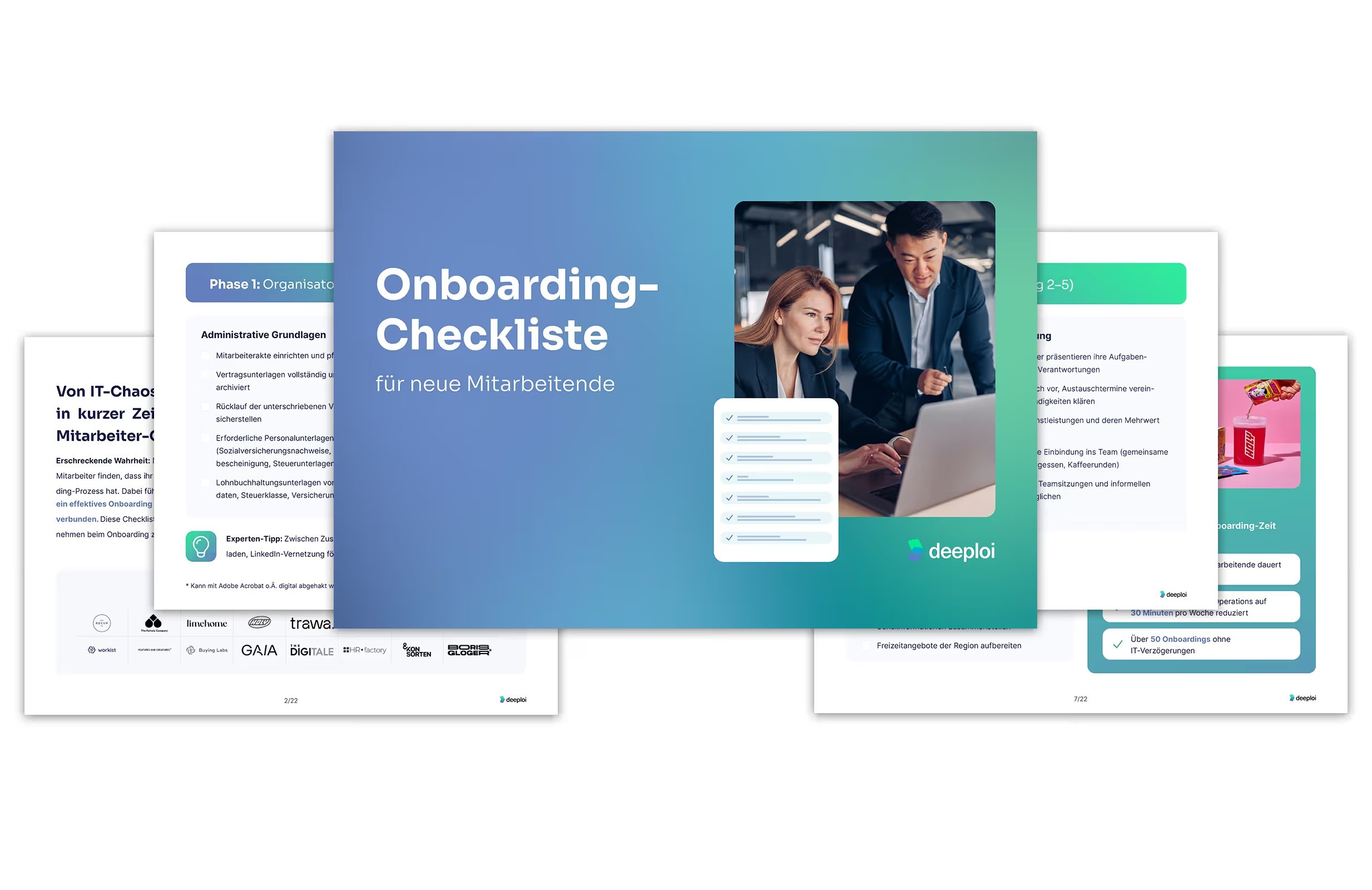
If you're looking for an onboarding checklist for new customer success hires, one distinction is important: this isn't about onboarding your customers – it's about ramping up new CSMs, Customer Success Associates, or Onboarding Specialists. This is exactly where the biggest gaps appear in many SMBs. HR organizes the start date, the team lead schedules training sessions, but on day one there are still missing CRM access credentials, incorrect device configurations, or no clear overview of customer processes. For the general basics, you can supplement this with our onboarding checklist. This article goes deeper on purpose: covering the CS-specific tools, learning paths, handoffs, and security requirements that actually make new customer success employees productive.
Why customer success onboarding is different
Customer success is a cross-functional role. New employees need to understand your product, confidently advise customers, manage clean handoffs with sales, interpret signals from support and product – and often contribute to existing revenue and retention from early on. That's precisely why a generic onboarding rarely cuts it here. A new CSM isn't productive just because email, calendar, and Slack are working.
In practice, a new CSM often needs access to 8 to 12 tools, plus product knowledge, process understanding, and a clear grasp of metrics like health score, time to value, churn, and NPS. When these building blocks are missing, the role gets off to a rough start. That's expensive: poor onboarding is a well-known driver of early attrition, and in customer success every false start costs twice as much – because knowledge about accounts, relationships, and recurring workflows gets lost.
- CS is relationship-intensive: New employees inherit customer contexts, not just internal tasks.
- CS is data-driven: Metrics and usage data need to be part of onboarding from day one.
- CS is process-critical: The transition from sales to CS must be understood and documented.
- CS is tool-heavy: Without a standardized setup, the start is delayed immediately.
That's exactly why your customer success onboarding checklist shouldn't stay generic – it should precisely reflect the role, the tech stack, and the responsibilities involved.
The CS-specific tool landscape: what new employees need from day 1
Many teams underestimate how broad the setup for customer success really is. Alongside the standard tools for communication and productivity, CSMs typically need a CRM, often a customer success platform, access to support and meeting data, a knowledge base, and frequently product analytics as well. When these access credentials are set up one by one via tickets, onboarding drags on unnecessarily.
A role-based software package for customer success makes sense here. You define once which tools a new CSM receives as standard and which permissions are unlocked later. This reduces errors, saves time, and also simplifies topics like software license management. With deeploi, these packages can be defined in advance and automatically assigned during onboarding. Instead of setting up each app individually, the role gets a consistent, repeatable setup.
If you're hiring multiple CSMs simultaneously, this list quickly becomes an operational risk. That's exactly when a standardized onboarding solution that consistently rolls out access, accounts, and software packages pays off.
Onboarding checklist: from preboarding to full productivity
The best customer success onboarding checklist combines operational preparation with role-specific training. This is exactly where many processes break down: the HR side is well organised, but the CS team improvises product training, system access, and customer contexts after the start date. For new employees, that feels uncoordinated – and valuable time is lost.
Instead, you should break onboarding down into clear phases. During preboarding, the focus is on devices, access, data protection, and planning. In the first week, it's about orientation, product training, and first insights into customer calls. From month 1 onwards come shadowing, process understanding, and first independent tasks. Months 2 and 3 are for controlled autonomy. If you also standardize device management and software provisioning, the role gets off to a much smoother start.
- Before system access: data protection briefing and confidentiality requirements clearly documented.
- Before first customer contact: product knowledge, conversation guides, and escalation paths trained.
- Before first own account: KPIs, handoffs, and documentation standards securely mastered.
The 30-60-90 day plan for new CSMs
A good checklist answers what needs to get done. A good 30-60-90 day plan also answers what a new CSM should actually be capable of after 30, 60, and 90 days. In customer success especially, this is hugely helpful – because technical confidence and customer contact should be built up step by step.
In the first 30 days, understanding comes before performance: the product, the customer journey, internal roles, existing playbooks, and relevant systems. By day 60, the person should be able to help prepare customer conversations, read health scores, and independently document typical use cases. By day 90, it's about controlled responsibility: first independent customer interactions, clean follow-ups, and a solid understanding of risks, opportunities, and escalations.
One important note: the plan needs to fit your setup. In small startups, a CSM can take on a broader scope earlier; in larger teams, they may work in a more specialised capacity. What matters isn't rigid theory – it's clear expectations, repeatable onboarding, and regular feedback.
Sales-to-CS handoff: the often-overlooked onboarding building block
A new CSM can only get off to a strong start if they understand how customers are handed over to customer success after the deal closes. This sales-to-CS handoff is underdocumented in many companies. The result: information is scattered across the CRM, notes, emails, and the heads of individual colleagues. New employees then don't know what was actually sold, which goals were committed to, or which risks were already known.
Make the handoff a fixed part of the onboarding checklist. In their first few weeks, new CSMs shouldn't just shadow customer calls – they should also learn where the handoff is documented, which CRM fields are mandatory, and how open items are passed on internally. Meeting recording tools like tl;dv, Gong, or Chorus also help new hires get up to speed on historical conversations more quickly.
- Customer goals: What did the customer specifically want to achieve?
- Sales-side expectations: What results or timelines were indicated during the sales process?
- Stakeholders: Who decides, who uses the product, who might push back?
- Risks: Were there concerns, technical hurdles, or sensitive points?
- Next milestone: What needs to happen with the customer in the first few weeks?
When this information is handed over cleanly, onboarding becomes tangible for new CSMs. They understand more quickly how a signed contract turns into a stable customer relationship.
Data protection, permissions, and device compliance in CS onboarding
Customer success employees almost always work with personal customer data, usage information, and communication histories. That's exactly why data protection shouldn't come at the end of onboarding – it belongs at the beginning. New CSMs should receive a data protection briefing before accessing any customer data, and should clearly understand which data they are permitted to process in which systems.
For SMBs, this means three things above all: first, permissions based on the need-to-know principle; second, secure endpoints; and third, consistent policies. When employees work remotely or in a hybrid setup, this becomes even more critical. With a clean MDM setup, devices can be centrally configured, security standards enforced, and lost devices secured via remote lock or wipe if needed. You can find more on this in our MDM software comparison and in the topic of patch management.
- Data protection before data access: Briefing and sign-off belong in preboarding.
- Targeted permissions: Not every new hire needs immediate access to all accounts.
- Secure devices: Encryption, up-to-date updates, and clear password requirements are non-negotiable.
- Centralised management: Windows, macOS, and iOS should be uniformly administrable.
deeploi supports exactly this foundation: centralized device management, automated device encryption, policy enforcement, active threat management with partners like SentinelOne and Acronis, and GDPR-compliant administration. That way, security isn't an afterthought – it's part of a clean onboarding process.
Common mistakes when onboarding customer success employees – and how to avoid them
The most common mistakes are surprisingly consistent, regardless of whether HR, office management, or a small IT team is running onboarding. In an all-in-one setup, IT is often handled on the side. With a traditional MSP, role-specific CS tools are missing. And internal IT teams lose time because every onboarding is built from scratch as a one-off. From three parallel hires onwards, this quickly becomes inefficient.
- Myth 1: CSMs only need a CRM. In reality, the stack often includes a CRM, a CS platform, support tools, meeting insights, a knowledge base, and product analytics.
- Myth 2: Tool setup only takes a moment. Without standardization, access credentials, licenses, and permissions quickly add up to several hours.
- Myth 3: Role-specific onboarding can wait. In customer success, product training and handoff understanding are immediately relevant.
- Myth 4: We'll sort out permissions later. That's exactly what creates security gaps and unnecessary wait times.
The better solution is a standardised CS workflow: define the role, set the software package, stage permissions, preconfigure the device, and set up the learning path in parallel. With deeploi, onboarding can be configured in 3–5 minutes instead of 2–3 hours. HR systems like Personio can be integrated, access credentials and email accounts are created automatically, devices are shipped ready to use via zero-touch provisioning, and the team has full visibility from one central place. For growing companies, that means up to 95% less IT overhead and significantly less chaos between HR, the team lead, and IT.
Conclusion
A strong onboarding checklist for new customer success employees connects three things: a complete tool setup, a clear role-specific training plan, and clean security and permission processes. Exactly this combination determines whether new CSMs have orientation from day one – or spend their first days waiting for access, answers, and improvised explanations.
If you want to standardize your CS onboarding, deeploi is a particularly well-suited all-in-one solution. Role-based software packages, automated onboarding, centralised device management, and fast support with an average response time of 12 minutes help you get new customer success employees up and running efficiently and securely.
FAQ
What tools does a new customer success manager need on day one?
At a minimum: email, calendar, an internal communication tool, a password manager, secure device access, and the CRM. Depending on the team, a CS platform, support tool, meeting recording software, knowledge base, and product analytics may also be required. The key is that these tools are prepared as a role-based package – not requested one by one via ticket after the start date.
How long does a full customer success onboarding take?
The role-specific onboarding typically spans several weeks, usually following a clear 30-60-90 day plan. IT onboarding, on the other hand, should be completed before or at the very latest on the first working day. With deeploi, technical provisioning can be organized in 3–5 minutes instead of 2–3 hours.
What makes CS onboarding different from general employee onboarding?
Customer success comes with role-specific processes on top of the basics – such as the sales-to-CS handoff, working with customer data, product training, and understanding metrics like health score or churn. General onboarding rarely covers this depth. That's why CS almost always needs its own checklist.
How do I get started if we don't have a CS onboarding process yet?
Start with a simple standard: a role profile, a CS software package, a preboarding list, a buddy, and a 30-60-90 day plan. Then document which access credentials and learning modules were actually needed. If you're planning to grow, it's worth investing early in an automated solution like deeploi – so that individual one-offs turn into a repeatable process.
What role does data protection play when onboarding new CSMs?
A very significant one, because CSMs often work with personal customer data from early on. A data protection briefing, need-to-know permissions, secure devices, and documented policies should all be in place before the first data access. With centrally managed devices and clear policies, this is far easier to implement cleanly than with manual, ad hoc processes.